
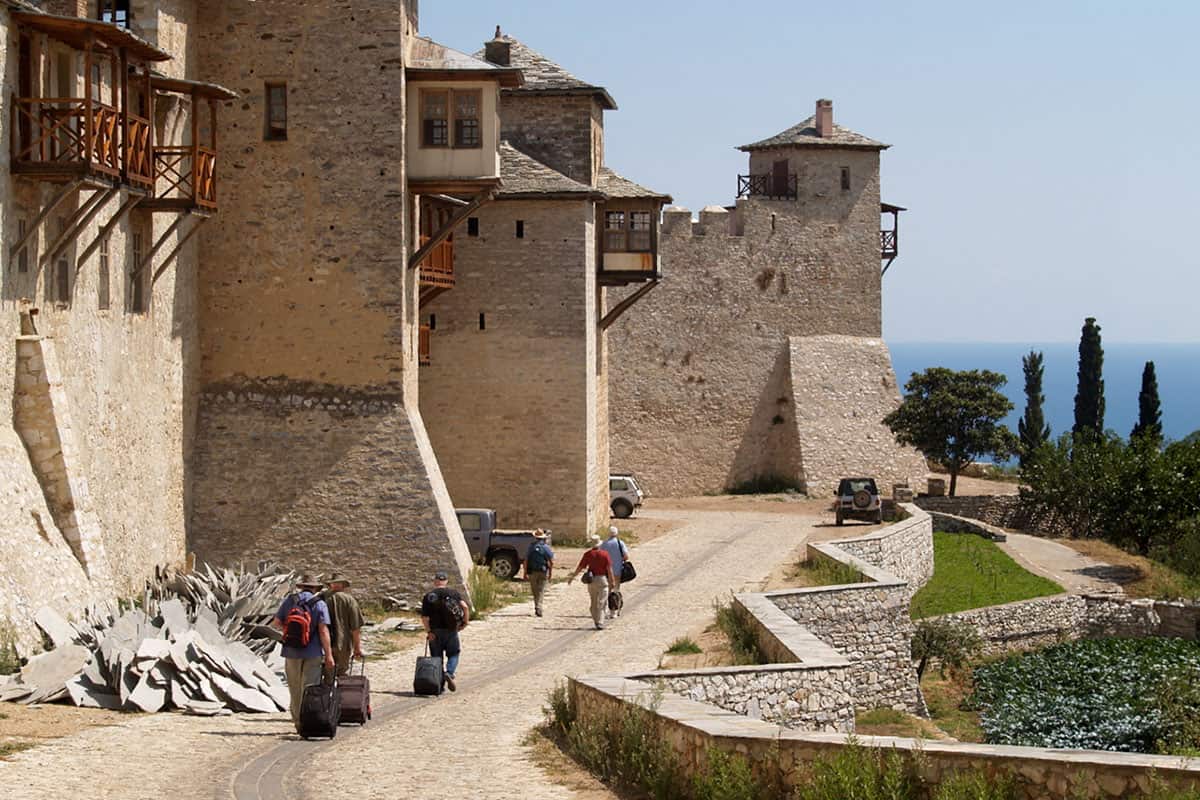
An international team of researchers has recovered the text of 42 lost pages from Codex H, a sixth-century manuscript of the Letters of St. Paul whose later history passed through the Great Lavra Monastery, the earliest of Mount Athos’s first-rank monasteries and a central site in Athonite monastic history.
The project, led by Professor Garrick Allen at the University of Glasgow, used advanced imaging to make faint traces of writing readable again. The university announced the findings on April 24, 2026.
Codex H is considered one of the most important early New Testament manuscripts. According to the University of Glasgow, the manuscript was disassembled in the 13th century at the Great Lavra Monastery, where its pages were re-inked and reused as binding material and flyleaves in other manuscripts. Today, the surviving fragments are scattered across libraries in Italy, Greece, Russia, Ukraine, and France.
The recovered pages do not reveal an unknown gospel or a new biblical text. Their value lies elsewhere. They give scholars a clearer view of how early Christian scripture was copied, organized, corrected, annotated, and later reused.
The breakthrough came from traces left behind after the manuscript was re-inked. Chemicals in the later ink created faint mirror impressions on facing pages, leaving “ghost” traces of text that remained hidden in the parchment. Working with advanced imaging techniques, researchers were able to make those traces readable again.
Among the most significant findings are early chapter lists for Paul’s Letters. These lists differ from the chapter divisions familiar to modern readers and help scholars understand how Christians in late antiquity organized and navigated sacred texts. For researchers, those divisions can show which passages were grouped together, how readers moved through the letters, and what parts of the text may have carried particular importance in worship, study, or teaching.
The fragments also show scribal corrections and annotations, offering a rare look at how the manuscript was used by the people who copied and read it.
The Mount Athos connection gives the story a deeper historical weight. Codex H belonged not only to the world of early Christian copying, but also to the later monastic world that handled, preserved, repaired, and sometimes reused sacred books. At the Great Lavra Monastery, damaged or unusable parchment could find a second life in the binding or repair of other manuscripts.
The University of Glasgow said the project was funded by the Templeton Religion Trust and the Arts and Humanities Research Council in the United Kingdom, with the cooperation of the Great Lavra Monastery. A new print edition of Codex H is forthcoming, and a digital edition is now available online.
The discovery is less a story of a lost Bible found than of patient scholarship, careful imaging, and the long afterlife of Christian books.