
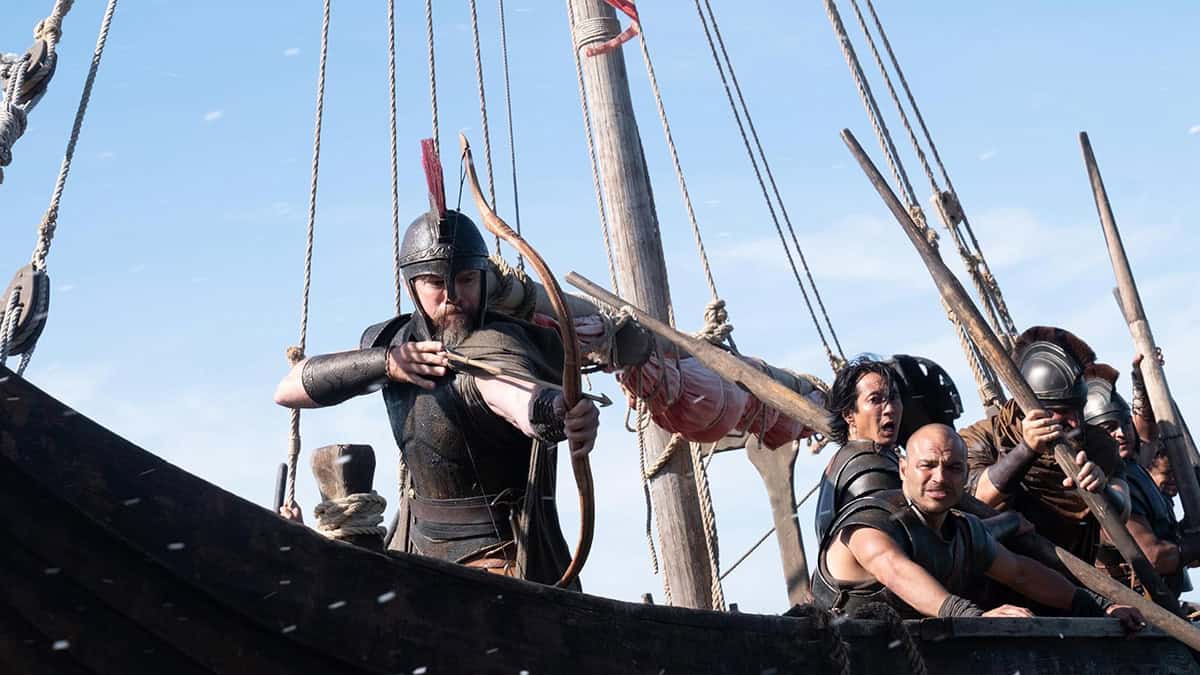
British Google searches for “learn Greek” rose sharply around the July 17 release of Christopher Nolan’s The Odyssey, while sales of Homer’s epic also climbed. The response has reached Philadelphia through Emily Wilson, the University of Pennsylvania translator whose work influenced Nolan and who has since delivered a blistering critique of the film.
A one-month Google Trends chart reviewed by Cosmos Philly classified the UK query as “Breakout” compared with both the preceding month and the same period a year earlier. Google uses that label when a search term has grown by more than 5,000 percent.
The term showed no measurable daily activity in the chart through July 13, then rose to an index value of 82 on July 14. It reached 100, the highest point in the selected period, on July 19 and remained between 73 and 96 through July 27.
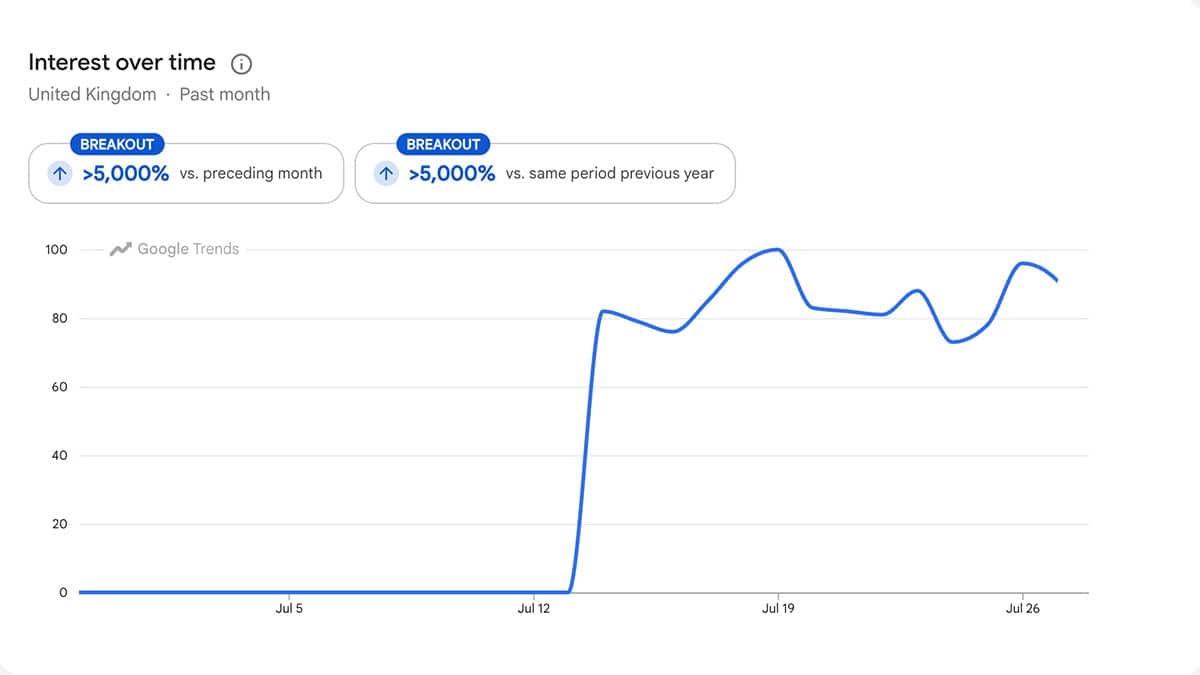
The chart documents a sudden change in search behavior, not the number of people looking for lessons. Google Trends normalizes activity according to location and time, then scales the results from zero to 100. Searches made by too few people may appear as zero, while 100 marks the term’s highest relative popularity during the selected period.
The data also does not show how many searchers enrolled in a course or continued studying. It supports a pronounced British surge around the release, rather than the broader claim that the film has produced a worldwide wave of new Greek speakers.
The renewed attention is also visible in book sales. NielsenIQ BookScan data reported by The Bookseller showed that editions of The Odyssey sold 18,726 copies in Britain over four weeks surrounding the release. Forty-five percent of those copies were sold during the final seven days, with four-week sales up 450 percent from the same period in 2025.
The search phrase itself leaves one question unanswered: which Greek?
Homeric Greek, the literary language of the epic, is part of the Ancient Greek tradition and is not interchangeable with Modern Greek. A viewer hoping to approach Homer in the original would need Ancient Greek, with further study of Homeric language. Someone who wants to speak with relatives, travel in Greece or participate in contemporary Greek life would be looking for Modern Greek, the living language of Greece, Cyprus and Diaspora communities.
Nolan has cited Emily Wilson’s 2017 translation of The Odyssey as an influence on his approach to Odysseus. Wilson, professor and chair of classical studies at the University of Pennsylvania, opens her translation with the line, “Tell me about a complicated man.”
Wilson found little of that complexity in the finished adaptation.
Writing in the London Review of Books, she argued that Nolan had reduced Odysseus to a conventional action hero and failed to engage with the epic’s treatment of war, memory, family and moral responsibility. She called the screenplay’s writing “abysmal.”
“I would be ashamed to have written any part of this script,” Wilson wrote.
Her criticism did not extend to the public attention surrounding Homer. Wilson welcomed the rise in sales of translations and credited the release with sending people back to the epic. She also suggested that greater interest in Greek literature could help universities defend threatened programs in languages, literature and history.
That tension gives the story its edge. Nolan’s interpretation can be disputed by classicists, including the Penn scholar whose translation helped shape his approach, while still drawing audiences toward Homer and the Greek language.
A search spike does not necessarily become sustained study, and the current rise may fade as the film leaves theaters. In Britain, however, the connection between the release and renewed curiosity is visible in both search behavior and book sales.