
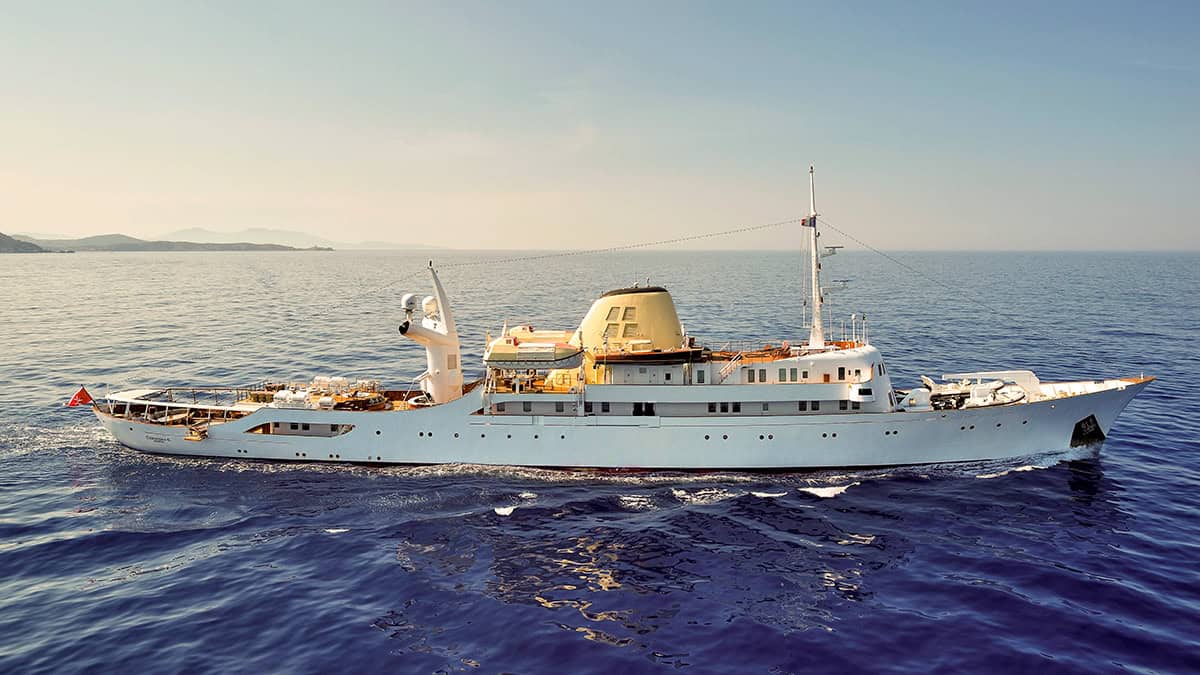
The Christina O is for sale again at €52 million, after a major reduction from €90 million. The cut has a practical reason. The yacht has been owned in recent years by the late Irish businessman Ivor Fitzpatrick, and his widow, Susan Fitzpatrick, lowered the asking price to move the sale along. Broker Tim Morley has said there has been interest, but no completed deal.
The number is striking, but the more interesting question is what it is trying to measure. Christina O is not being sold as just another yacht. It is being sold as a story: war, Greek shipping wealth, celebrity, politics, opera, scandal, and memory.
It is glamorous, but not innocent.
The vessel began as HMCS Stormont, a Canadian River-class frigate built by Canadian Vickers and commissioned into the Royal Canadian Navy in 1943. It was present on D-Day, assisted the damaged HMCS Matane in reaching Plymouth, escorted a convoy to Gibraltar, and later escorted Arctic convoys to and from Kola Inlet near Murmansk. Before it became one of the most famous private yachts in the world, it was a working naval ship in a brutal Atlantic war.
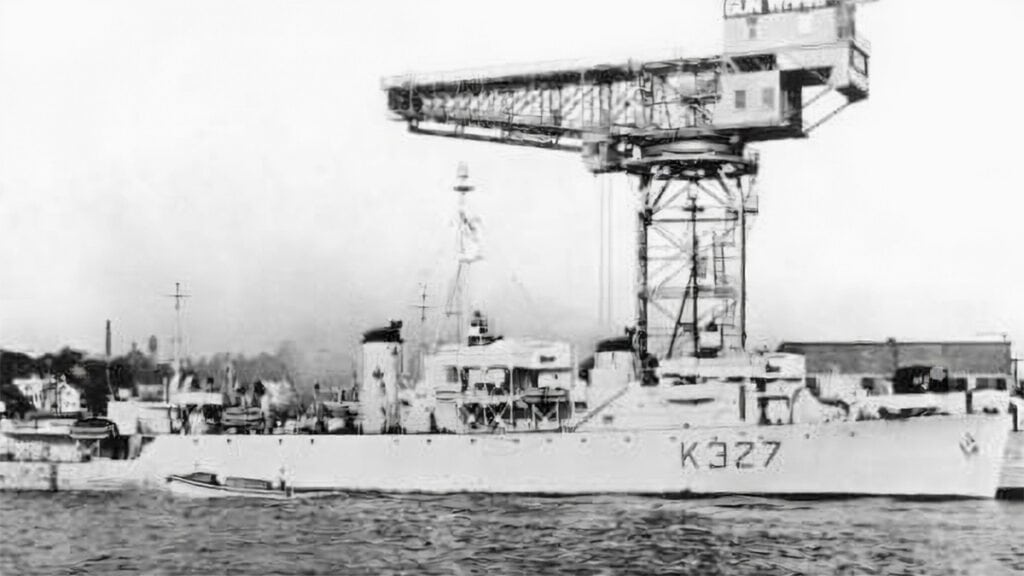
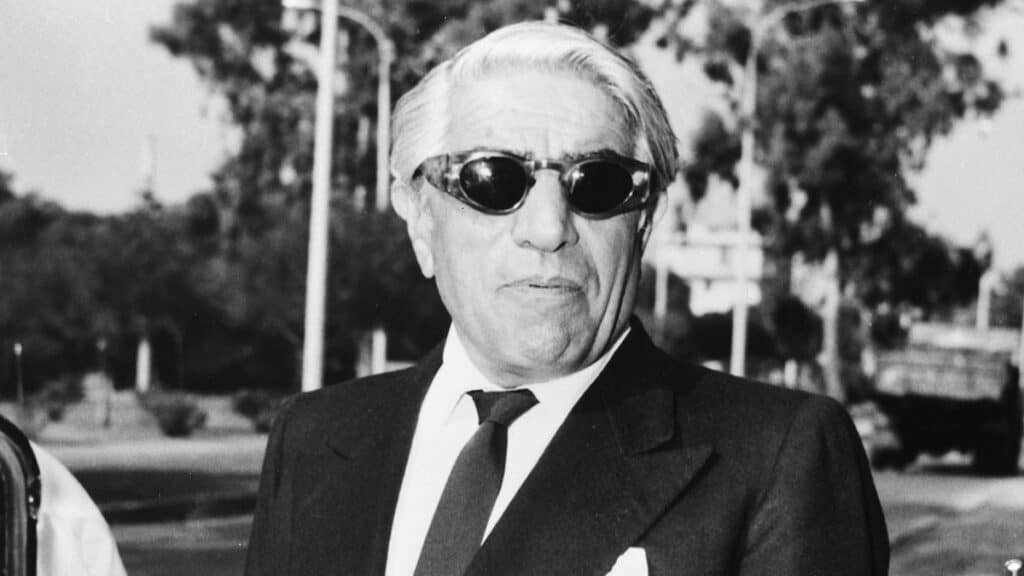
In 1954, Aristotle Onassis bought the former frigate at scrap value, widely reported as $34,000, and spent about $4 million converting it into his dream yacht. The gap between those two numbers is almost the whole Onassis story in miniature. He did not simply buy a ship. He turned discarded steel into theater.
He named her after his daughter, Christina. Cäsar Pinnau shaped the Onassis-era exterior, while Apostolos Molindris & Associates designed the interiors. What emerged was not only a private vessel, but a place where people who normally belonged to separate worlds could be brought into the same room.
Winston Churchill was one of the yacht’s most important guests. Morley Yachts says he took nine cruises aboard Christina as Onassis’s guest. In Monaco in 1958, Churchill first met John F. Kennedy aboard the yacht, while Kennedy was still a senator. The meeting was repeated the following year, when Kennedy discussed his presidential ambitions with Churchill.
Maria Callas gave the yacht its private wound. Her relationship with Onassis became one of the defining romances of his life, and one of the most painful. She was not merely another famous guest. Her presence tied Christina to opera, desire, public spectacle, and private damage.
Jacqueline Kennedy added a different charge. After she married Onassis on Skorpios in 1968, the wedding reception was held aboard Christina. From that moment, the yacht was tied not only to Greek shipping history, but also to the Kennedy afterlife. For American audiences, that connection still matters.
The guest list became part of the legend. Grace Kelly and Prince Rainier held their wedding reception aboard in 1956. Elizabeth Taylor, Richard Burton, Frank Sinatra, John Wayne, Marilyn Monroe, Liza Minnelli, Rudolf Nureyev, and others have long been associated with the yacht’s story. At its height, Christina was less a private boat than a moving salon of twentieth-century fame.
The physical details helped build that reputation. The pool, with its mosaic floor, could rise and become a dance floor. Ari’s Bar became one of the most famous rooms aboard. It also preserved the shock value of Onassis-era extravagance, including bar stools upholstered in whale foreskin and whale-tooth fittings carved with pornographic scenes from the Odyssey. Those details are difficult to read now, and they should be.
After Onassis died in 1975, the yacht lost the man who had given it its social force. His will offered it first to Christina Onassis and then to Jacqueline Kennedy Onassis. Both declined. The vessel passed to the Greek state, was renamed Argo, and deteriorated.
Its second life came through Greek shipping magnate John Paul Papanicolaou, an Onassis family friend, who bought the neglected yacht and led a major restoration. The rebuild, completed in 2001, preserved key Onassis-era features while turning the vessel into a modern charter yacht. The “O” was added in tribute to Onassis.
That raises the question at the heart of the sale. What exactly is being bought? A yacht? A brand? A relic? A film set? A memory?
The answer is probably all of them.
In recent years, Christina O has continued to perform its old role in new ways. Heidi Klum married Tom Kaulitz aboard the yacht in Capri in 2019. It appeared in Triangle of Sadness, Ruben Östlund’s satire of wealth and status. It was also used for Maria, the film starring Angelina Jolie as Maria Callas. The yacht that once hosted the people of its century is now used to recreate that century on screen.
That modern afterlife sharpens the point. Christina O is valuable partly because it has already become a set. It is where the twentieth century performed itself, and where the present keeps returning when it wants to picture old money, celebrity, desire, and decline.
Its commercial problem is also its identity. Built for naval service, the hull is narrow compared with many modern superyachts of similar length. Its interiors, even after restoration, follow an older idea of luxury: cabins for guests, salons for conversation, decks for entertaining, rooms meant for arrival and display. Today’s buyers often want volume, privacy, spas, beach clubs, new technology, and cleaner lines. Christina O offers something harder to maintain and harder to replace.
Whatever this yacht is worth, it is not measured only in steel.
That is why this sale feels different from an ordinary listing. The next owner will not simply be buying cabins, engines, decks, and a famous yellow funnel. They will be taking responsibility for an object that already belongs to public imagination.
Whoever buys Christina O will not just be buying a yacht.
They will be buying the Onassis myth, still afloat.