
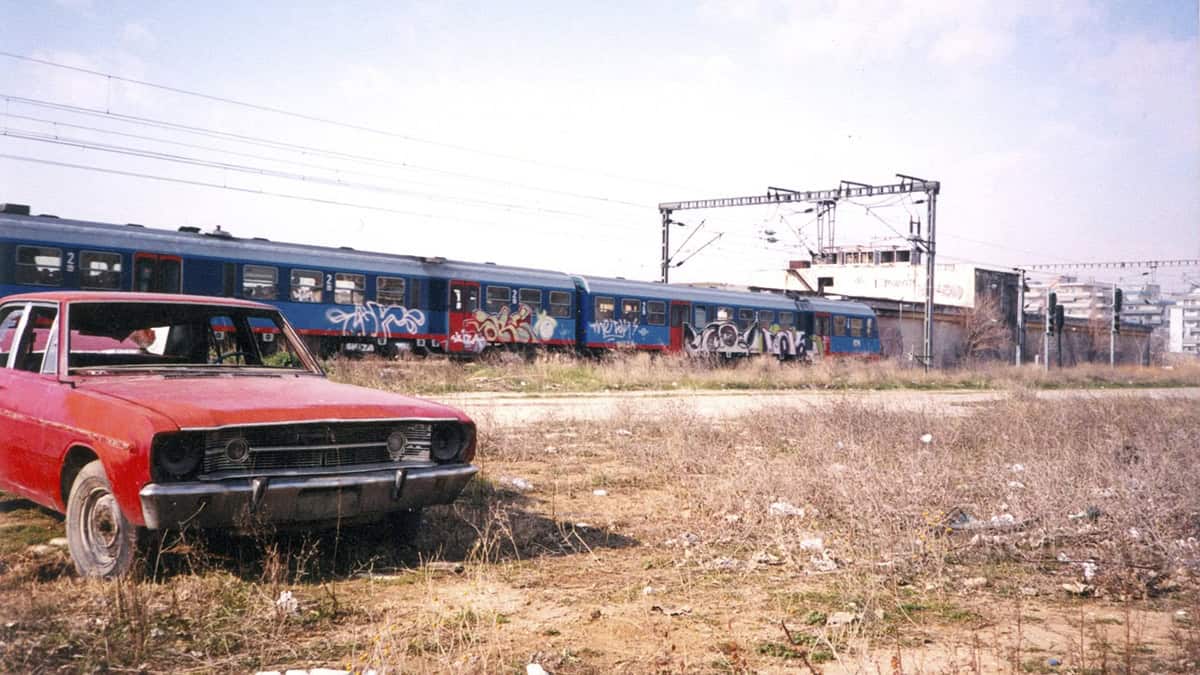
Graffiti rarely comes with the expectation that it will last. Walls are repainted, buildings change, trains are cleaned, and the city moves on. What survives may be the work itself, a fragment of it, or simply a photograph.
That uncertainty runs through “Orestis Pangalos. Works, graffiti, archive,” now on view at the MOMUS Experimental Center for the Arts in Thessaloniki. The exhibition opened August 27 and brings together more than 500 photographs of graffiti and murals, along with videos, projections, publications, archival material and objects connected with public space.
Pangalos has been working with graffiti since 1993. Over the decades, he has made hundreds of murals and dozens of installations while also photographing the environments in which this work appeared. What began as participation in an emerging scene gradually became an extensive visual record.
Photography does not simply illustrate the graffiti here. In many cases, it has become one of the few ways a work, a surface, or even an entire setting can still be seen.
A scene before it had an archive
MOMUS places Pangalos’s material within a much longer history, reaching back to the writing cultures that emerged in Philadelphia and New York in the 1960s before graffiti spread internationally.
Philadelphia belongs to that historical frame, rather than to a direct route leading to Thessaloniki. By the time graffiti began appearing in Greece in the 1980s, the images circulating internationally were closely associated with New York hip-hop, breakdancing, music, film and magazines.
Greek graffiti began with fragments of a culture seen from a distance and then developed locally.
Research gathered for The History of Graffiti in Greece 1984-1994 includes accounts of young people in Athens, Thessaloniki, Kavala and Drama looking at magazine photographs of New York breakdancers. The dancers occupied the foreground. Behind them were walls covered with painted letters, outlines and arrows.
The graffiti may not have been the subject of those photographs, but it was there to be noticed. Accounts from Greece’s early graffiti scene describe young people beginning to experiment with what they had seen, often using automotive spray paint because specialized materials were difficult to find.
A photograph can carry information its maker may never have intended to emphasize. Something at the edge of the frame can eventually become important to someone looking from another city or another country.
Graffiti began appearing in the Greek urban landscape in the mid-1980s. Over the following decade, writers formed crews, developed their own styles, and adapted the form to Greek cities. By the mid-1990s, organized graffiti festivals were taking place in Thessaloniki and Athens.
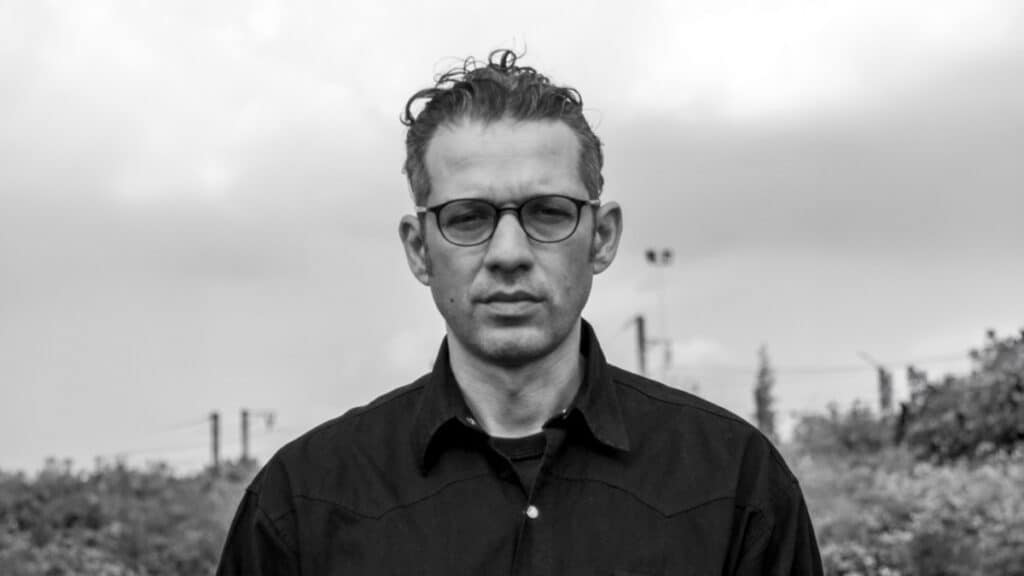
Pangalos entered the scene in 1993. He later served as editor of The History of Graffiti in Greece 1984-1994, based on material assembled through years of research by Charitonas Tsamantakis. He was part of the culture he later helped document.
What a photograph keeps
The MOMUS exhibition spans four decades, 14 countries, 17 European cities and 30 Greek cities and regions. Much of the material is connected to places that no longer look the way they did when Pangalos photographed them.
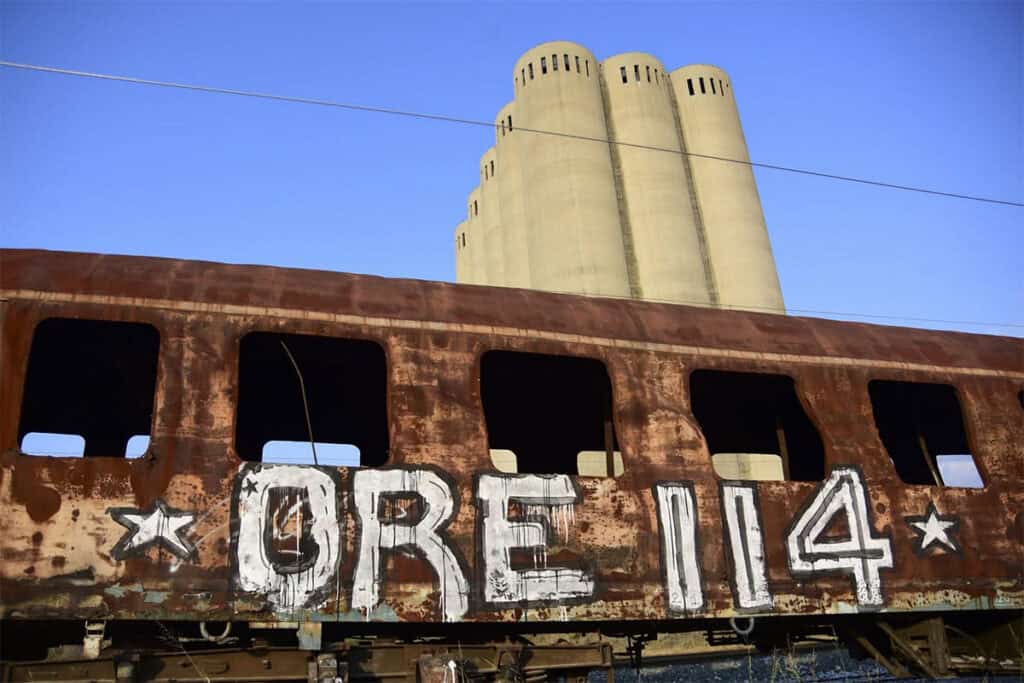
Some graffiti has disappeared completely. Other works and fragments were physically detached from sidewalks, benches, walls, and steps. Trains went out of service. Industrial sites changed. Buildings were renovated or demolished.
Pangalos has described the photographs as pieces of a diary.
Returning to photographs made years earlier can change what we notice in them. A storefront has vanished, a building has been replaced, someone standing casually at the edge of the image is no longer there. Even the way people used a street can look unfamiliar. None of it necessarily seemed historical when the shutter was pressed.
With graffiti, the distance between documentation and memory can be very short. A photograph made simply to record a freshly painted piece may become, years later, the primary way that work can still be seen.
But the photograph is not the graffiti itself.
Graffiti depends on its surface, scale and surroundings. Paint on a train is experienced differently from the same image on a screen. A piece on an abandoned wall carries the marks, damage and history of that wall with it. A photograph selects one view and leaves everything outside the frame unseen.
The photographs preserve works, but they also preserve context: rust, weeds, concrete, railway lines, industrial buildings, empty lots and the accidental details of the city around them. Years later, those details may tell us as much about the period as the graffiti itself.
From the street to the museum
Moving this material into a museum changes its relationship to the street.
Graffiti developed largely outside institutions. Its appearance in public space was often unauthorized, temporary, and unpredictable. A museum gives objects stability, labels and a controlled environment, precisely the things the street never guaranteed.
MOMUS does not attempt to turn Pangalos’s archive into a complete chronological history of Greek graffiti. The exhibition remains personal, built around his work and the material he collected along the way.
An archive is never everything. It reflects where someone was, what they noticed, what they thought worth photographing, and what they happened to keep.
Here, that point of view is particularly valuable because Pangalos was not documenting the scene from a distance. He was making work while the visual language around him was still developing. His photographs now carry two records at once: the graffiti and the places where it appeared.
The painted surface attracts the eye first, but time changes the photograph. Years later, we begin to notice the train, the building behind it, the empty ground, and everything that once seemed to be simply background.
“Orestis Pangalos. Works, graffiti, archive” remains on view at the MOMUS Experimental Center for the Arts in Thessaloniki through October 4, 2026. Pangalos and curators Areti Leopoulou and Theodoros Markoglou are scheduled to lead a Greek-language tour on September 17 at 6 p.m.
About the Author
Vasiliki Eleftheriou is a photographer and founder of Photoglobe, a photography school in Thessaloniki. Her work focuses on people and everyday moments, an approach she also brings to her teaching.