
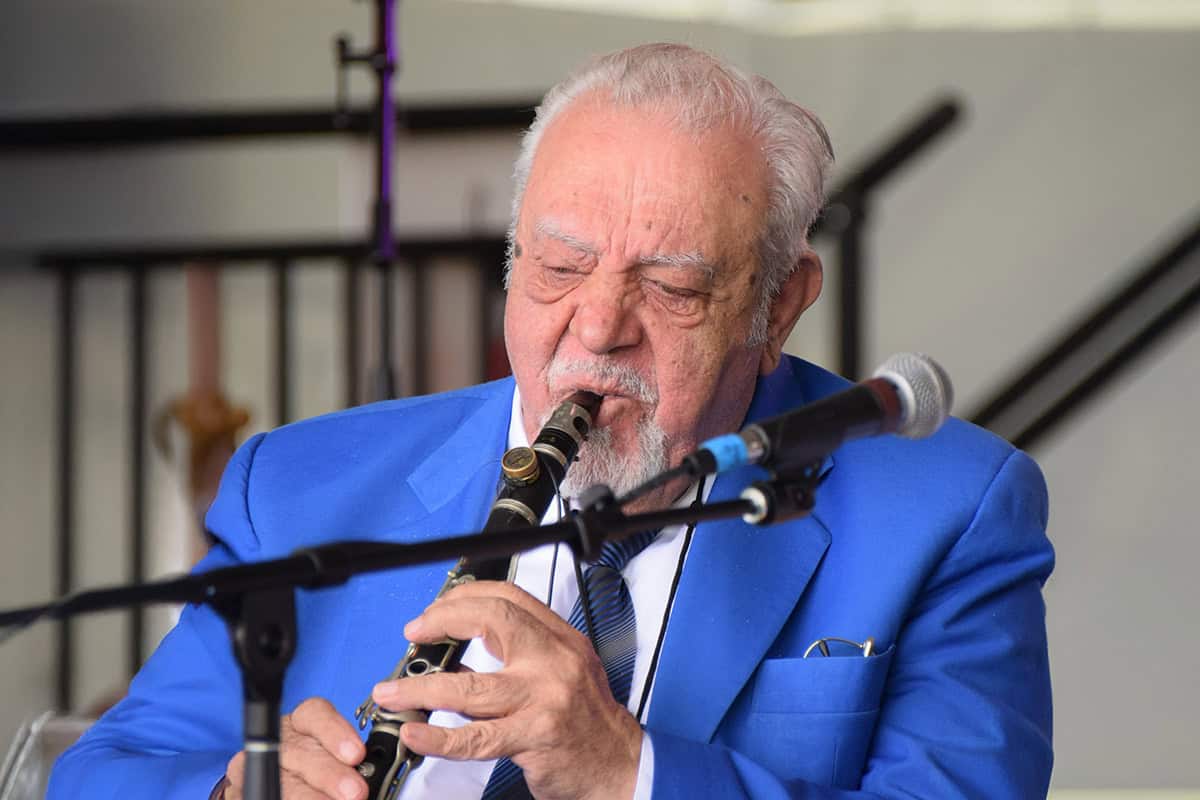
On October 12, the sound of the clarinet will fill St. Demetrios Hall in Moonee Ponds, Melbourne. From 7 to 11 p.m., members of the city’s Greek community will gather for a special evening dedicated to the memory of Petroloukas Halkias, the legendary clarinetist of Epirus who passed away earlier this year at the age of 90.
According to ERTnews, the tribute has been organized by educator Anthi Tzani, musician Yannis Kostarakis, and Konstantinos Kalymnios, secretary of the Pan-Epirotic Federation of Australia, together with the youth of the Greek Orthodox Community of Melbourne and Victoria. The event aims to celebrate Halkias’ life and musical legacy while inspiring younger generations to reconnect with the traditional sounds of their ancestral homeland.
The program will feature performances of mirologia, syrta, and tsamikos, the same Epirotic rhythms that Halkias devoted his life to preserving. Young musicians from the local Greek diaspora will share the stage with seasoned artists, creating a dialogue between generations that continues the master’s own philosophy of continuity and renewal.
A Legend Born in the Mountains of Epirus
Born on July 27, 1934, in Delvinaki, Pogoni, Epirus, Petroloukas Halkias grew up in a family where music was as natural as breathing. His father, Periklis Halkias, was a clarinetist who had built a career in America, while his mother, Kallirrói Charisiadi, came from one of the most respected musical families of the region.
Despite his father’s wish for him to become a mechanic, the young Petroloukas began learning the clarinet at age eleven. His teachers included Filippos Roundas, known as “the best clarinet in Zagori,” and Kitsos Charisiadis, a legendary figure of Epirotic music and a relative on his mother’s side.
How “Petroloukas” Was Born
The name “Petroloukas” was not a childhood nickname but the result of a mix-up during his early career in Athens. When he began performing with Alekos Kitsakis in the band of Tasos Halkias, a typographical error appeared on the record cover of “White Rose I Hold.” The initial “P” of his name was printed as “T,” making listeners think the performer was Tasos Halkias. To distinguish himself, he added his grandfather’s name, Loukas, thus becoming Petroloukas Halkias, a name that would soon become legendary.
From Epirus to America
In 1960, Halkias emigrated to the United States, where he lived for about twenty years. He performed in Greek communities across the country, bringing the sound of Epirus to weddings, festivals, and parish celebrations. His artistry caught the attention of American jazz icons Benny Goodman and Louis Armstrong, who once visited a club to hear him play. They were astonished by his ability to perform for hours without written music, telling him that if he had studied composition formally, he might have changed the history of music.
During this period, he was also invited to perform at the White House, a moment that symbolized the bridge between Greek folk tradition and the wider world.
A Return Home and Worldwide Recognition
When he returned to Greece in the early 1980s, Halkias began a prolific recording career that included albums such as The Soul of Epirus and Mastores Tou Klarinou. His performances at venues like the Carnegie Hall in New York and the Megaron Athens Concert Hall brought Epirotic music to global audiences.
He collaborated with artists including Antonis Kyritsis, Haroula Alexiou, Goran Bregovic, and the laouto virtuoso Vasilis Kostas, a younger Epirotic musician who carried on his spirit of musical exploration. Halkias also recorded with Indian musicians in cross-cultural sessions that showed how traditional forms could communicate across continents.
Over his lifetime, he composed and arranged more than a thousand works, many of which remain cornerstones of the Greek folk repertoire. To him, music was the truest reflection of a community’s soul. “We didn’t tear down the columns of the Parthenon,” he once said. “We reinforced them so the next generation could build higher.”
A Legacy That Crosses Oceans
For the Greek diaspora, his clarinet was a voice from home. Its sound could bring the mountains of Epirus to a festival stage in New York, a community celebration in Chicago, or a wedding in Melbourne.
Now, as the Melbourne community prepares to celebrate his life, that voice will sound once again through young hands and old melodies, through reverence and joy. The October 12 tribute will honor not only a musician but a teacher, a philosopher of sound, and a man who turned tradition into timeless art.
Featured image: Petroloukas Halkias performing at the Richmond Folk Festival, 2019.
Please confirm event details with the organizers before attending, as dates, times, locations, and registration information may change.