
Ten years ago, China’s COSCO SHIPPING acquired control of the Piraeus Port Authority, paying €280.5 million for an initial 51 percent stake on August 10, 2016. The company increased its holding to 67 percent in 2021, a share it still holds today.
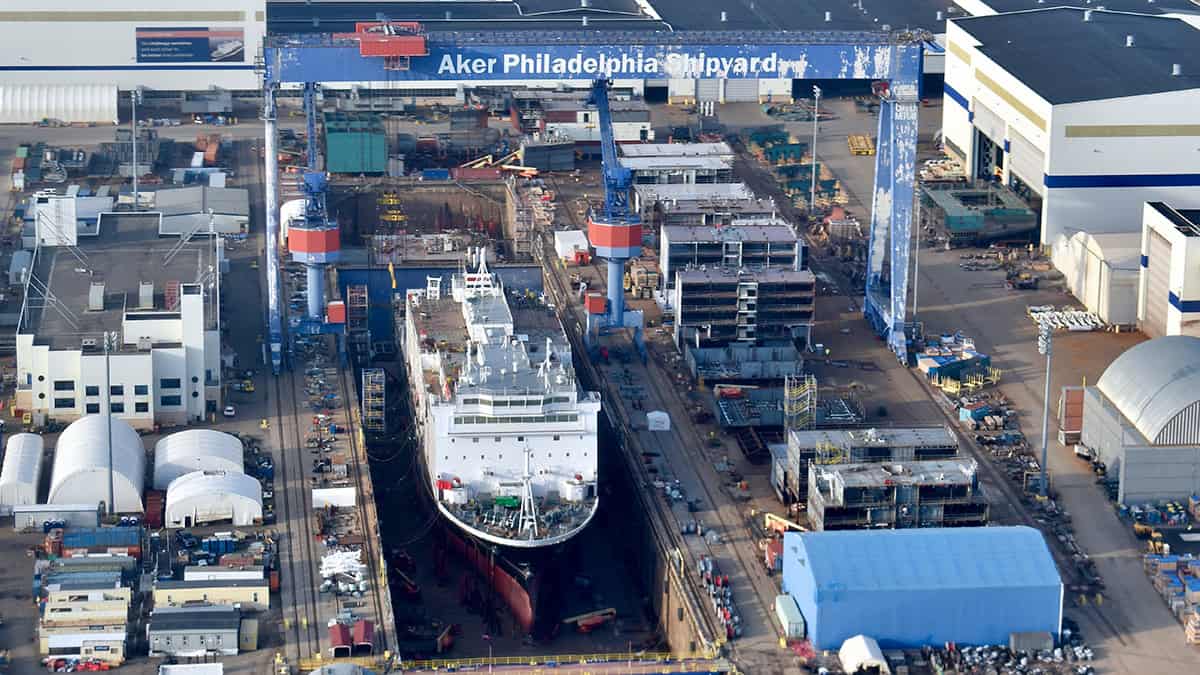
The anniversary comes as a different maritime investment story develops about 12 miles west of Piraeus. At Elefsina, Greek shipyard operator ONEX is working with South Korea’s Hanwha on plans that reach from commercial and naval shipbuilding to energy and logistics. The relationship also extends across the Atlantic: Hanwha owns Philly Shipyard and is pursuing a $5 billion expansion of the South Philadelphia facility.
A Decade of COSCO at Piraeus
COSCO’s initial acquisition was the first stage of an agreement for 67 percent of Piraeus Port Authority. The remaining 16 percent transferred in October 2021, taking COSCO SHIPPING’s stake to its current 67 percent.
The Chinese group was already active at the port before taking control of PPA, through the container-terminal concession that began in 2009. Under COSCO ownership, Piraeus has remained a major container and transshipment port while also handling cruise traffic, ferries, vehicles, logistics and ship repair. PPA lists a ship-repair zone and dry-dock operations among the port’s services.
PPA has been marking the 2016-2026 anniversary in its public communications this year. In April, the authority described the period as ten years since the beginning of its partnership with COSCO SHIPPING.
Piraeus is primarily a port and logistics story rather than a shipbuilding story. The development taking shape nearby at Elefsina follows a different model.
Elefsina’s Revival and U.S. Financing
The U.S. International Development Finance Corporation signed a $125 million financing agreement with ONEX Elefsis Shipyards and Industries in November 2023 to support the acquisition, rehabilitation and modernization of the Elefsina yard. DFC said the work would expand its capacity to repair and upgrade vessels, particularly ships serving the nearby Revithoussa LNG terminal.
The agency has also described the investment in geopolitical terms. In a later account of the project, DFC said its financing supported U.S. strategic interests and countered efforts by the Chinese government to expand its influence in the region. The agency specifically noted Elefsina’s proximity to COSCO-controlled Piraeus.
The two investments are not equivalents. COSCO owns a controlling stake in the company operating Piraeus. ONEX operates Elefsina, with DFC providing financing for its rehabilitation. One is a multipurpose commercial port; the other is a shipbuilding, maintenance and repair facility.
Hanwha Joins the Greek Shipbuilding Plans
ONEX and Hanwha Power Systems signed a cooperation agreement in Washington on February 25, during a visit by Greek Foreign Minister George Gerapetritis. In remarks at the ceremony, the Greek Foreign Ministry described shipbuilding and energy cooperation as part of the developing economic relationship among Greece, the United States and South Korea.
The agreement covers joint activity in the United States involving shipbuilding and energy, including power generation, regasification and related infrastructure.
A broader plan followed on May 29, when ONEX and Hanwha Ocean signed a strategic cooperation agreement at the residence of U.S. Ambassador Kimberly Guilfoyle in Athens. The agreement introduced Project Trident, a proposed investment program centered on Elefsina and estimated at €1.35 billion.
The figure represents a planned program, not €1.35 billion already invested. According to Kathimerini’s account of the Project Trident framework, the first phase, estimated at €150 million, is intended to expand ship maintenance and repair capacity. A second €200 million phase covers port and logistics infrastructure. The largest component, valued at €1 billion, calls for industrial equipment, production lines and facilities capable of supporting ship construction and submarine maintenance.
The agreement moves Elefsina’s ambitions beyond the repair and modernization work supported by the original DFC financing. Project Trident remains at the memorandum stage, and the scale ultimately built may differ from the €1.35 billion framework announced in May.
Hanwha’s Expansion in Philadelphia
Hanwha Ocean and Hanwha Systems agreed to acquire Philly Shipyard for $100 million in 2024, with the transaction completed later that year. In its acquisition announcement, Hanwha described the South Philadelphia yard as having delivered approximately half of the large U.S. commercial ships built under the Jones Act since 2000.
In August 2025, Hanwha announced a $5 billion infrastructure plan for the yard. The program calls for two additional docks, three quays and potentially a new block-assembly facility. Hanwha says the expansion could raise annual output from fewer than two vessels to as many as 20, while allowing the yard to take on LNG carriers, naval modules and, over time, naval ships. Those remain company targets rather than current production levels.
Work on the Philadelphia operation has already expanded beyond commercial construction. Hanwha said in March that it had invested more than $200 million in the yard’s workforce, capabilities and capacity since the acquisition. That month, Hanwha Defense USA and Hanwha Philly Shipyard also received their first U.S. Navy project, working as subcontractors on the Navy’s Next Generation Logistics Ship program.
There is no indication that Elefsina and Philadelphia are operating as a shared production line. The connection is through Hanwha’s growing role in both markets and through ONEX’s agreements covering shipbuilding projects in Greece and the United States.
That gives the Elefsina story a direct Delaware Valley dimension: the South Korean group participating in Greece’s shipbuilding plans is simultaneously spending billions to expand shipbuilding capacity on the Philadelphia waterfront.
Greece Owns Ships, Asia Builds Them
The broader industry remains heavily concentrated in Asia.
According to UN Trade and Development, China, South Korea and Japan accounted for 91 percent of the gross tonnage of ships completed worldwide in 2025. Greece leads a different part of the maritime business. Under UNCTAD’s beneficial-ownership measure, Greek interests controlled 397 million deadweight tons of merchant-ship capacity at the beginning of 2026, more than any other individual economy.
The Hanwha relationship connects Greek yards with one of the world’s dominant shipbuilding industries. Greece remains the world’s largest ship-owning economy by that measure, but it is not among the countries building most of the world’s large vessels.
Hanwha is also bringing Korean shipbuilding expertise to Philadelphia as the United States seeks to expand domestic commercial and naval capacity. The company’s plans at Philly Shipyard include new infrastructure, workforce training and production methods developed through its Korean operations.
Piraeus and Elefsina Take Different Paths
A decade after COSCO took control of Piraeus Port Authority, Chinese investment remains firmly established at Greece’s largest port. Nearby, Elefsina is developing along another track: Greek ownership, U.S. financing and a growing partnership with South Korean shipbuilders.
Washington has explicitly connected its support for Elefsina with concerns about Chinese influence. Greece, however, has not exchanged one maritime relationship for another. COSCO still controls 67 percent of PPA, while ONEX and Hanwha pursue separate plans in shipbuilding, defense and energy.
Ten years after the Piraeus sale, Greece’s maritime investment picture has broadened considerably. It now stretches from a Chinese-controlled port at Piraeus to new shipbuilding plans at Elefsina and, through Hanwha, to the yards of South Philadelphia.