
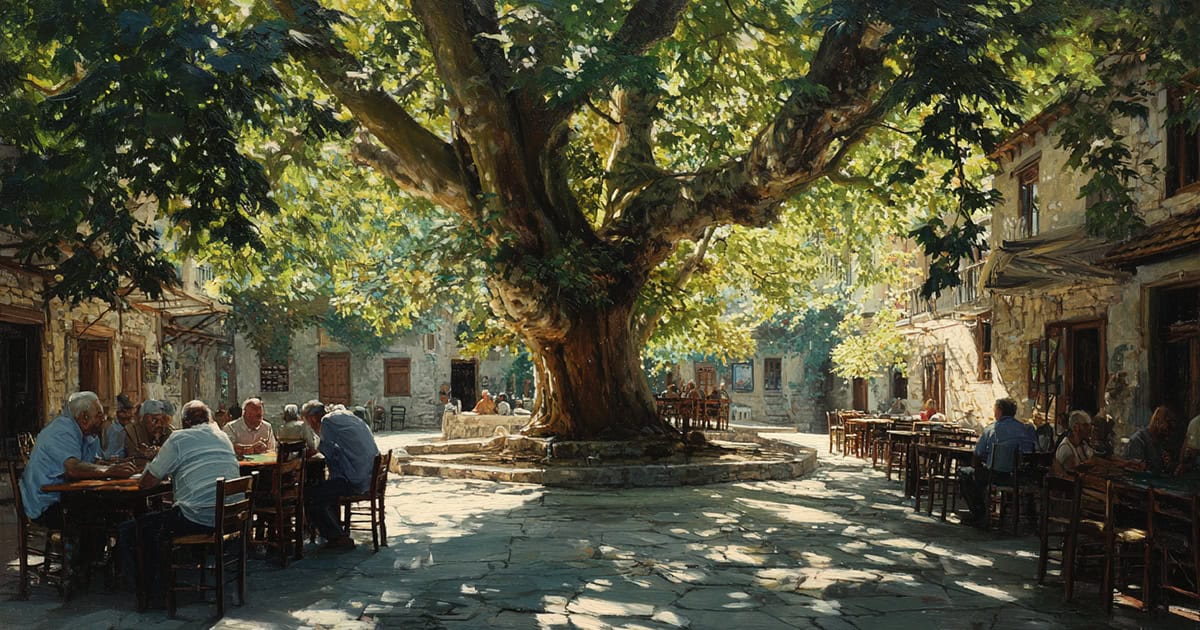
If you’ve ever had a coffee under a giant platanos in your village square, you know what we’re losing.
For generations, plane trees have stood quietly at the center of life in Greece. They shaded café tables, lined riverbanks, and held the kind of memories that don’t make it into guidebooks. You didn’t think about them much. Until they were gone.
Now, across the country, they’re disappearing. A deadly fungus is killing them from the inside out. There’s no treatment, no chemical that stops it, no reliable way to save an infected tree. It spreads invisibly, underground, from one tree to another through their shared roots. It travels in soil, on tools, on the soles of hiking boots, even in firewood.
The result is a quiet, devastating transformation. Forested riverbanks stripped bare. Cafés without shade. Springs and footpaths left exposed to the sun. And entire communities losing something they always assumed would be there.
Forest pathologist Nikoleta Soulioti, interviewed recently by Deutsche Welle, explained that the disease likely entered Greece in the early 2000s. It has spread rapidly, especially in places where people unknowingly carry spores from one region to another. Since there’s no cure, the only real hope is containment. But that only works if people recognize the danger early. Most don’t.
This isn’t just about trees. In regions like Messinia, Epirus, and Evia, where so many families from the Greek-American community have roots, the landscapes are changing. Rivers like the Louros, the Acheron, and the Kalamas once ran in the shadow of massive plane trees. You might remember swimming there as a kid, or cooling off after a long walk, or sitting nearby with your cousins on a hot afternoon. These weren’t just scenic places. They were part of how we knew where we came from.
Ask around, and someone in your family probably remembers a specific platanos. Maybe it stood outside the village café, or by the church, or near the family spring. Maybe Papou played tavli under it for hours, or your aunt took a photo there the summer she got engaged. There’s a reason so many cafés and tavernas are called “O Platanos.” It’s not a random name. It’s a reminder of a place to sit, to talk, to cool down, to just be.
When we lose these trees, we lose more than shade. We lose something rooted in memory.
For those of us in the diaspora, it’s easy to think of this as something far away. But many of us still visit those same villages. We go back in the summer, maybe bring our kids, hoping they’ll get a glimpse of where we came from. Sometimes we bring firewood, gardening tools, hiking gear, or just a pair of dusty shoes. That’s enough to carry the fungus to a new area. Not because we mean to do harm, but because we didn’t know better.
That’s why this story matters. Not to create fear, but to raise awareness.
If you’re heading to Greece, especially to rural or riverside areas, be mindful. Don’t move firewood from one village to another. Clean tools, shoes, and gear after a hike. Avoid touching wounded trees or digging around their roots. And ask your family if they’ve noticed anything strange. Dead branches. Leafless trunks. Changes they can’t quite explain.
Most of all, if you still have a favorite platanos in your village, take a moment next time you’re under it. Look up. Feel the breeze. Remember what it’s giving you.
Because that quiet, generous presence might not be there forever.