
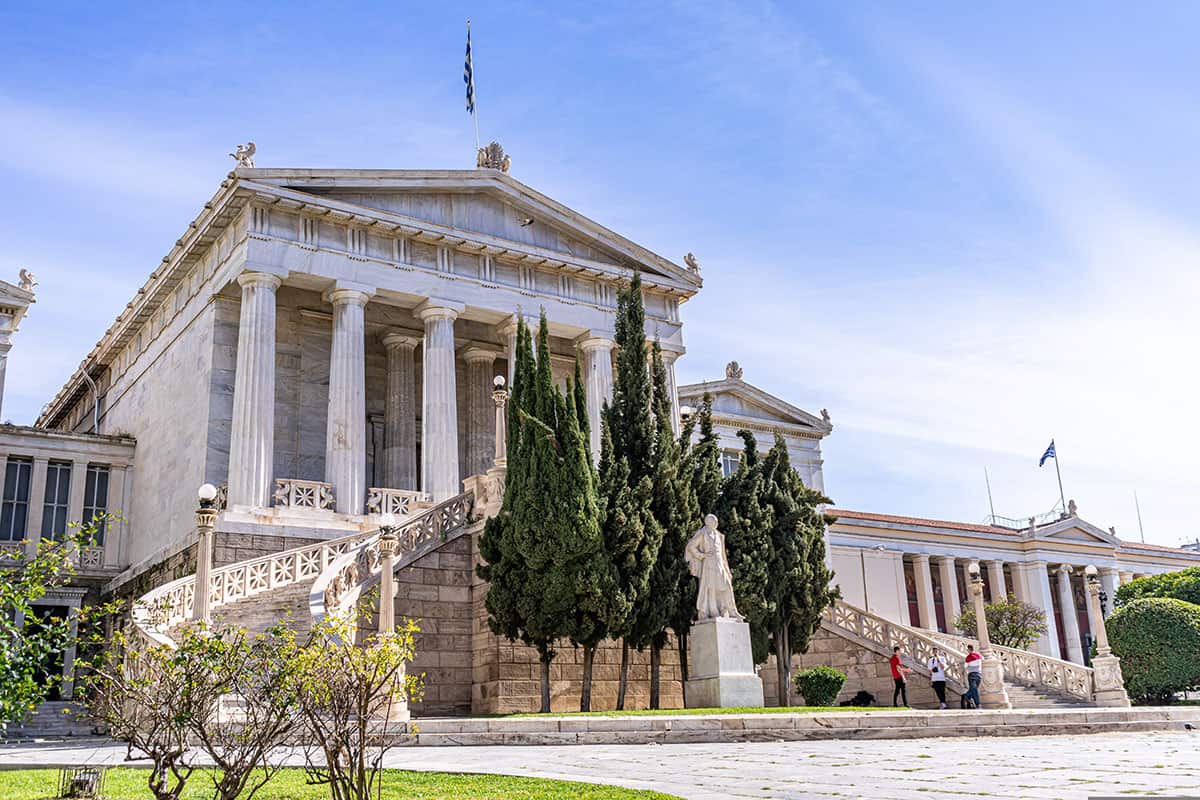
In Athens this September, students walked past graffiti-covered university gates and into something Greece had never seen before: private universities. For decades the Constitution made higher education a strictly public matter. Now, for the first time, classrooms are opening under a Council of State ruling that upheld Law 5094/2024 in June 2025, ending the constitutional ban on private higher education.
Four universities have been cleared to begin: UNIC Athens (University of Nicosia branch); the American University Anatolia, in partnership with the UK’s Open University; the University of Keele branch in Athens; and CITY College in Thessaloniki, formally recognized as the University of York’s Europe Campus. Combined, they can enroll up to 6,280 students in their inaugural year. Actual first-term enrollments reported so far total around 1,540 students: roughly 850 at UNIC Athens, 183 at American University Anatolia, 170 at Keele Athens, and 337 at CITY College.
The change has been called historic, but it has also been met with anger. Demonstrations swept the country throughout early 2024, peaking with over 150 faculty buildings occupied by students.
As the academic year begins, unrest is spreading. Teachers have announced daily strike action starting September 11, 2025, to oppose new evaluation systems and expanded disciplinary powers. Nationwide strikes by public sector workers earlier in September closed schools, trains, and ferries.
Behind the anger lies a longer story of underfunding. Greek universities have struggled since the financial crisis, when austerity gutted budgets and a sovereign bond haircut wiped out millions in deposits. More recently, a €300 million RRF research program collapsed amid delays and mismanagement, with professors now preparing legal action. The strain shows in international standings. According to Webometrics, Greek universities saw an average decline of 12.1 percent in 2024–25, a drop of 179 positions on average, with only a few institutions improving.
At the same time Greece is facing a demographic crisis in its schools. For 2025–26, 721 schools will close due to shrinking enrollments, affecting more than 1.21 million students and forcing some children in rural areas to travel long distances just to reach a classroom.
Still, the government says private universities could be a turning point. Officials argue the new institutions can help Greece become a regional education hub and keep young Greeks from leaving. About 40,395 Greek students studied abroad in 2023–24, the highest proportion in the European Union.
One story from the 1990s captures the point. A Greek visiting a friend studying in the United Kingdom found himself in a conversation with classmates from around the world. A student from Thailand asked him, “I have heard of the Ancient Greeks, Socrates, Plato, the birth of democracy, Pythagoras. But what is modern Greece known for? What does it export?” The Greek laughed. “Isn’t it obvious? Students.”
For the diaspora the implications are clear. Until now, American-born students with ties to Greece often looked to Cyprus or Britain for English-language degrees, usually at a steep price. Now Athens and Thessaloniki will offer programs that carry international recognition at tuition levels far below those in the United States or the United Kingdom. Families weighing study abroad may soon find themselves considering Greece as seriously as London or Nicosia, not only for heritage and language but also for affordability.
Whether these reforms strengthen the country’s universities or deepen the divide remains to be seen. For the students taking their seats this fall, it is the beginning of something new, and for Greece itself, the start of one of the most turbulent chapters in its modern educational history.