
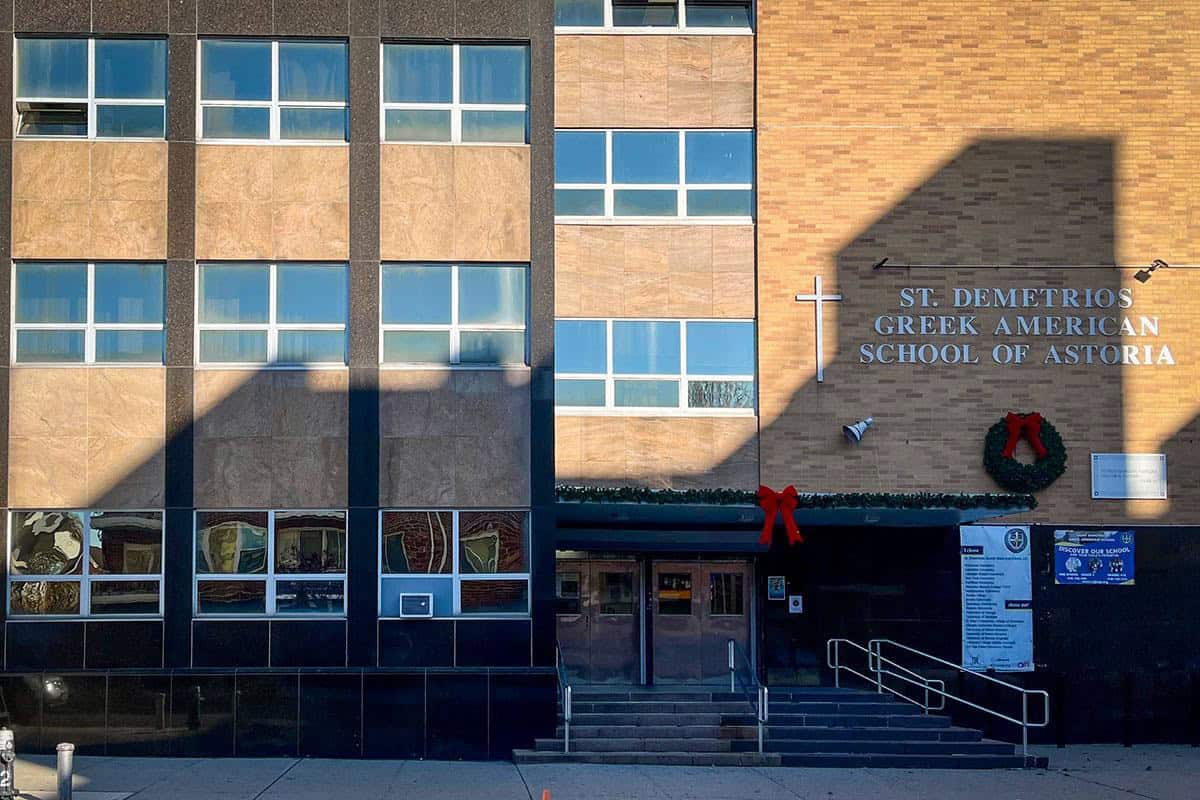
On an October evening in 2025, parishioners gathered outside the Cathedral of St. Demetrios in Astoria, some holding candles, others holding signs that read “Hands Off St. Demetrios” and “Save the School.” Some had children enrolled in the day school. Others had grown up in the community themselves. When Bishop Athenagoras arrived, he attempted to calm the crowd. Some in attendance responded with anger, accusing the Archdiocese of overreach.
The Cathedral of St. Demetrios is not just another parish. It is one of the largest and most prominent Greek Orthodox communities in the United States, with a long history tied closely to the growth of Astoria’s Greek-American population. For decades, the church and its school have functioned as a center of religious, educational, and cultural life.
Part of the story goes back to 2019, when the community declined a $25 million grant from the Stavros Niarchos Foundation that would have supported the school’s long-term development. The decision, which has since been described as a mistake even by Archdiocesan leadership, left the institution without a major source of capital at a critical moment. When The National Herald contacted the foundation’s co-president about later claims of renewed outreach, he said he was unaware of any such effort.
The situation now unfolding has been building for years. By 2025, the community was facing serious financial strain tied to accumulated debt, ongoing operating costs, and a mixed-use development on 31st Street with rental units and a daycare center, intended to generate ongoing revenue for the parish. The project cost roughly $7 million to construct, but estimates discussed publicly suggested that even a full sale would yield far less than anticipated once debt and expenses were accounted for.
Instead of pursuing a full sale, the Greek Orthodox Archdiocese of America moved to acquire a 39 percent interest in the building for $3 million, providing immediate liquidity while keeping the structure in place.
The Archdiocese described this as a necessary intervention. Officials pointed to payroll pressures, structural deficits tied to the school, and a financial model that had not adapted after the loss of a major benefactor. The emphasis was on stabilization, oversight, and long-term sustainability.
At the parish level, the same developments were interpreted differently. The removal of elected Parish Council members and the introduction of an oversight agreement raised questions about how decisions were being made and where authority ultimately rests. Former parish leaders said they had acted “within their fiduciary duty to protect the Parish’s assets and mission,” framing the issue not only as financial, but as one of stewardship.
That tension surfaced in concrete ways. In one instance reported by The National Herald and disputed by the Archdiocese, a remark attributed to a newly appointed interim leader suggested that a fast-food drive-through could be considered as a revenue source. The comment appeared directly on protest signs and became shorthand for fears about the future direction of church property.
Questions about authority extended beyond the parish itself. Reporting in The National Herald described an internal effort to identify the source of leaks from an Archdiocesan Executive Committee meeting, including requests related to members’ communications. The episode was cited by community members as evidence of increasing centralization.
Around the same time, New York changed how certain church property decisions are approved. Under the revised law, Greek Orthodox parishes must obtain the Archbishop’s consent before petitioning a court over the sale, lease, or mortgage of property. Court approval remains required, but the previous step of notifying the Attorney General is no longer part of the process.
The change directly affects transactions like the St. Demetrios building arrangement, shaping how such agreements move forward legally. Supporters say the law aligns the Archdiocese with other hierarchical churches. Critics argue it reduces an external layer of oversight and concentrates authority within the institution.
The school remains the emotional center of the story. St. Demetrios describes itself as the only Greek-American school in the United States serving students from preschool through high school. Its program also includes Greek language and culture, Orthodox Christian formation, college preparation, and a dual-enrollment partnership with St. John’s University.
The Archdiocese has said clearly that the school will remain open and that the financial intervention is intended in part to support it. At the same time, questions about long-term sustainability remain. Public data on enrollment, tuition, and operating costs is limited, which makes it difficult to assess how the school’s finances relate to the broader parish situation.
Some of the most important details are still not public. The full terms of the property arrangement have not been released in detail. The oversight agreement itself has not been widely circulated in full. Parish-level financial statements are not readily available. Without those documents, it is difficult to draw firm conclusions about the long-term balance between local governance and central oversight.
What is clear is that St. Demetrios has become a focal point for a larger conversation. The pressures it faces are not unique. Across the United States, Greek Orthodox communities with schools and large property footprints are confronting similar financial and demographic pressures, even if not always at the same scale or visibility. The question is how those pressures are addressed, and who makes the decisions when financial stability and community control appear to pull in different directions.
For readers outside New York, the story is not about Astoria alone. It is about a model that has shaped Greek Orthodox life in America for generations. Parishes built by local communities, often centered around schools, are now operating in a very different financial and social landscape. The outcome in Astoria may offer some indication of how similar challenges will be handled elsewhere.
The crowd that gathered that evening was not responding to a single decision. It was responding to a sense that something long familiar was becoming uncertain, and that decisions about its future might no longer be made in the same way.