
In 1977–78, Greek archaeologist Manolis Andronikos led a determined team into the Great Tumulus at ancient Aigai, today’s Vergina. It was a dig marked by long days, careful trowel work, and the hope of finding something more than shards and rubble. What they uncovered was beyond expectation — four royal tombs, two of them completely undisturbed since the 4th century BC. In those sealed chambers lay a world preserved in darkness, a royal story untouched for over two thousand years.
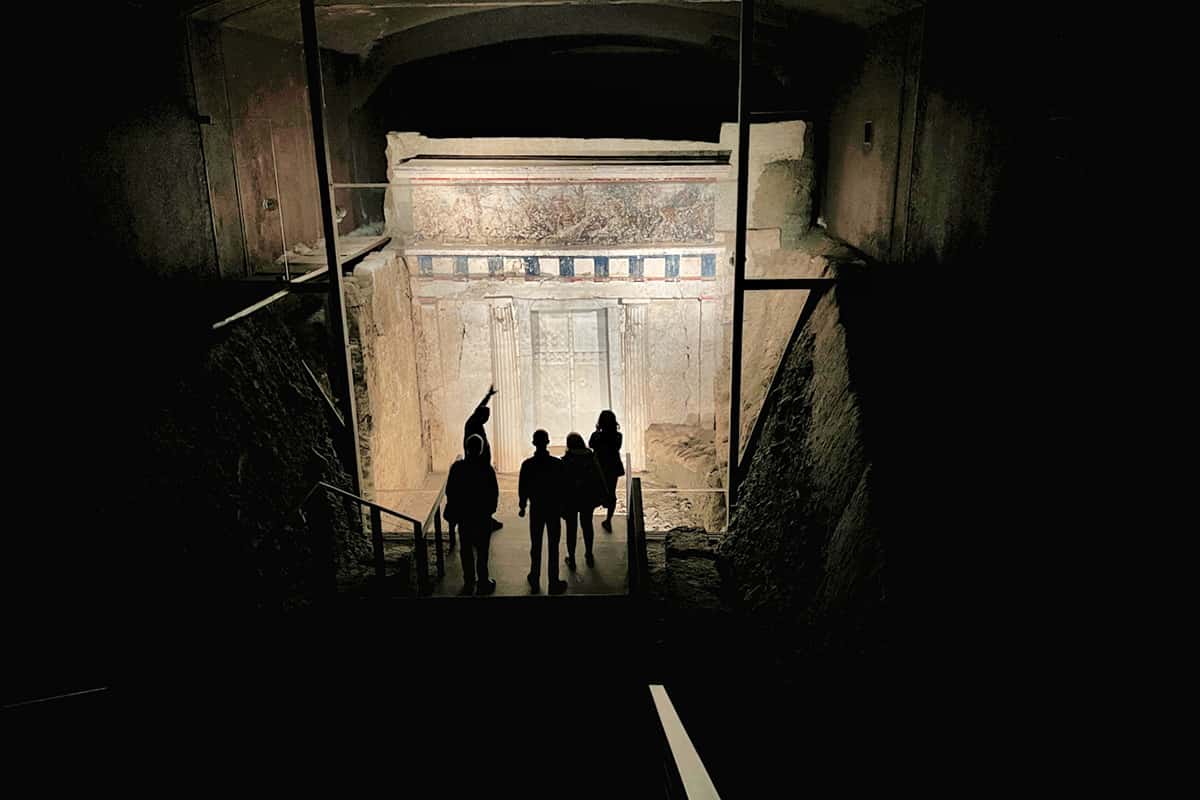
Tomb II, the most monumental of the group, stood out immediately. Its Doric façade carried a painted hunting scene alive with motion and tension. Heavy stone doors, fitted with bronze and iron, had kept the burial safe from looters through centuries of upheaval. Behind them, the tomb opened into two vaulted chambers: a main burial for a male and a slightly smaller antechamber for a female.
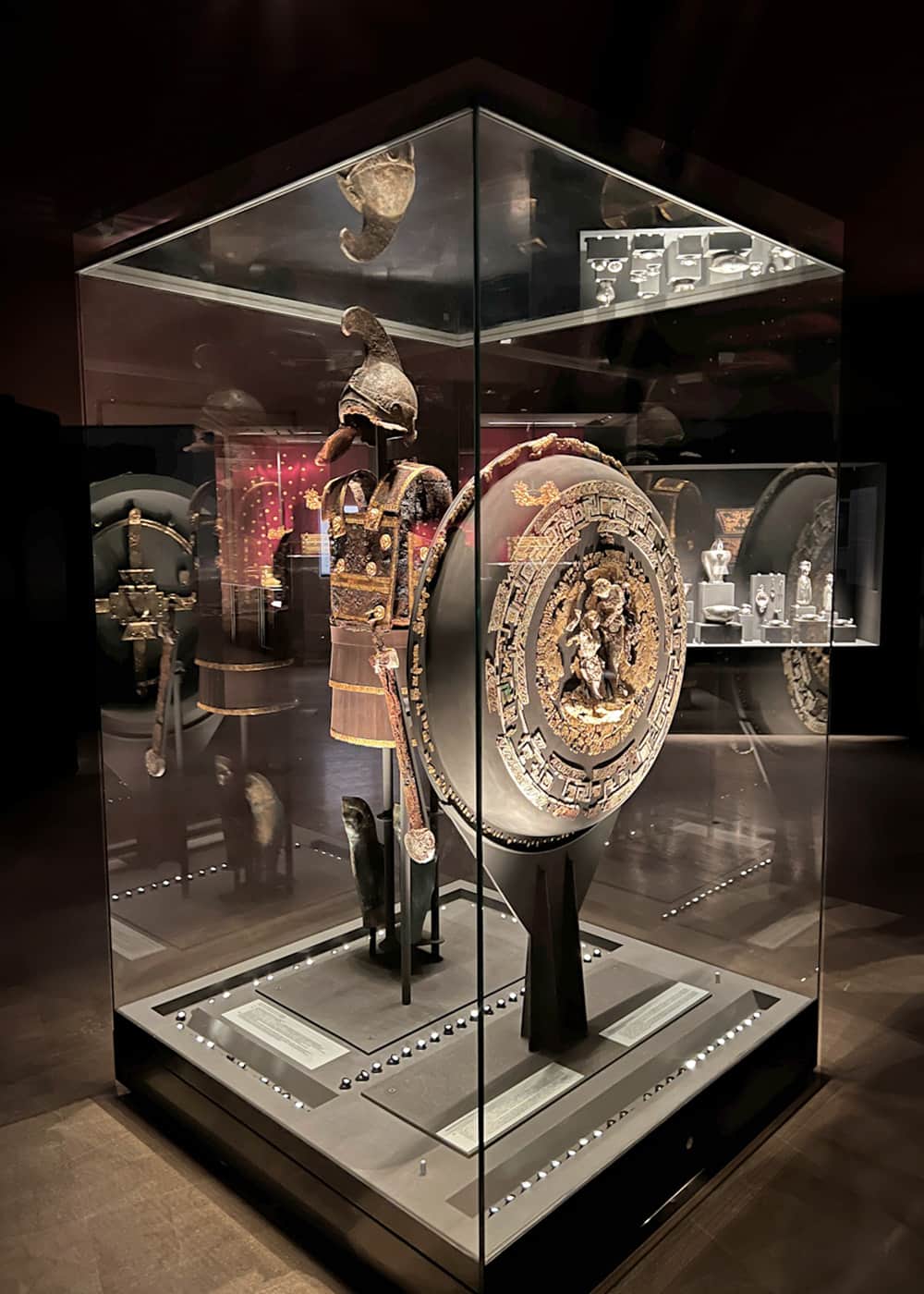
The contents took the breath away. In the main chamber, a marble sarcophagus held a gold larnax, its lid bearing the sixteen-ray Sun of Vergina. Inside were cremated remains wrapped in purple cloth, crowned with an oak-leaf gold wreath made of hundreds of delicately worked leaves and acorns. Around it lay silver and gold diadems, armor inlaid with gold, including a pair of greaves, one custom-shaped to fit a damaged leg, helmets, shields, swords, lance points and a gold-plated bow-case (gorytos) with arrows. Silver vessels, bronze utensils and carved ivory from an ornate funerary couch completed the scene.
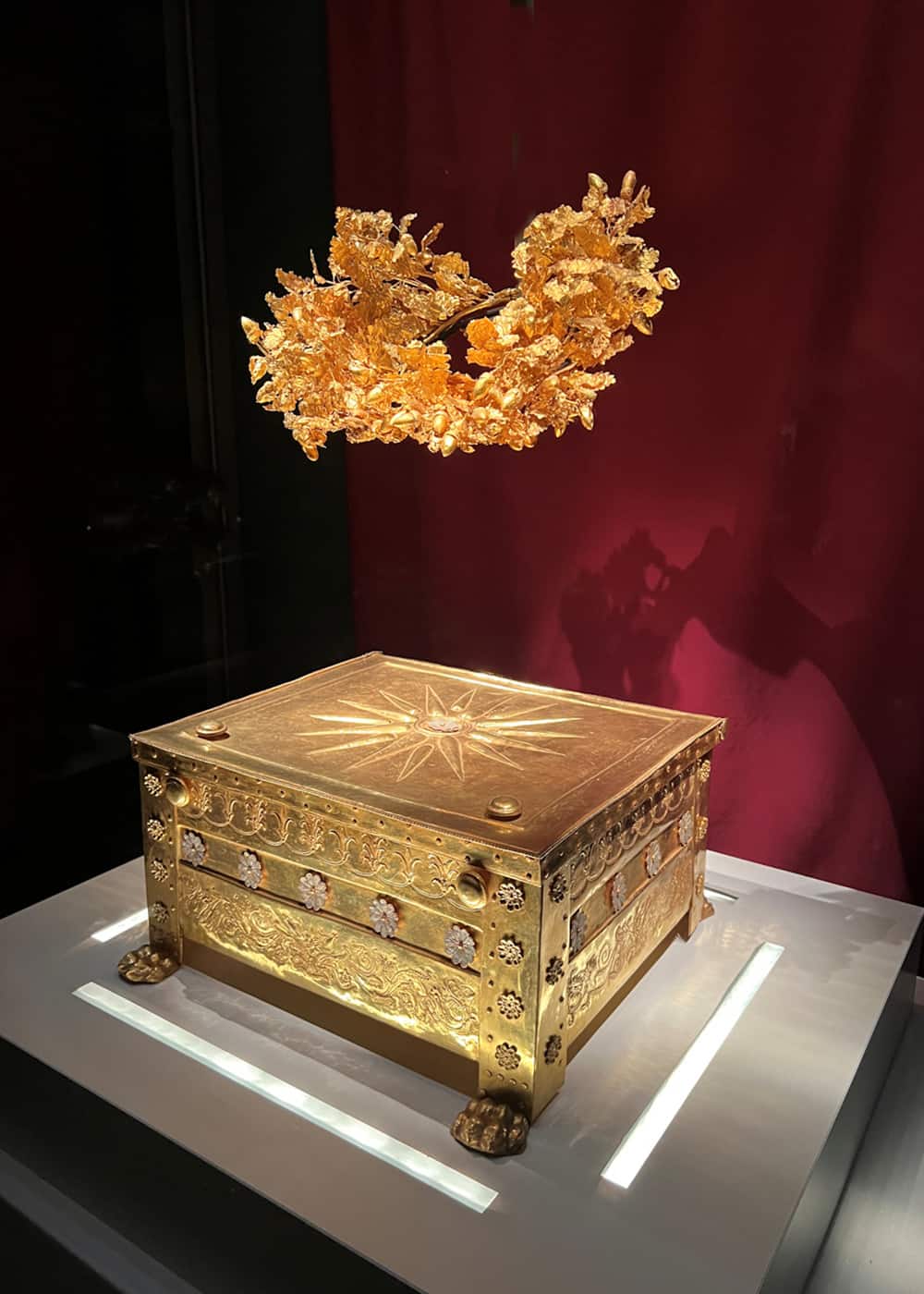
The antechamber held its own treasures: a second gold larnax with the ashes of a woman, a gold myrtle wreath, a diadem, and other royal ornaments. Both individuals had been cremated and interred together, suggesting a double funeral, perhaps even a ritual sacrifice.
Analysis of the bones places the man in his early to mid-forties. Some specialists see evidence of an orbital injury in the skull that could match Philip II’s loss of an eye, while others disagree. There is no confirmed hand injury or horse-riding wear, details that appear in popular accounts but not in published studies. From the moment of discovery, most archaeologists and the Greek Ministry of Culture have identified Tomb II as the burial of Philip II of Macedon, the father of Alexander the Great, and a royal consort, possibly the Thracian princess Meda. A 2015 osteological study offered a competing view, proposing that Philip II rests in nearby Tomb I and that Tomb II may instead belong to Philip III Arrhidaeus. The official position still favors the Philip II attribution, though the scholarly debate remains alive.
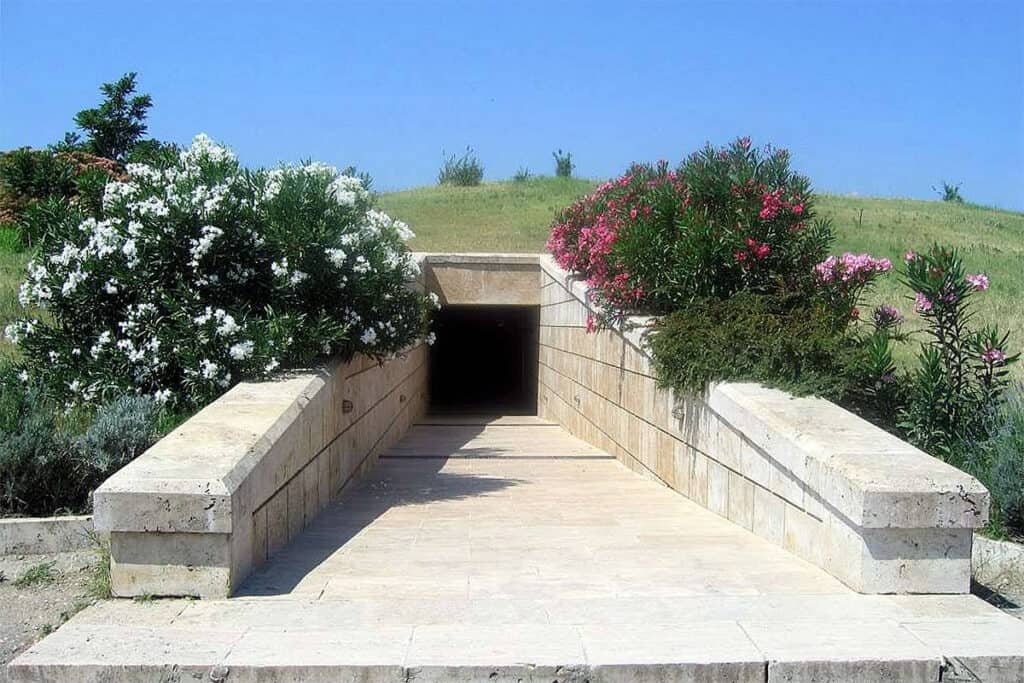
Today, these treasures are housed in the underground Museum of the Royal Tombs of Aigai, which encloses the tombs exactly where they were found. Visitors enter the reconstructed mound into a dimly lit space where façades emerge from the shadows and the gold and silver artifacts glimmer under soft spotlights. The atmosphere is quiet and almost theatrical, evoking the moment in 1977 when Andronikos first stepped through those ancient doors.
The site, part of the UNESCO-listed archaeological area of Aigai, continues to draw historians, archaeologists, and travelers from around the world, linking the modern visitor to the power and pageantry of Macedonia’s royal past.
Editor’s note: This article is an updated and expanded version of our May 20, 2023, story on the Tomb of King Philip II. It includes new details from recent research and corrects earlier information to reflect the latest archaeological findings.