
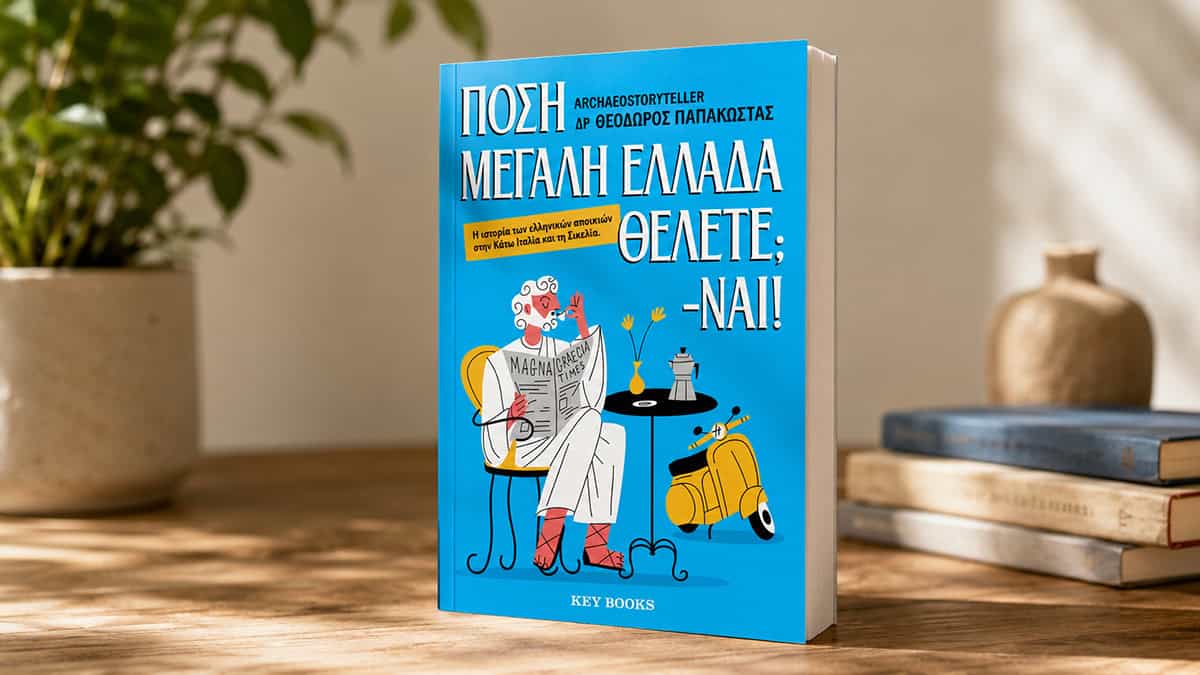
Theodoros Papakostas’ latest book traces six centuries of Greek settlement, political rivalry and cultural exchange in southern Italy and Sicily, presenting Magna Graecia as a central part of ancient Greek history rather than a peripheral chapter.
Πόση Μεγάλη Ελλάδα θέλετε; – Ναι! was released by Key Books on June 11. Its subtitle, The History of the Greek Colonies in Southern Italy and Sicily, defines the book’s scope: the rise of Greek cities in the western Mediterranean and the rivalries and encounters that shaped them.
The 344-page Greek-language book begins with early settlements such as Pithekoussai and Kyme before moving through cities including Taras, Kroton, Sybaris, Akragas and Syrakousai. Their modern counterparts include Taranto, Crotone, Agrigento and modern-day Syracuse. Its later chapters examine the conflicts with Carthage, the rule of the Syracusan rulers, and the city’s eventual fall to Rome.
In the publisher’s presentation and interviews surrounding the release, Papakostas frames Magna Graecia not as a distant appendage of mainland Greece but as a parallel Greek world with its own political and cultural history.
Speaking to Athens Voice, he called the region “the other half of ancient Greece that we never focused on.” That framing shifts attention beyond Athens, Sparta, and the Aegean toward the Greek cities of the western Mediterranean.
Papakostas does not treat colonization as a simple story of Greeks founding cities on unoccupied land. The history also involves conflict, commerce, political alliances, displacement, and contact with the established populations of Italy and Sicily.
Settlers arriving from different Greek city-states created communities that developed their own local identities while maintaining religious, linguistic, and commercial ties across the Mediterranean. Those cities also competed with one another and became entangled in wider struggles among Greeks, Carthaginians, neighboring communities, and, eventually, Rome.
Papakostas uses the conversational method familiar from his earlier work. The narrative begins aboard a ship traveling to Italy, where a historian meets two tourists preparing to visit ancient sites. Their exchanges become the route through the history, allowing explanations, disagreements and anecdotes to replace the structure of a conventional academic survey.
An early review in Book Press praised the “liveliness and theatricality” of the approach and its ability to introduce readers to a part of antiquity that receives comparatively little attention in popular history. The review also pointed to the range of figures and communities covered throughout the narrative, from settlers and local populations to rulers, philosophers, and poets.
Papakostas, widely known through his Archaeostoryteller project, studied archaeology at the University of Reading, completed postgraduate work at the University of Nottingham, and earned a doctorate in classical archaeology from Aristotle University of Thessaloniki in 2017. He launched Archaeostoryteller the following year to bring archaeology and ancient history to a general audience.
His first book, Χωράει όλη η αρχαιότητα στο ασανσέρ; (Can All of Antiquity Fit in an Elevator?), appeared in 2021 and has been translated into 15 languages. Several adult and children’s titles followed, combining archaeological research with dialogue, humor, and contemporary storytelling.
The new book may also interest Diaspora readers because it examines Greek communities that developed beyond the Aegean while remaining connected to a wider Greek-speaking world. The ancient experience cannot be equated with modern migration, but it complicates the idea of Greek history as something confined to the borders of present-day Greece.
Πόση Μεγάλη Ελλάδα θέλετε; – Ναι! is available in paperback from Key Books. A Greek-language audiobook edition, narrated by Dimitris Barbas, is available through JukeBooks and runs eight hours and 16 minutes.