
Nearly thirty years ago, a Philadelphia Inquirer article asked whether Byzantine chant could survive in Greek-American parishes. Reading it today, the question feels less theoretical and more personal.
In many Greek Orthodox churches today, the sound is familiar. A choir stands together, often mixed voices, often singing in English, sometimes with Greek woven in. The hymns are orderly and comforting. For many parishioners, this is simply what church sounds like.
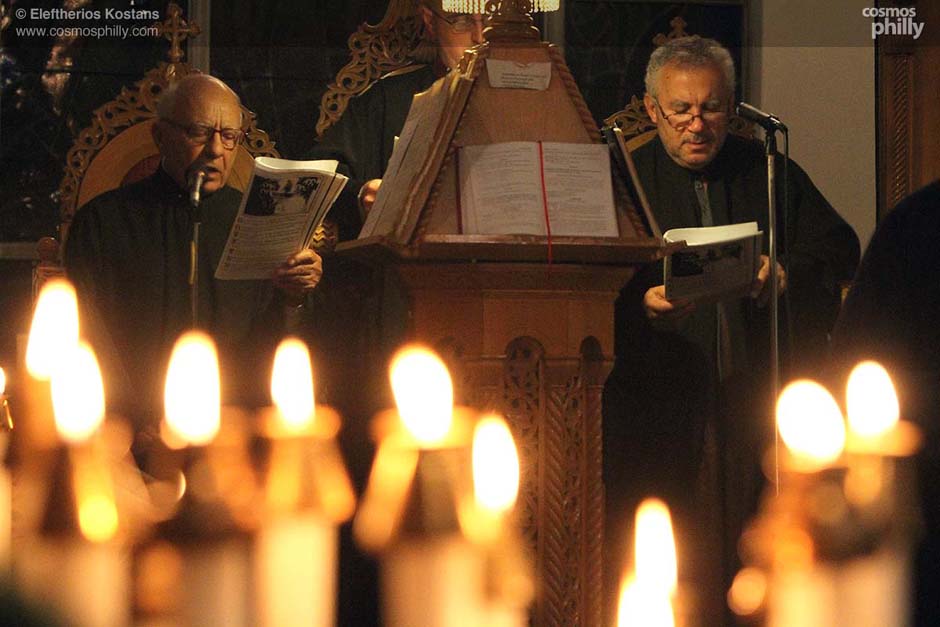
But for others, especially those who grew up in immigrant households, something else is missing. A single voice, or two, rising slowly from the chanter’s stand. The long, unhurried phrasing. The feeling that the music was not performing the service, but carrying it.
Nearly thirty years ago, a Philadelphia Inquirer article quietly asked whether that sound could survive in Greek-American parishes. Reading it today, the question feels less theoretical and more personal.
A Sound Once Taken for Granted
For most of Orthodox history, especially in the Greek tradition, there were no choirs. There were chanters.
They stood to the side of the altar and carried the service with their voices. They chanted the Orthros before the Divine Liturgy, the Psalms, the hymns of feast days, and the verses honoring saints. They chanted for the living and the dead, sometimes for hours, shaping the rhythm of worship without ever stepping into the center.
In December 1996, Inquirer reporter Annette John-Hall visited Orthodox churches in the Philadelphia area, including St. Luke Greek Orthodox Church in Broomall. Her article, “Winds of change can’t silence chants,” captured a moment when this tradition, once assumed, was beginning to feel fragile.
Choirs were becoming more common. Services were increasingly conducted in English. Younger generations were less likely to speak Greek fluently, let alone master the demanding system of Byzantine chant. The concern was not dramatic, but it was real. Who would take the chanter’s place?
From the Chanter’s Stand
At St. Luke’s, the article focused on Dimitri Ververelli, then 71 years old. He had learned chanting in Constantinople, present-day Istanbul, long before coming to the United States. Alongside Zacharias Triantafillou and Stelios Haritonidis, Ververelli represented a generation shaped by immersion, not instruction manuals.
Chanting, as they understood it, was not simply singing. It was knowing the tones, the phrasing, the moments when the voice should press forward and when it should hold back. It took years. Often a lifetime.
“As long as we are here, we will take care of it,” Ververelli told the Inquirer. “What happens beyond that, God knows.”
It is a line that lingers. Not because it sounds poetic, but because it sounds practical. There was no panic in it. Just an acknowledgment that traditions survive only as long as someone is there to carry them.
When the Language Began to Shift
Language sat at the center of the question, even when it wasn’t stated directly.
Byzantine chant follows Greek closely. Its rhythm bends to the language. Translating it into English is possible, and many parishes have done so with care, but the experience changes. Something in the pacing, something in the sound, shifts.
By the mid-1990s, many Greek-American families no longer spoke Greek at home. Priests noticed it. Chanters felt it. Children could participate more easily in English, but fewer were willing or able to train as chanters.
Father Stephen P. Theophilos of St. Luke acknowledged this openly in the article. There were simply fewer children learning Greek, and fewer families arriving from Greece with the tradition already in hand.
At the same time, choirs offered something different. They allowed more people to participate. Women, long excluded from the chanter’s role, found a visible place in worship. For many congregations, this was not loss. It was inclusion.
A Church Learning to Sound American
Looking back now, it is clear that the church was doing what Greek-American communities have always done.
Parishes founded by first-generation immigrants slowly became communities of second-, third-, and fourth-generation Greek Americans. English became not a concession, but a necessity. Worship had to speak to the people who were actually there.
Byzantine chant did not disappear, but it no longer held the same central place everywhere. In some churches, it survived quietly. In others, it returned on feast days or special services. In still others, it became something parishioners remembered more than practiced.
Technology later changed the picture again. Recordings, online lessons, and workshops made chant more accessible than it had been in decades. What once passed from elder to apprentice could now travel digitally.
What Was Carried Forward, What Was Left Behind
The value of the 1996 Inquirer article lies in its timing. It captured a moment before outcomes were clear, when people still spoke in questions rather than conclusions.
The chanters at St. Luke’s were not resisting change. They were naming it. They knew what it took to learn the tradition, and they could see how few were stepping forward.
What was left behind, in many places, was the slow, patient intimacy of a single voice shaping the service. What was carried forward was a church that remained accessible, participatory, and rooted in the lives of its community.
Both are true. Neither cancels the other.
Listening for the Echoes
Today, if you listen closely in Greek Orthodox churches, you can still hear traces of what came before. A short chant before a hymn. A priest trained to chant who fills the space when the choir rests. A visiting chanter on a feast day who reminds older parishioners of a sound they once knew by heart.
These moments are not about returning to the past. They are about memory. About recognizing that faith is not only something believed or spoken, but something heard and felt.
The question asked in Philadelphia in 1996 was never really about music. It was about transmission. About whether a community knows how to pass something on without freezing it in time.
The answer, then as now, is unfinished. It unfolds slowly, one voice at a time, wherever someone is still willing to stand and chant.
Source: Annette John-Hall, “Winds of change can’t silence chants,” Philadelphia Inquirer, December 8, 1996.
Editor’s Note: This article revisits a 1996 Philadelphia Inquirer report on Byzantine chant in local Orthodox churches because the questions it raised have not faded. Language, worship, and tradition continue to shift across Greek-American parishes, often quietly and without record. By returning to this moment, Cosmos Philly aims to preserve a small but telling piece of community memory and to reflect on how cultural practices change, endure, or are handed forward over time.