
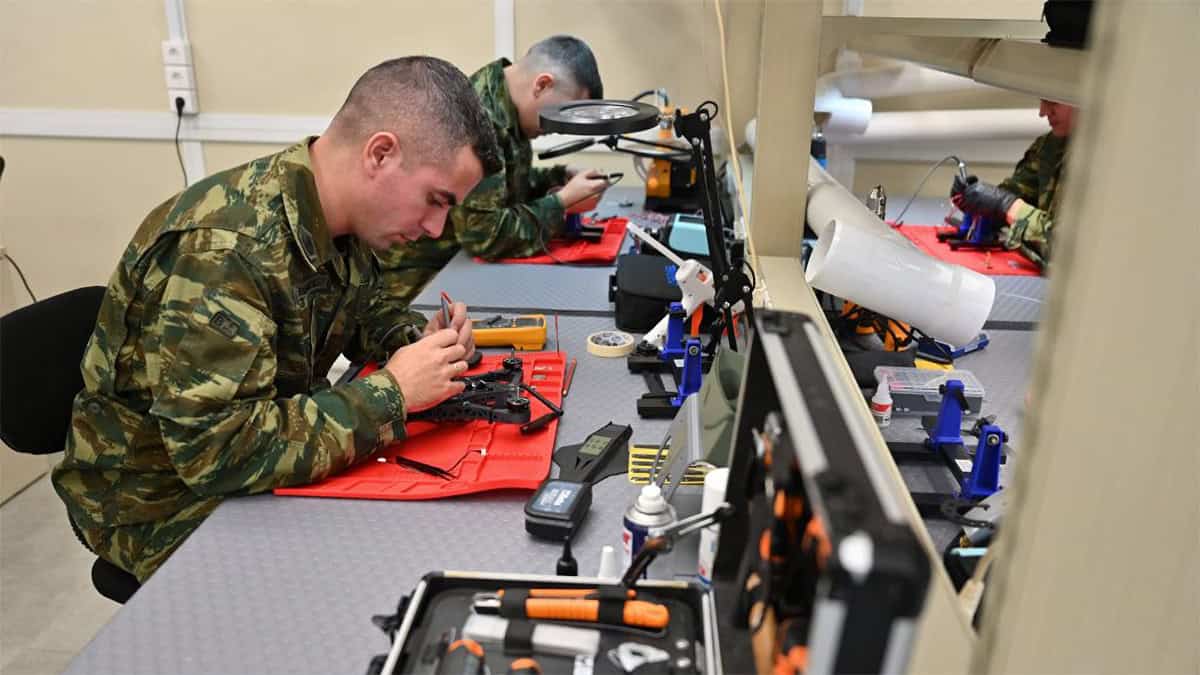
Greece has laid the foundation stone for a new Armed Forces drone factory in Malakasa, north of Athens, as part of the country’s effort to modernize its military and build more of its own defense technology.
The facility, officially known as the 309th Factory for the Construction of Unmanned Systems, was presented by Defense Minister Nikos Dendias as part of a broader shift in Greek defense planning. The practical question behind the ceremony: how much of Greece’s defense future can the country build itself?
According to Kathimerini, the Malakasa facility will become the military’s third and largest drone factory. It is expected to produce Class I and Class II drones, while a research and development unit will work on larger systems. The Defense Ministry wants to raise the annual production of Class I drones from about 4,000 today to at least 10,000. New drone operator schools for the Air Force and Navy are also planned.
The production target is only one part of what the factory is meant to do. CNN Greece reported that the project includes the modernization of older military facilities and the construction of a new 3,600-square-meter building with production lines, laboratories, research areas, and testing centers. The site is expected to support work on aerial drones, unmanned ground vehicles, unmanned surface vessels, underwater systems, and anti-drone technology.
That broader range reflects Greece’s geography. The country has islands, border regions, naval passages, military outposts, ports, energy infrastructure, and remote areas that are difficult to monitor with traditional systems alone. Unmanned systems can help watch, patrol, relay information, protect installations, and respond faster when conditions change.
The timing is hard to separate from the war in Ukraine. Drones have become part of daily warfare there, not as futuristic weapons but as tools used constantly by soldiers in the field. They scout roads, watch trenches, guide artillery, carry explosives, expose troop movement, and get replaced quickly when they are lost. A military that uses drones seriously has to think not only about buying them, but also about producing, repairing, adapting, and replacing them at speed.
For Greece, this points to a different kind of defense planning. For decades, modernization has usually been discussed through major imported platforms, including fighter jets, frigates, missiles, radar systems, and air defense. Those systems remain central.
Earlier this year, Reuters reported that Greece was moving ahead with major defense investments, including air and drone defense capabilities and upgrades to F-16 fighter jets, as part of a larger modernization program through 2036.
The drone factory belongs to that same defense picture, but it serves a different purpose. Large imported systems give Greece reach, firepower, and deterrence. Domestic drone production gives it the chance to adjust faster to local needs.
Dendias placed the Malakasa project inside Greece’s “Agenda 2030,” the government’s broad plan to reorganize and modernize the Armed Forces. He also connected it to “Achilles Shield,” a layered defense concept meant to protect the country across sea, land, air, cyberspace, and space.
In plain terms, the ministry is trying to move from separate weapons purchases toward a more connected defense system, where sensors, drones, anti-drone tools, air defense, communications, and command decisions work together.
His message at Malakasa was also political and industrial. Greece, he said, cannot remain only a buyer and user of foreign systems. It has to produce, design, and develop them. For a country that has often depended on foreign suppliers for major defense equipment, that marks a meaningful shift in tone. The harder question is whether the system around the factory can support that ambition.
A production line can build drones, but it cannot by itself create an effective drone force. The real test will be whether Greek forces can update software quickly, protect communications from jamming, adapt designs after field testing, secure parts and sensors, and train enough operators to use the systems well. Defense projects in Greece have not always been known for speed or simplicity. Delays, bureaucracy, supplier dependence, and announcements that run ahead of delivery remain real risks.
There are signs that the government understands the factory cannot stand alone. In March, the Hellenic Centre for Defence Innovation signed four contracts involving military research centers and Greek defense companies for kamikaze drones and three types of domestic unmanned combat aircraft. The ministry described the contracts as part of a new model connecting research, industry, production, and the operational needs of the Armed Forces.
That connection is where the Malakasa project will either gain substance or remain mostly symbolic. If feedback from soldiers and operators reaches engineers quickly, and if Greek companies and research centers can turn that feedback into usable changes, the factory could become more than an assembly site. It could become part of a learning loop.
The comparison with Turkey will naturally come up, especially in Greek defense discussions. Turkey built a visible drone industry around platforms such as the Bayraktar TB2 and used that industry not only for military purposes but also for exports, diplomacy, and influence.
Greece is not in the same position, and it is not simply trying to copy that model. Turkey’s drone program became a national brand. Greece’s immediate challenge is more defensive and more geographic: surveillance over the Aegean, protection of islands and bases, border monitoring, maritime awareness, and defense against unmanned threats.
That difference shapes what Greece needs from Malakasa. It does not need only a headline-making combat drone. It needs many types of unmanned systems that can fit into the daily work of the Armed Forces. Some may be small and expendable. Others may be used for reconnaissance, infrastructure protection, communications, or anti-drone defense. The factory’s value may come less from one famous product and more from the ability to produce many useful ones.
The anti-drone part of the project deserves special attention. Modern drone warfare is no longer a race over who can fly more drones. It is also about who can detect them, jam them, intercept them, and keep troops and installations safe from them. By placing drones and anti-drone systems in the same production plan, Greece is acknowledging that unmanned warfare is already a contest between attack, defense, and rapid adaptation.
The Malakasa factory will not transform Greek defense on its own. No single facility can do that. Its real value will be measured by whether Greece can turn it into a place where the Armed Forces, engineers, researchers, and industry learn from one another quickly enough to keep pace with the battlefield around them.