
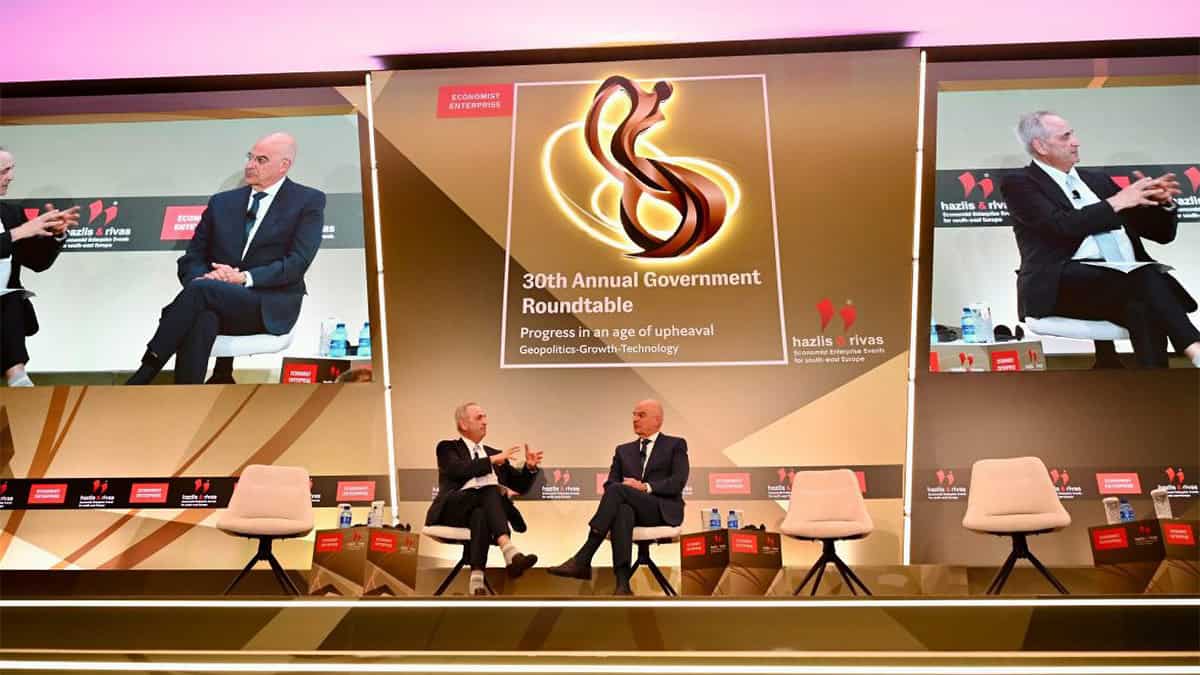
Greek Defense Minister Nikos Dendias said Greece would not welcome Turkey receiving F-35 fighter jets or engines for next-generation aircraft, while stressing that decisions on U.S. arms sales are Washington’s.
Speaking on July 9 at the 30th Economist Roundtable in Lagonisi, Dendias was asked about Turkey potentially receiving new aircraft, including F-35s, and the effect such a move would have on Greece’s security concerns, according to the official transcript published by the Greek Ministry of National Defense.
Dendias replied that he hoped Turkey would not receive the aircraft. He then made clear that Greece’s objection was not framed as an attempt to decide U.S. policy.
He said Greece would not judge what the United States does or to whom it sells equipment, calling that a matter for the U.S. government.
He added, however, that Greece asks whether such a decision would truly serve U.S. interests, especially in the Eastern Mediterranean, where Greece and Turkey are both NATO members but remain divided by longstanding disputes.
Dendias questioned whether it would serve U.S. interests to provide advanced platforms in the Eastern Mediterranean without a restriction preventing their use against another NATO member.
The issue has resurfaced in U.S.-Turkey relations after President Donald Trump said he would lift U.S. sanctions on Turkey and decide on a possible sale of F-35 fighter jets, Reuters reported.
Turkey was removed from the F-35 program after its purchase of the Russian S-400 air defense system, a move Washington said posed a security risk to the aircraft. U.S. law still restricts F-35 sales to Turkey as long as Ankara retains the S-400 system, and any possible change is expected to face scrutiny in Congress, according to Reuters.
Dendias did not present Greece’s position as a formal demand. Asked whether he would support a sale under such a restriction, he said the answer would ultimately belong to the Greek government and prime minister.
His own advice, according to the Ministry transcript, would be that platforms sold from one NATO country to another should not be used against a NATO member.
He also said Greece would try to convey that position to the U.S. government, while noting that the matter involves diplomacy and that he did not want to comment further in public.
The F-35 exchange was one part of a broader roundtable discussion that also touched on NATO, regional security, defense spending, and Greece’s defense modernization plans.
In that discussion, Dendias argued that Greece’s defense policy is not only about spending more, but about spending more effectively. He said Greece is implementing “Agenda 2030,” a reform effort launched in January 2024 that he described as a total reform of the Greek Armed Forces for the 21st century.
“The basic idea behind it is the modernization, not just spending money on big fancy platforms,” Dendias said.
He said Greece does not aspire to acquire an aircraft carrier or helicopter carrier.
“We are small, we don’t punch above our weight,” he said. “We are trying to produce innovative solutions that will serve two purposes.”
The first purpose, he said, is Greece’s constitutional duty to defend the country against any threat. The second is to create growth in the economy.
“If we spend 5% of our GDP, we have to give to society something back,” Dendias said.
For Greece, he said, the goal is to spend “cleverly” and “efficiently,” using defense expenditure to create a Greek defense ecosystem able to produce dual-use solutions that can also serve the broader economy.
Dendias linked the approach to lessons from Greece’s 2010 debt crisis, saying the country entered that period because of public debt and because it was exporting much less than it was importing.
At the Ministry of Defense, he said, Greece is trying to address both issues by staying within its fiscal space and developing home-produced, exportable defense solutions.
“We don’t overspend,” he said. “We spend exactly what we have, not a penny more.”
The aim, he added, is not only to fulfill Greece’s constitutional duty to defend the country, but also to serve the economy and the Greek people.
A major part of that shift, Dendias said later in the discussion, involves drones, artificial intelligence, and systems designed for Greece’s geography. He said Greece entered the drone field late but could move quickly by learning from the experience of others, including Ukraine and the earlier war in Nagorno-Karabakh.
He described the future battlefield as one shaped not only by individual drones, but by swarms operating in the air, at sea, underwater, and on land.
Greece, he said, has already created production lines for drones and is also developing mobile production capacity that can be moved inside containers. The idea, he explained, is to avoid depending only on large centralized facilities and to allow military units to adapt production more quickly in a crisis.
Dendias also pointed to the Greek anti-drone system “Kentavros,” saying it has been deployed on Greek frigates and has operated in the Red Sea against Houthi drones. He described it as one of the few such systems in the world to have operated in action and estimated that it costs about 50% to 55% less than a comparable system from another European country or the United States.
He also said Kentavros is an exportable product, with other countries already showing interest in seeing what Greece can offer.
Maritime drones were another area where Dendias said Greece could develop a particular advantage. Because of the Aegean’s island geography, he argued that Greece can build interconnected systems of multiple bases able to respond to challenges in ways that larger, less geographically specialized forces may not be able to do as efficiently.
Still, he acknowledged that technology alone is not enough. One of the most difficult changes, he said, is cultural: moving the armed forces away from a mindset built around large platforms and rigid chains of command, and toward faster decision-making at lower levels.
Dendias said his goal is for the Greek Armed Forces by 2030 to be among the most modern in the European Union, while also helping strengthen the Greek economy through domestic defense production and innovation.