
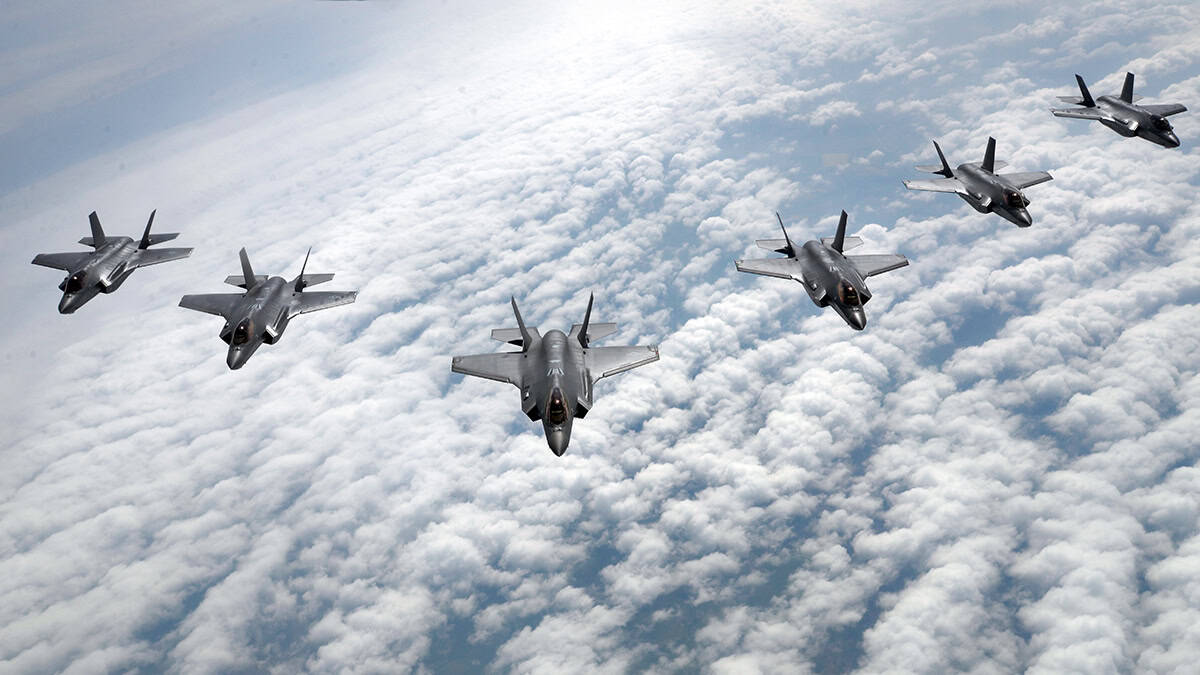
Members of Congress had already begun pushing back against any move to return Turkey to the F-35 Joint Strike Fighter program before President Donald Trump publicly opened the door to selling the advanced aircraft to Ankara during this week’s NATO summit.
The issue moved into sharper focus on July 7, when Trump met Turkish President Recep Tayyip Erdogan during the July 7-8 NATO summit in Ankara. Reuters reported that it was the first visit to Turkey by a U.S. president in 11 years. Speaking before his meeting with Erdogan, Trump said the United States would lift sanctions imposed on Turkey over its purchase of Russia’s S-400 air defense system and signaled that an F-35 sale was under consideration.
“We’re going to be taking the sanctions off,” Trump told reporters, according to Reuters. He added that his secretary of state and Treasury secretary, Marco Rubio and Scott Bessent, were working on the issue. During the same appearance, Trump said an F-35 sale was “certainly something we would consider,” according to The Times of Israel.
The congressional resistance began before those remarks. On July 2, Rep. Mike Lawler, a New York Republican, and Rep. Brad Sherman, a California Democrat, led a bipartisan letter to Trump opposing any F-35 sale to Turkey. Sherman also signed a separate Democratic letter led by Rep. Dina Titus of Nevada, joining 17 House colleagues in urging House Majority Leader Steve Scalise and House Democratic Leader Hakeem Jeffries to be ready to block any effort to readmit Turkey to the F-35 program.
The Titus letter was sent on the eve of the NATO summit, according to the Armenian National Committee of America, which backed the effort. The lawmakers asked House leaders to use congressional review powers under U.S. sanctions law if the administration seeks to restore Turkey’s access to the aircraft without a credible legal basis.
Four Greek-American Republican lawmakers, Reps. Gus Bilirakis, Nicole Malliotakis, Mike Haridopolos, and Jimmy Patronis, also issued a joint statement raising concerns about a proposed U.S. engine sale to Turkey and opposing any Turkish return to the F-35 program without full compliance with U.S. law.
Turkey was removed from the F-35 program in 2019 after Ankara took delivery of the S-400 system from Russia. U.S. officials argued that operating the Russian system in proximity to the F-35 could compromise sensitive information about the aircraft’s stealth and defense capabilities.
The legal obstacle remains central to the dispute. Section 1245 of the Fiscal Year 2020 National Defense Authorization Act bars the Defense Department from transferring F-35 aircraft, support equipment, parts, technical data, or related maintenance support to Turkey unless the secretaries of defense and state certify that Ankara no longer possesses the S-400 system, has provided credible assurances that it will not acquire it again, and has not accepted additional Russian defense equipment that could endanger F-35 capabilities.
The administration has acknowledged that legal review. On June 24, Vice President JD Vance said the administration was examining how Turkey could receive F-35s while complying with U.S. law. “There are certain things that we have to certify have happened … in order to comply with American law,” Vance said, according to Reuters.
Turkey has continued to press its case. Erdogan said in Ankara that he hoped for a positive result on the F-35 issue and said Trump had previously promised Turkey five jets. “I know that Mr. Trump always keeps his promises,” Erdogan said. Turkey has long argued that its removal from the program was unjust and has demanded either the aircraft it paid for, reinstatement, or reimbursement.
The pushback in Congress is not unanimous. Sen. Lindsey Graham of South Carolina told Türkiye Today during the Ankara summit that he was open to delivering F-35s to Turkey, while acknowledging possible resistance in Congress. Graham said Turkey’s relations with Israel were “not very helpful” on Capitol Hill.
For Hellenic and Eastern Mediterranean advocates, the F-35 question reaches beyond the aircraft itself. The Lawler-Sherman letter pointed to Turkey’s military presence in Cyprus, maritime and airspace disputes with Greece, anti-Israel rhetoric, and relations with Iran. The ANCA-backed Titus letter cited Turkey’s posture toward Greece and Cyprus and what it described as material support to Azerbaijan in its military campaigns against Armenia. The Greek-American Republican statement cited Turkey’s disputed maritime claims, its illegal occupation of Cyprus, its rhetoric toward Israel, its harboring of Hamas, and its refusal as a NATO member to join sanctions against Russia.
The issue is also tied to a separate arms-sale dispute already moving through Congress. The Trump administration formally notified Congress on June 24 of a proposed sale of GE Aerospace F110 jet engines to Turkey, intended for Ankara’s KAAN fighter program. Titus responded by introducing a joint resolution of disapproval on July 2 to stop the $700 million sale, arguing that the transfer would strengthen Turkey’s military capabilities while Ankara continues to threaten U.S. partners in the region.
The congressional letters and resolutions do not by themselves block a sale. They mark the beginning of a renewed fight over whether the administration can find a legal route to restore Turkey’s place in the F-35 program, and whether Congress will use its authority to stop it. The administration has opened the door to movement. Congress is preparing to challenge it.