
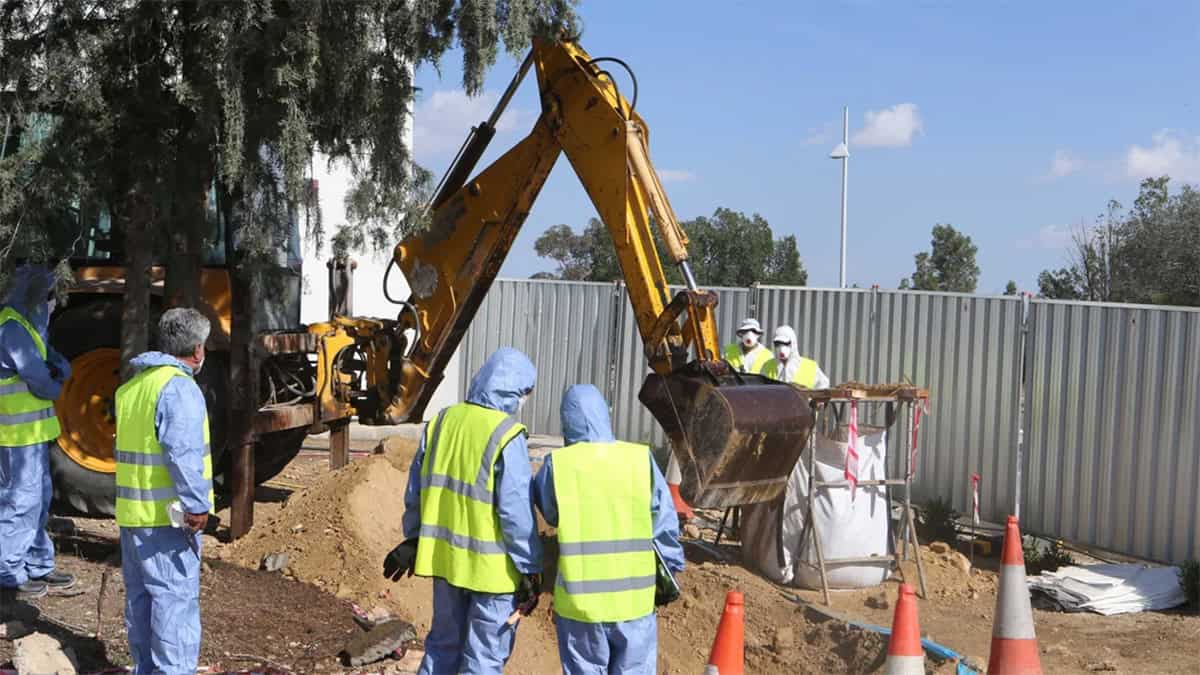
An archaeologist who worked on the 2017 exhumations at Athalassa Hospital has described finding human remains still wrapped in hospital blankets and sheets, along with medicine ampoules, shattered glass and fire-blackened soil left by the 1974 Turkish air attack.
Michalis Iakovides gave the account to the Cyprus News Agency alongside former nurse Tassos Christodoulou, who was on duty when Turkish aircraft bombed the psychiatric hospital near Nicosia on July 20, 1974. Their testimony was published on August 3, two days before a memorial for the 33 people killed in the attack.
The victims included patients and hospital personnel. Three of the 31 patients were Turkish Cypriots.
A nearby National Guard camp was believed to have been the intended target. Iakovides said the bombardment continued from approximately 9 a.m. until 1:30 p.m., striking Wards 1 and 2, the parts of the hospital closest to the camp.
Buried inside the bomb crater
Iakovides said a 500-pound bomb destroyed Ward 1 and left a crater roughly half the size of the ward.
After the attack, staff searched the wreckage for survivors and recovered the dead. Christodoulou recalled that workers collected around 20 bodies and transported them by truck to the mortuary at the old Nicosia General Hospital. Doctors and nurses continued treating the wounded until about 5 p.m.
With no formal burial operation in place and the summer heat making further delay impossible, other bodies were wrapped in blankets and sheets and placed inside the crater.
Not all 33 victims were buried at the same site. Two bodies were returned to their families and buried in their home villages. Cemetery records later suggested that others were buried in Nicosia’s Greek cemetery under general designations rather than their names.
The crater remained identifiable because hospital employees remembered the improvised burial site. In May 1993, nurse Takis Agathokleous and former colleagues planted 11 cypress trees around the area to mark it.
Investigators opened a preliminary trench on August 3, 2017, and uncovered blankets and human remains that confirmed the witnesses’ accounts. The full excavation began on November 1 after precautions were arranged for asbestos and building debris. The recovery of skeletal remains ended on November 16.
The excavation recovered human remains from the crater. DNA testing later identified seven people: six Greek Cypriots and one Turkish Cypriot.
Evidence preserved for 43 years
At a depth of about 2.5 meters, Iakovides said the team found remains wrapped as witnesses had described.
He said some bore shards of glass embedded in them. Investigators also recovered up to 30 medicine ampoules marked Serenace, including one found in a victim’s folded hand.
A red nylon dress worn by one patient had also survived beneath the soil.
The team excavated to a depth of approximately four meters. Iakovides said it found fragments of the bomb, a blackened layer created by the fire and soil that still carried the smell of sulfur 43 years after the attack.
The search did not resolve every case. Investigators examined hospital, cemetery and government records and searched additional areas near the former wards, but the burial locations of several victims remained uncertain.
Iakovides said the long delay reflected the stigma attached to psychiatric illness, which left the victims largely overlooked for decades.
A monument bearing the victims’ names was unveiled near Nicosia General Hospital in February 2023. Relatives, health officials and state representatives gathered there on August 5 to mark 52 years since the bombing and remember victims whose remains were left unidentified or whose burial places remained unknown for decades.