
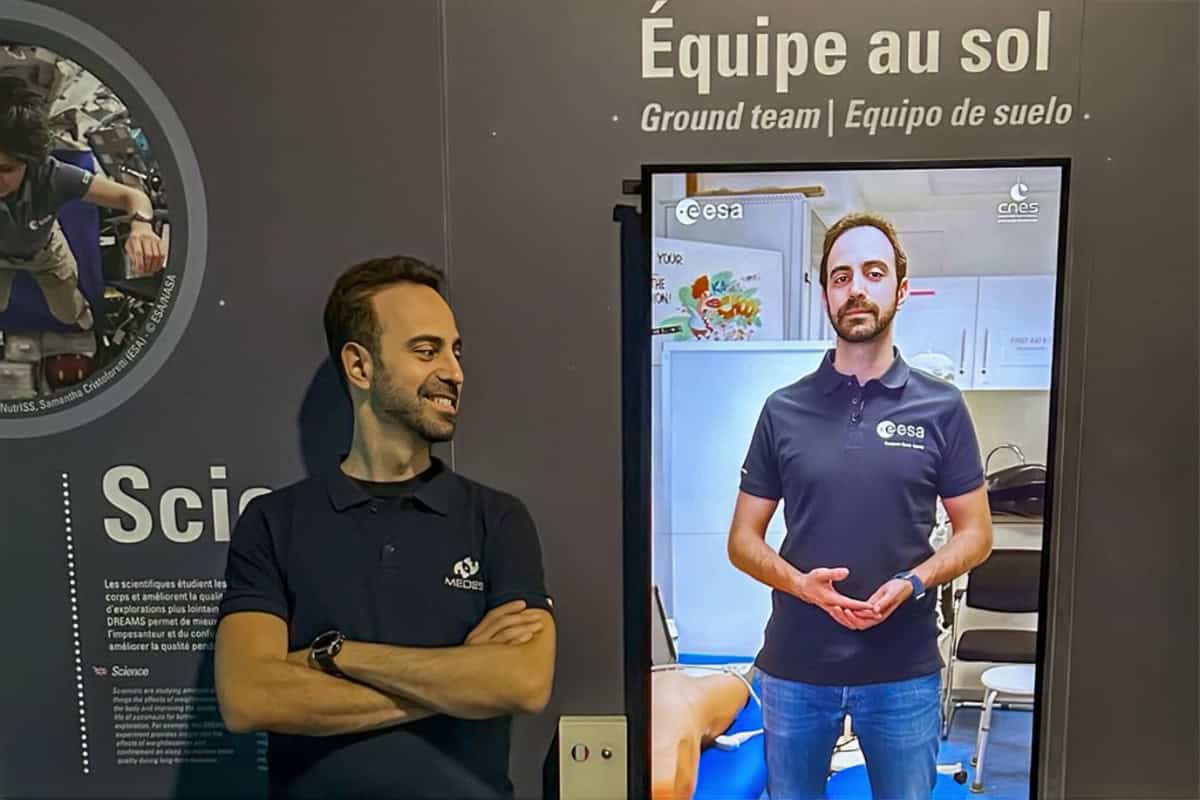
A Greek physician working inside Europe’s space program has taken a step that could eventually place a Greek astronaut in orbit.
Dr. Adrianos Golemis has entered the European Space Agency’s astronaut training pipeline at the European Astronaut Centre in Cologne, Germany, after emerging from a selection process that drew more than 22,000 applicants across Europe. His entry into the program places Greece closer than ever to seeing one of its own nationals fly on a future space mission, something that until recently remained largely outside the country’s role in international space efforts.
The ESA astronaut selection process is among the most competitive in the world. Tens of thousands of candidates typically apply during each recruitment cycle, but only a few dozen move forward into the agency’s training pipeline. Even then, candidates must complete years of basic and advanced training before they can be considered for assignment to missions aboard the International Space Station or other future projects.
Golemis is not entering the program as an outsider. A physician specializing in space medicine, he has already built his career within the European Space Agency, working on astronaut health and medical support for human spaceflight missions. His work focuses on the physiological challenges astronauts face during training and long-duration missions in space.
His name first drew wider attention in 2024, when it was widely reported that he had become the first Greek national to pass ESA’s astronaut selection tests and advance into the candidate pool. Entering the agency’s formal training program now places him on the same path followed by European astronauts who later fly on space missions.
Spaceflight, however, is not guaranteed. ESA’s training process can take several years, and only a portion of candidates eventually receive mission assignments. Still, Golemis’s progress means that Greece now has a credible presence within Europe’s astronaut corps.
His medical background could prove especially valuable as space agencies prepare for longer missions in orbit and beyond. Research into human physiology, health monitoring, and life-support systems is a central part of modern space exploration.
Golemis’s progress also comes at a moment when Greece is beginning to build a more visible role in space technology.
In recent years the country has launched a national effort to develop its own Earth-observation capability through the National Small Satellite Programme. The initiative aims to deploy a constellation of roughly 13 to 15 microsatellites designed to monitor climate conditions, natural disasters, agriculture, and maritime activity across Greece and the surrounding region.
Cosmos Philly reported last year that Greece is beginning to design and assemble its own satellites, marking a shift toward building long-term technical capacity inside the country.
The program has already moved from planning to deployment. In November 2025, five Greek microsatellites were launched from Vandenberg Space Force Base in California aboard a SpaceX rideshare mission. Two operational radar satellites and three experimental research satellites were placed into orbit, giving Greece its first dedicated Earth-observation capability.
Officials have described the system as providing the country with its own “eyes in space.” The satellites are expected to support wildfire monitoring, environmental tracking, and maritime surveillance across the eastern Mediterranean while strengthening civil protection and disaster response capabilities.
The constellation is expected to expand over the coming years, creating opportunities for Greek universities, research institutes, and technology companies working in geospatial data and environmental monitoring.
Seen in that broader context, Golemis’s progress reflects more than a personal achievement. It comes at a moment when Greece is beginning to participate more actively in Europe’s space ecosystem, from satellite infrastructure to human spaceflight.
If he successfully completes ESA’s training and is later assigned to a mission, Golemis would likely become the first Greek national to fly in space.
That milestone has not happened yet. But for the first time, the path is real.