
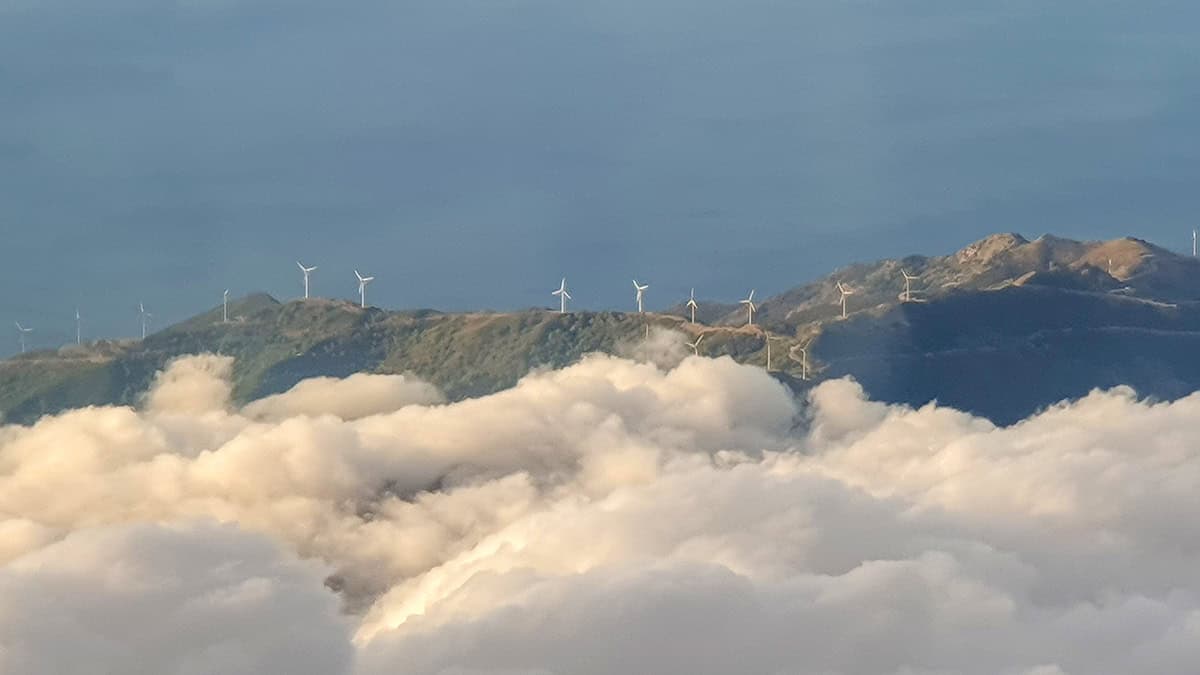
Greece has passed 6 gigawatts of wind power connected to the grid as the government reserves transmission capacity for the country’s first large-scale offshore projects.
Wind capacity reached 6,017 megawatts at the end of June, according to the Hellenic Wind Energy Association, ELETAEN. During the first six months of 2026, 65 new turbines with a combined capacity of 320.6 MW entered operation, raising the total by 5.6% from the end of last year. About 700 MW more was under construction at midyear, with most expected to begin operating within the following 18 months.
A decision published in the Government Gazette on July 2 reserved transmission capacity for future offshore projects.
The Ministry of Environment and Energy decision reserved 2,350 MW of grid capacity for offshore wind. The allocation includes 600 MW in the Thracian Sea, 250 MW off Crete, two allocations of 250 MW involving the Cyclades and the southern Evian Gulf, 500 MW in the southeastern Aegean around the Dodecanese, 300 MW in the northern Evian Gulf and 200 MW in the Gulf of Patras. The decision also identifies potential connection points to the high-voltage network.
The reservation does not mean 2.35 GW of new wind farms have been approved, nor does it guarantee that all of that capacity will be built. The same decision says offshore developments will remain subject to possible production curtailments and that the transmission system is not guaranteed to absorb their full output under every operating condition.
The amount reserved exceeds the 1.9 GW offshore wind target set in Greece’s revised National Energy and Climate Plan for 2030. That target is cited in a strategic environmental study for the national offshore wind program.
Greece has not yet built a commercial offshore wind sector. HEREMA, the state company responsible for managing exploration and development rights, presented a draft national program in 2023 identifying 25 potentially suitable areas covering 2,712 square kilometers. Together, those areas had an estimated minimum potential of 12.4 GW, far above what Greece plans to develop this decade. Most were considered suitable for floating turbines.
Floating technology is particularly relevant in Greek waters because many prospective sites are too deep for conventional foundations fixed directly to the seabed. Floating turbines are instead mounted on buoyant platforms secured by anchors and mooring lines, allowing them to operate farther offshore and in deeper water.
Much of northern Europe’s offshore wind development has taken place in shallower waters, where fixed-bottom turbines are easier to install. HEREMA’s draft program anticipated floating technology for most of the areas under consideration, including much of the roughly 4.9 GW identified as potential development during the program’s earlier phases.
Offshore turbines have also grown far larger than many of the machines already operating in Greece. Vestas’ V236, now being deployed in offshore projects internationally, is rated at 15 MW. Its rotor measures 236 meters across, with blades 115.5 meters long. Larger rotors capture wind across a greater area, while higher-output turbines can reduce the number of individual machines needed for a project of a given size.
There is no indication that the V236 has been selected for Greece. It simply illustrates the scale of turbines now available for offshore development.
Several regulatory stages still separate the offshore program from construction. HEREMA’s regulatory framework calls for approval of the National Offshore Wind Development Program and its strategic environmental assessment, designation of development areas, exploration and survey licenses, competitive tenders and final project permits before construction and grid connection.
The Thracian Sea is being treated separately as a pilot area with 600 MW of reserved grid capacity. Those projects now face additional uncertainty after the Athens Administrative Court of Appeal accepted a challenge by the Municipality of Samothrace involving licenses for two planned wind farms between Evros and Samothrace. The developers may pursue further legal remedies, and the ruling has not ended the broader offshore program.
HEREMA established a special-purpose company in late June to handle wind-measurement and seabed studies for the first development areas, while final approval of the national offshore wind program remains pending.
For now, Greece’s wind expansion remains concentrated on land, where connected capacity has passed 6 GW. The July decision sets aside transmission space offshore, but site selection, licensing, legal challenges, and competitive procedures must still be resolved before construction can begin.