
At seven in the morning on October 28, 1940, an Italian police officer knocked on the door of Stavros Malandrakis’s family home in Rhodes. Eighteen-year-old Stavros and his father, Christos, were ordered to report to the authorities within an hour.
Stavros asked whether they should bring extra clothing. The officer told them to come as they were.
Italian troops had begun invading Greece from Albania that morning. In the Italian-occupied Dodecanese, authorities were arresting men who held Greek nationality. More than 300 would be detained in Rhodes.
In Athens and Piraeus, Dodecanesians were asking to join the Greek Army and fight Italy, the country that claimed them as its own citizens.
The arrests in Rhodes
Italy had occupied the Dodecanese since 1912, with its sovereignty over the islands recognized under the 1923 Treaty of Lausanne. Most native Dodecanesians held a restricted form of Italian citizenship, known as piccola cittadinanza. Others, including the Malandrakis family, retained Greek nationality and lived on the islands under permits issued by the Italian authorities.
When war began, Cesare Maria De Vecchi, Italy’s governor of the Dodecanese, ordered the detention of Greek nationals.
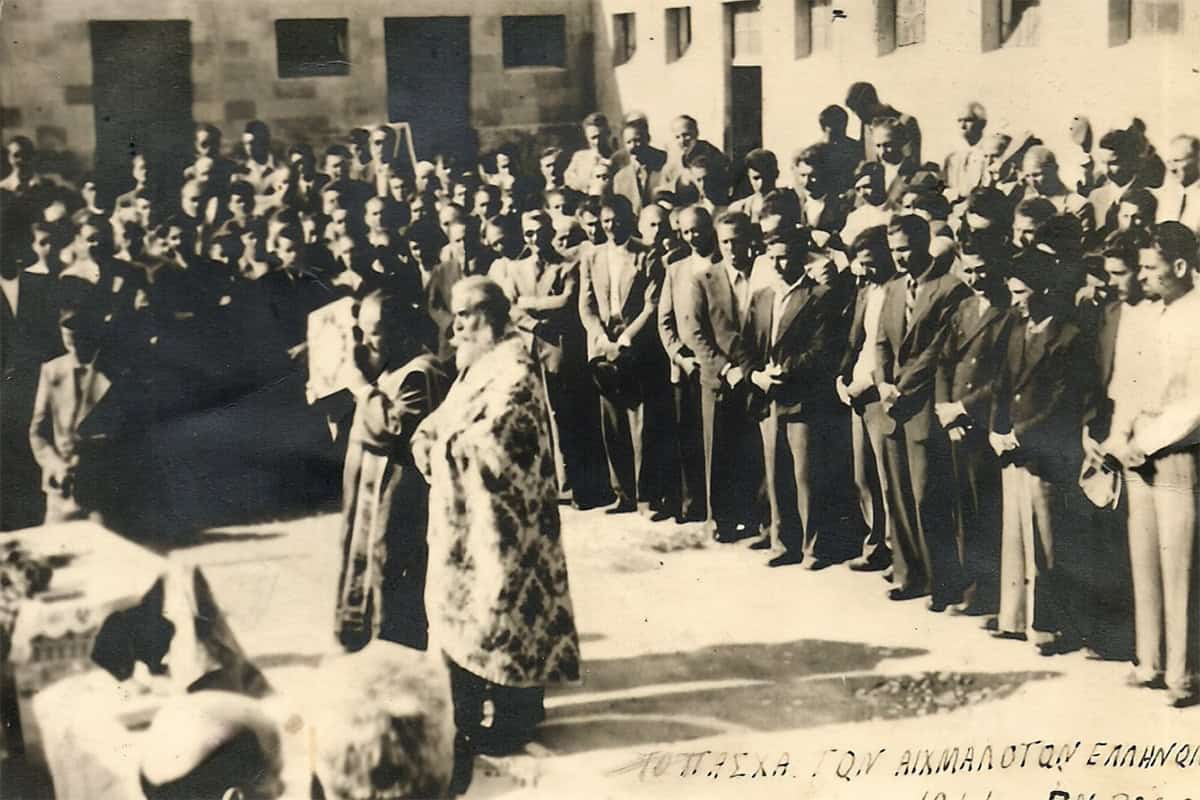
Italian carabinieri rounded up men from Rhodes and other islands, holding them in the moat surrounding the medieval Old Town of Rhodes. The camp became known as the Concentramento.
In an interview with journalist Rodoula Louloudaki, originally published by I Rodiaki, Stavros recalled the heavy rain that flooded the enclosure on the first night. Water reached the prisoners’ knees as they struggled to erect their tents in the mud.
Six or seven men crowded into tents intended for three or four. They slept fully clothed, without bedding. There were no proper toilets, and drinking water was scarce.
Stavros remembered approximately 330 prisoners, including elderly men and others brought from Kos, Karpathos, Kasos, Astypalaia, and Patmos.
His younger brother George had initially been spared because he was under 18. On January 1, 1941, when he reached that age, George was brought into the camp as well.
The prisoners chose Christos Malandrakis to represent them before the camp authorities. Food was scarce, and after repeated complaints, families were permitted to bring meals.
Women arrived with whatever they could spare from households already struggling with shortages. Many detainees from other islands had no relatives nearby. Christos arranged for those receiving food to share portions with the others.
Supporters outside the camp secretly listened to BBC broadcasts and found ways to pass the news to the prisoners.
Stavros recalled messages hidden inside stuffed vegetables delivered with the meals. A seamstress named Lousi devised another method, concealing a folded note inside a specially made button attached to her food bag. The prisoners broke the button open with a stone, read the message, and returned the bag for its next delivery.
By mid-December, complaints about the prisoners’ treatment had led to their transfer to a former stable complex. General Ettore Bastico had replaced De Vecchi as governor.
There, the detainees were allowed to carve wooden objects that their families could sell, including model boats and worry beads. George made beads from olive pits, rubbing them smooth and drilling a hole through each one.
Stavros later recalled being released toward the end of May 1941, as the Battle of Crete was ending. Other published accounts place the prisoners’ release earlier.
Dodecanesians volunteer for the Greek Army
In Athens and Piraeus, Dodecanesian youths organized demonstrations demanding permission to enlist.
Many were legally classified as Italian nationals and therefore were not eligible for ordinary Greek military service. The Greek authorities initially turned them away.
Their decision also carried a serious risk. Under Article 242 of Italy’s Penal Code, an Italian citizen who voluntarily served in the armed forces of an enemy country could face life imprisonment. A harsher penalty applied to those holding senior command positions.
Dodecanesian organizations continued pressing the Greek government. A committee representing the islanders approached Prime Minister Ioannis Metaxas and requested permission to form a volunteer regiment.
The government eventually agreed. On November 13, 1940, Greek General Headquarters issued Order No. 10234 establishing the Dodecanese Volunteer Regiment, or Syntagma Ethelonton Dodekanision, as recorded in the Hellenic Parliament Foundation’s wartime chronology.
Enlistment opened at Goudi on November 20. Relatives accompanied the volunteers, some carrying traditional island instruments and singing local songs as the men arrived.
The normal age range was 20 to 45, although older Dodecanesians also sought permission to serve.
By the end of December, 1,924 had presented themselves. Of these, 1,665 passed the initial selection process. After further departures because of age or illness, the Dodecanesian contingent numbered 1,586.
The largest groups came from Kalymnos, Karpathos, and Symi. Others arrived from Rhodes, Kos, Leros, and the smaller islands.
The Army supplemented its ranks with Dodecanesians who already held Greek nationality, as well as reservists and conscripts from Samos, Chios, Lesbos, and the Cyclades.
Reserve Captain Markos Kladakis, from Symi, organized much of the initial training and later commanded the First Battalion. Lieutenant Colonel Ioannis Nikolaou took command of the regiment.
Equipment and experienced officers were in short supply. Some companies were placed under the command of second-year cadets from the Military Academy who had yet to complete their own training.
The volunteers took their military oath and received their battle flag in January 1941.
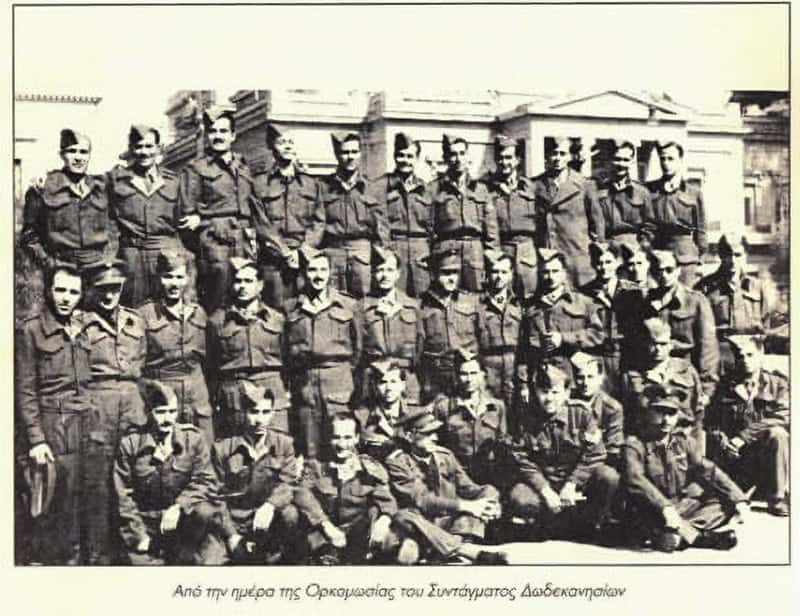
Among them was Ioannis Angelidis, a student from Symi serving as a noncommissioned officer. In a letter preserved in the Hellenic Army’s history of the regiment, he wrote of leaving his life in the city behind in the hope of winning freedom for his island homeland.
From Athens to the Macedonian front
The Greek Army had no immediate plans for an offensive against the Dodecanese, where Italian naval and air forces maintained strong positions.
The regiment joined the newly formed 20th Infantry Division.
On February 21, 1941, its men left Athens for northern Greece. The division had initially been intended to reinforce Greek troops fighting Italy in Albania, but preparations for a possible German invasion changed its assignment.
From March 9, the volunteers occupied defensive positions near Kelli in western Macedonia.
Germany invaded Greece on April 6. The Dodecanese Regiment fought German forces on April 10 and 11, withdrawing the following day as the Greek defensive line came under increasing pressure.
The retreat continued south. On April 22, the regiment surrendered its weapons near Ioannina, and four days later it was dissolved at Malakasi.
Although the Dodecanesians had enlisted after Italy invaded Greece, their regiment’s combat operations were against German troops.
Military service continued for some former volunteers who escaped to the Middle East and joined Greek forces fighting alongside the Allies, including the Sacred Band.
A Malandrakis brother returns to Rhodes
Andreas Malandrakis, Stavros’s youngest brother, was too young to join the Dodecanese Regiment in 1940. He would eventually serve in the Sacred Band by a different route.
Andreas had remained at home when Italian police detained his father and older brothers. In a separate interview with I Rodiaki, reproduced by Militaire.gr in 2016, he recalled being arrested and beaten by men working for the occupation authorities. The injuries, he said, left him bedridden for about two weeks.
Convinced he would be arrested again, he decided to escape.
He needed money to pay for a boat passage to Turkey. His father’s grocery shop had been closed during the detention, so Andreas broke its lock, took a box of preserved fish, and sold it to pay the fare.
Seven people gathered for the crossing. They walked toward the beach at Soroni, following a guide through an area where mines had been laid. A small boat was hidden beneath branches near the shore.
Their intended destination was Turkey, but Andreas recalled that a British patrol vessel intercepted them. He eventually reached Egypt, where he joined the Greek Sacred Band under Christodoulos Tsigantes and trained as a radio operator.
The unit carried out operations in the Aegean during the final years of the war.
On May 8, 1945, German forces in the Dodecanese surrendered to the Allies at Symi. Andreas was there, assigned to guard fuel supplies near the waterfront rather than attend the surrender ceremony.
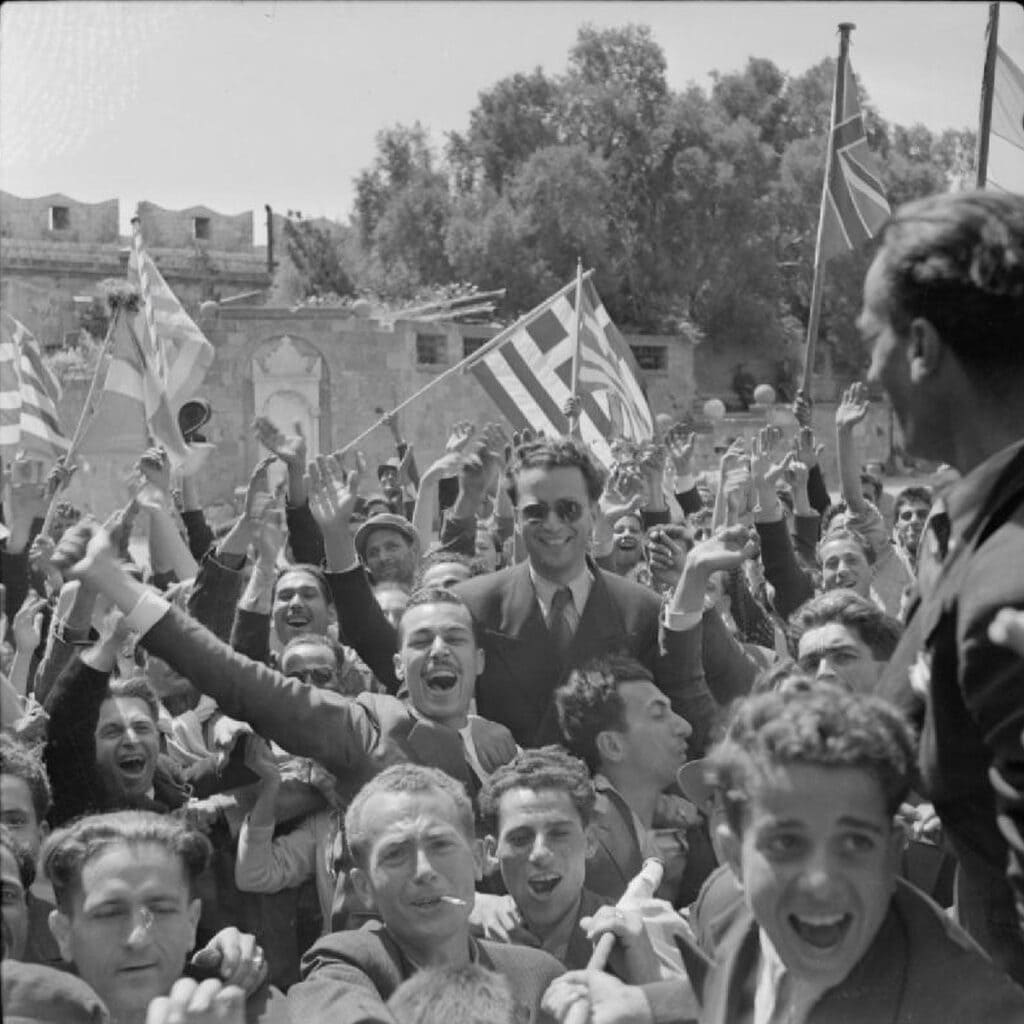
The islands subsequently came under British administration. Their formal union with Greece would follow in 1948.
Andreas later recalled returning to Rhodes with six companions. At Mandraki harbor, crowds had gathered to welcome the men home.
He remembered the flags, the singing, and the voices filling the waterfront.