
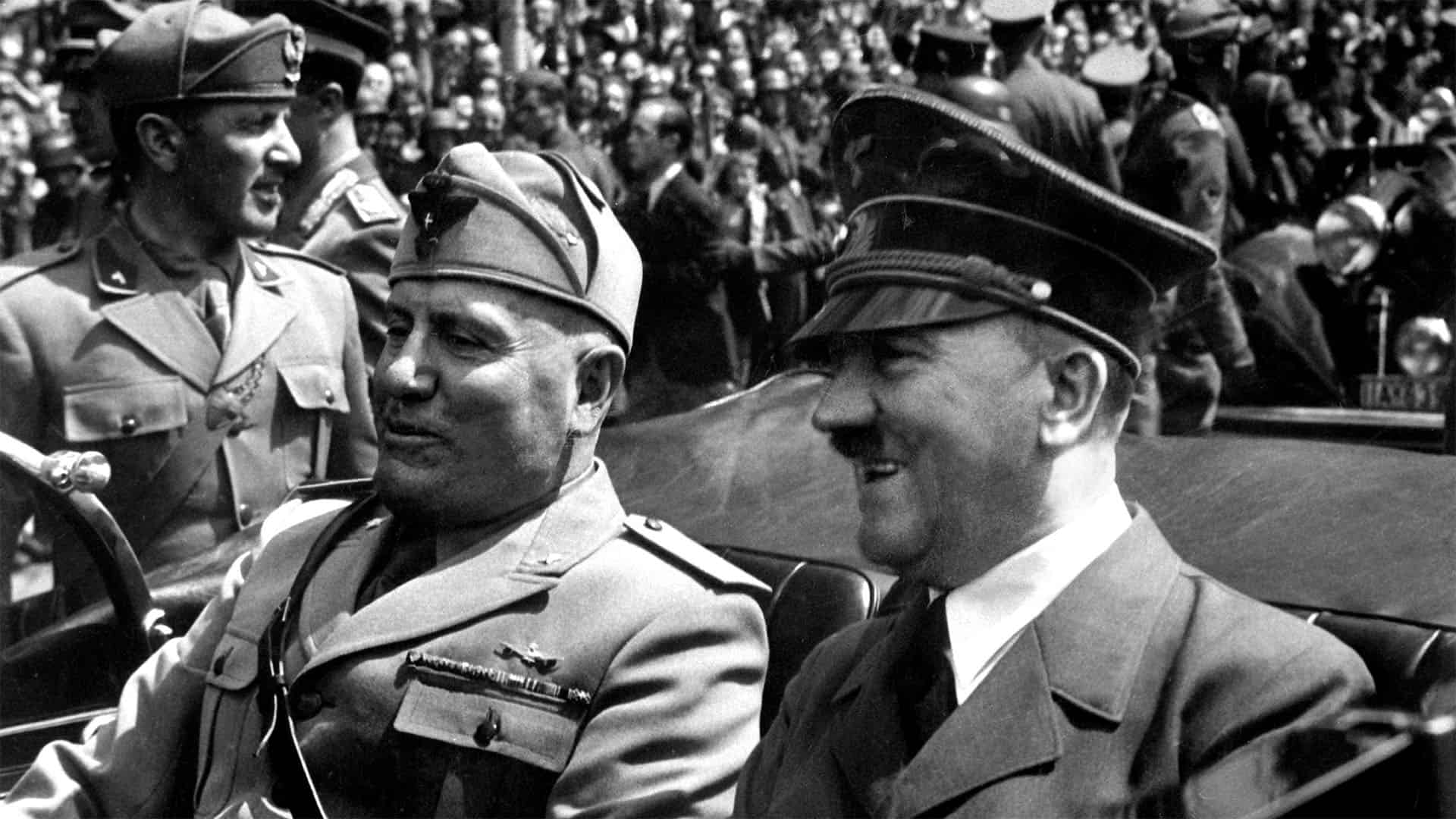
Every October 28, Greek Americans in Philadelphia and across the country commemorate Greece’s refusal of an Italian ultimatum in 1940. Two weeks before that historic “OXI,” Benito Mussolini was preparing to invade, despite warnings from his own military advisers that Italy lacked the forces and time to conquer Greece.
Mussolini expected a short campaign that would strengthen Italy’s position in the Mediterranean and demonstrate its independence from Nazi Germany. His confidence rested on assurances of weak Greek resistance, promises of political support, and an army already struggling to move troops and equipment through Albania.
A rivalry within the Axis
Mussolini had considered military action against Greece well before October 1940. Italy’s occupation of Albania in April 1939 had given him a base from which to threaten Greece’s northwestern frontier. Control of Greek territory and islands also promised strategic advantages against Britain in the Mediterranean.
In October 1940, German troops began arriving in Romania, whose oil fields were vital to the German war effort. Mussolini resented Adolf Hitler’s decision to proceed without properly consulting him.
Italian Foreign Minister Galeazzo Ciano, Mussolini’s son-in-law, recorded the dictator’s anger in his diary entry for October 12. Hitler repeatedly presented him with decisions already made. This time, Mussolini intended to respond in kind. Hitler would learn from the newspapers that Italy had occupied Greece.
Italy’s ambitions in the Balkans predated the dispute over Romania, and Ciano had long favored an attack on Greece. On October 14, Mussolini fixed October 26 as the invasion date. The following morning, he summoned his senior military and political advisers to Palazzo Venezia in Rome.
The warnings at Palazzo Venezia
Around the table were Ciano, Marshal Pietro Badoglio, Generals Ubaldo Soddu and Mario Roatta, and the two senior Italian officials in Albania: Francesco Jacomoni, the king’s lieutenant-general, and General Sebastiano Visconti Prasca, commander of Italian forces there.
The heads of the navy and air force were not invited.
Mussolini outlined objectives extending well beyond the Greek-Albanian frontier. Italy intended to occupy the Ionian Islands and nearby Greek coast, capture Thessaloniki, and eventually occupy all of Greece, bringing it into Italy’s political and economic sphere.
Visconti Prasca expressed confidence in the offensive against Epirus. He estimated that approximately 70,000 Italian soldiers faced 30,000 Greeks in the sector and dismissed the willingness of Greek troops to fight. Historians have since questioned his assessment of the balance of forces.
Badoglio estimated that occupying Greece would require approximately 20 divisions. Only nine were stationed in Albania, including a cavalry division, and assembling the additional forces would take about three months.
Roatta drew attention to the mountainous terrain and difficult roads. Badoglio nevertheless accepted the proposed initial operation in Epirus, and Mussolini maintained his timetable.
The minutes of the October 15 meeting, approved by Mussolini the following day, preserve the discussion.
Badoglio returned to his objections on October 17. During a visit to Ciano, he warned that the available forces were insufficient. He said the chiefs of the three armed services opposed the invasion and that the navy doubted its ability to support a landing near Preveza. Ciano urged him to raise these concerns directly with Mussolini.
The next morning, Ciano learned from Soddu that Badoglio had threatened to resign rather than accept responsibility for the operation. Mussolini reacted angrily when Ciano told him, declaring that he would go to Greece himself to witness the shame of Italians afraid of Greeks.
Yet Badoglio neither resigned nor repeated his earlier objections when he met Mussolini later that morning. He requested a postponement of at least two days, and the invasion date moved from October 26 to October 28.
Visconti Prasca had reasons of his own for resisting a larger force. In The Hollow Legions, historian Mario Cervi cites correspondence showing that the general feared the arrival of more senior commanders could cost him his position. In a handwritten letter dated October 25, Mussolini assured him that he had opposed attempts to replace him.
Demobilization before an invasion
On October 2, Mussolini had approved a partial demobilization of the army stationed in Italy. Of approximately 1.1 million soldiers serving at home, 600,000 were scheduled for release beginning October 10.
Agriculture needed workers, civilian production was under strain, and Italy’s armed forces were consuming resources the country could scarcely afford.
In Mussolini Unleashed, 1939–1941, historian MacGregor Knox explains that the decision disrupted the army’s organization because men were released according to age rather than by complete military units. Divisions lost trained personnel, while command structures were reduced or disbanded.
Reinforcing the troops in Albania presented another problem. Durrës (Dyrrachio in Greek) was the principal port for unloading military vehicles. Vlorë (Avlona in Greek) offered additional capacity, but both harbors had limitations. The roads toward the Greek frontier were poorly suited to moving large formations and heavy equipment.
Knox identifies port capacity as the principal obstacle to reinforcing the invasion force on time.
On October 19, Roatta informed Visconti Prasca that a motorized division requested for the campaign would probably not finish unloading in Albania before mid-November, more than two weeks after the planned invasion.
Political promises and manufactured pretexts
Jacomoni assured the October 15 meeting that enthusiasm for the campaign was widespread in Albania. Ciano claimed ordinary Greeks were largely indifferent to the prospect of invasion and that resistance came mainly from a small, wealthy, pro-British ruling class.
Italy’s ambassador in Athens, Emanuele Grazzi, had sent very different reports, warning that Greece would fight.
Even Jacomoni acknowledged that more recent intelligence suggested the Greeks were increasingly determined to resist. He still believed that a rapid, overwhelming offensive could succeed.
Rome hoped Bulgaria might enter the war to pursue its territorial ambitions in Greek Macedonia and Thrace, but King Boris III declined. Italy also anticipated assistance from Albanian irregulars and elements of the Albanian-speaking Cham Muslim population in northwestern Greece. Some Chams accompanied the invading forces, although the broader support Rome expected did not materialize.
Italian newspapers had spent much of the summer accusing Greece of mistreating Albanians. The campaign intensified after the killing of Daut Hoxha, an Albanian whose death Italian propaganda blamed on Athens. The circumstances remained disputed, and the Greek government denied responsibility.
Italy had also considered manufacturing an incident along the border.
In an August memorandum discussed by Cervi, Jacomoni described efforts to obtain Greek military rifles and foreign-made explosives. These could be used to stage an attack on an Italian frontier post.
The proposal resurfaced at Palazzo Venezia on October 15.
Mussolini asked how Italy could make its intervention appear necessary. Jacomoni proposed disturbances along the Greek-Albanian frontier involving the Chams and Greek authorities.
Visconti Prasca went further. He said French weapons and bombs had already been prepared for a staged attack.
Ciano asked when the incident should take place.
Mussolini selected October 24.
Ciano replied that the incident would occur on that date.
The meeting minutes establish that Italian officials discussed the proposed provocation, although they do not establish that it was carried out.
The Elli and the silence in Athens
On August 15, 1940, the feast of the Dormition of the Virgin Mary, the Greek light cruiser Elli lay anchored off Tinos, where thousands of pilgrims had gathered for the religious celebrations.
The Italian submarine Delfino had sailed from the naval base at Leros on the evening of August 14, under orders issued through Cesare Maria De Vecchi, Italy’s governor of the Dodecanese. The following morning, it approached Tinos and fired three torpedoes. One struck the cruiser, sinking it. The other two missed their targets and exploded near the quay. Nine Greek sailors lost their lives, and others were wounded.
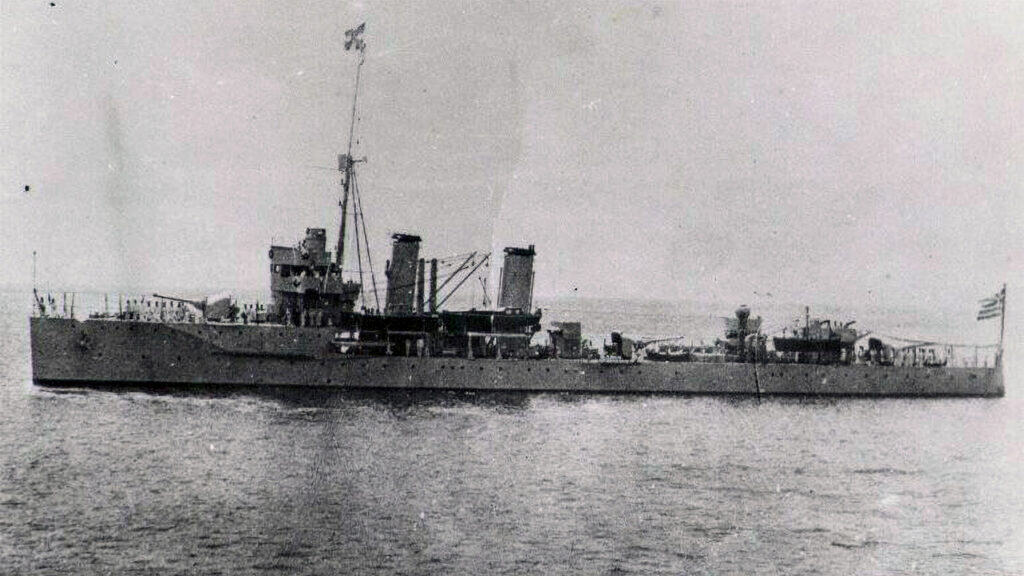
Prime Minister Ioannis Metaxas chose not to make the evidence public. His government officially attributed the attack to a submarine of unknown nationality, hoping to avoid an immediate confrontation with Italy.
Greece was governed by the authoritarian August 4 regime, which maintained strict censorship. The government’s control over public information also served its diplomatic efforts to prevent war.
An American diplomatic dispatch dated August 16 described Greek newspapers reporting the sinking without identifying the attacking submarine. It also noted mounting Italian pressure, Athens’ determination to maintain its relationship with Britain, and the call-up of approximately 100,000 reservists for what were officially described as autumn military exercises beginning September 1.
The Greek army was also preparing its defenses. A plan dated September 16, described by Cervi, established two defensive lines across Epirus and western Macedonia, including positions around Kalpaki and the Pindus Mountains.
Three in the morning at Kifisia
At 3 a.m. on October 28, Metaxas was awakened by Dimitrios Travlos, the guard outside his residence in Kifisia, north of Athens.
Italian Ambassador Emanuele Grazzi had arrived with an ultimatum.
Grazzi had been kept largely outside the discussions leading to the invasion. His reports warning that Greece would fight had received little attention in Rome.
The document demanded that Greece allow Italian troops to enter its territory and occupy unspecified strategic positions. The deadline was 6 a.m.
In his memoir Il principio della fine, published in 1945, Grazzi recalled Metaxas reading the document before looking up and answering in French:
“Alors, c’est la guerre.”
“Then it is war.”
Grazzi tried to persuade him that war was not inevitable if Greece accepted the Italian demands. Metaxas questioned how he could obtain the king’s approval and issue the necessary military orders within three hours.
He then asked which strategic positions Italy intended to occupy. Grazzi admitted that he did not know.
A U.S. diplomatic telegram sent from Athens on October 28 corroborates this detail. American Minister Lincoln MacVeagh reported the exchange after receiving an account from British Ambassador Michael Palairet, whom Metaxas had called in for consultation.
Metaxas’s own diary is more concise. In the published transcription of his October 28 entry, he noted being awakened by Travlos and Grazzi’s arrival, followed by a single word: “Πόλεμος!” (War!).
He informed King George II, telephoned Palairet to request British assistance, and attended a cabinet meeting at 5 a.m. The government moved to mobilize the country.
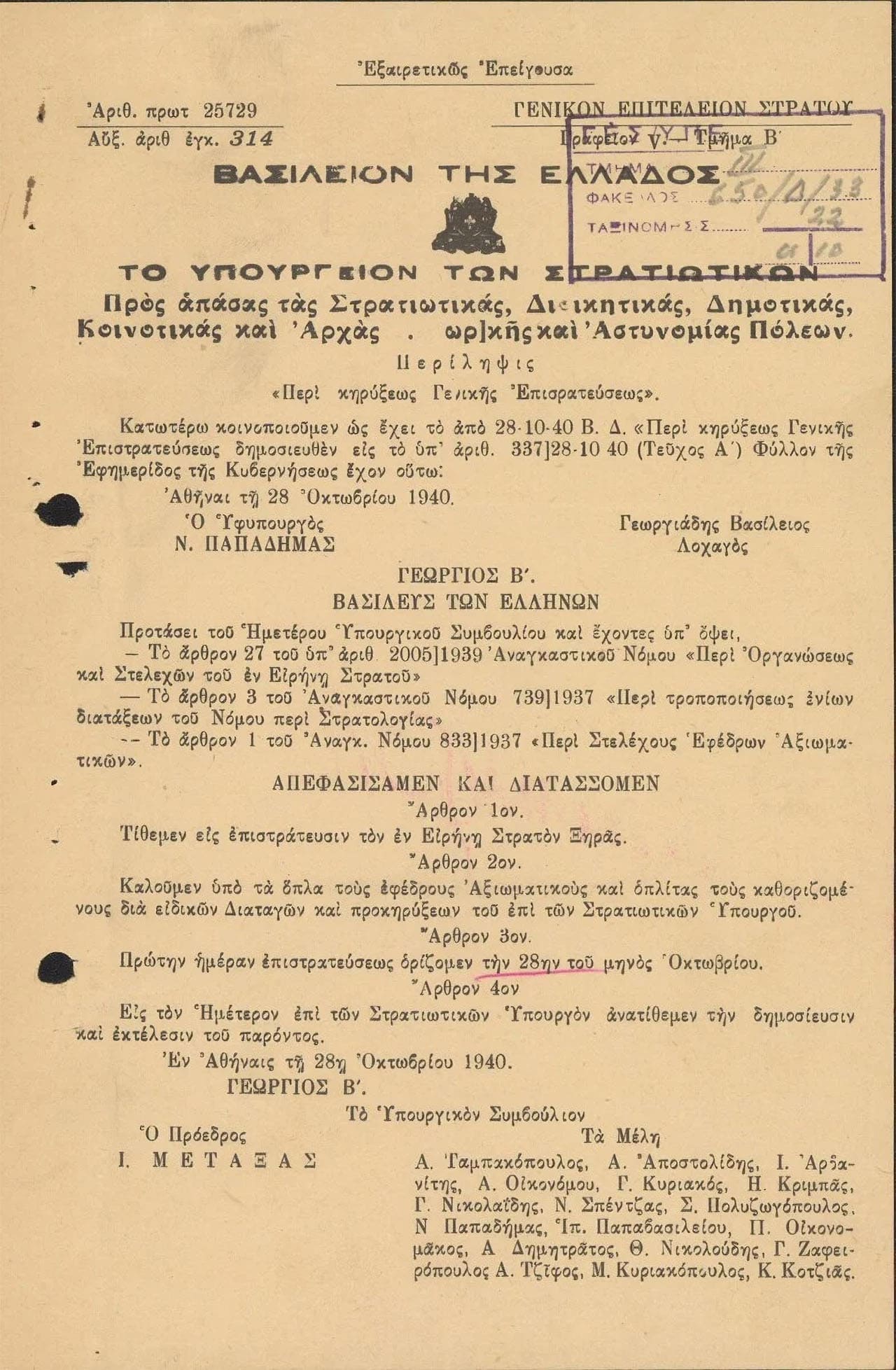
The word “OXI” was the popular expression of Greece’s refusal rather than the literal phrase spoken to Grazzi. It soon appeared in newspapers and spread through the streets as Greeks prepared for war.
Greek military accounts place the beginning of the Italian advance at 5:30 a.m., half an hour before the ultimatum expired.
Later that morning, Mussolini met Hitler in Florence. He greeted the German leader with the announcement: “Führer, we are on the march!”
The Italian offensive soon encountered determined Greek resistance. By mid-November, Greek forces had launched a counteroffensive that would carry them into Albania.
At Kifisia, that outcome was still unknown. Greece had endured months of Italian threats and provocations, concealed the evidence of the attack on the Elli, and prepared its defenses while trying to avoid war.
Mussolini had made his decision in Rome. Greece’s answer was no.