
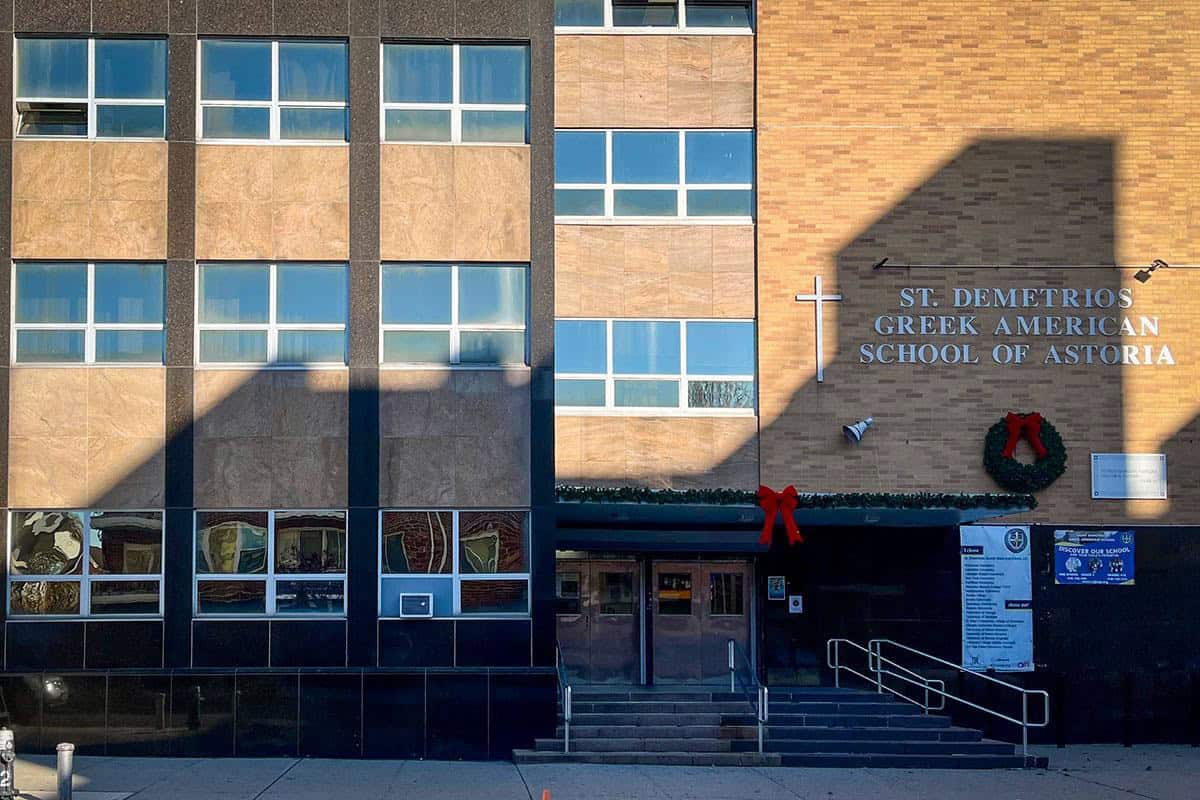
At St. Demetrios Astoria, the argument is no longer only over how to cover a school deficit.
The community is carrying a shrinking enrollment base, a seven-figure school gap, debt, expensive buildings, disputed leadership changes, and an unresolved question over who gets to shape the future of one of Greek America’s best-known institutions.
This analysis draws on three accounts that do not agree: the assembly report in Anamniseis, the official narrative in the Orthodox Observer, the Archdiocese’s own publication, and the more critical reporting of the National Herald.
At the annual general assembly on June 23, the latest numbers were stark. According to Anamniseis, enrollment in the day and afternoon schools has fallen from 509 students four years ago to 373 in the school year that just ended. Kostas Soukeras, president of the school committee, said the school’s deficit is about $1 million and called the situation unsustainable.
He also said the school is using tuition revenue from the new school year to cover the deficit from the previous one.
That line should alarm anyone who cares about St. Demetrios. A one-year shortfall can sometimes be bridged. A donor steps in. A festival overperforms. A loan is extended. But using next year’s tuition to pay last year’s bills means the school is already spending part of its future to keep the present operating.
The enrollment decline explains part of the strain. A drop of 136 students over four years is roughly a quarter of the student body. Payroll, insurance, utilities, maintenance, administration, and core academic staffing do not shrink in neat proportion when fewer children enroll. Revenue falls first. Expenses follow slowly, if they can follow at all.
At 373 students, a $1 million gap equals about $2,680 in uncovered cost per student. That does not mean families should simply be asked to pay more. It shows how much the current model depends on something beyond tuition: more students, recurring giving, expense control, better use of property, or all of them together.
The dispute soon moved beyond the school budget.
In October 2025, the Greek Orthodox Archdiocese of America stepped in publicly. In an Orthodox Observer report, Archdiocesan officials described St. Demetrios as a community struggling to meet payroll and basic expenses, with accumulated debt, structural school deficits, and an ambitious building project that had not produced the expected financial return.
To provide liquidity, the Archdiocese agreed to purchase a minority share in a parish-owned building while St. Demetrios retained majority ownership. It advanced $700,000 against a $3 million purchase price and guaranteed a $1 million line of credit that had already been fully drawn. In return, the Archdiocese sought financial oversight, described by officials as accountability rather than control.
The Archdiocese has continued to signal that the school remains central to its concern, attending the spring commencement and dedicating a new media production lab funded through a technology grant from the Greek Orthodox Archdiocese of America and the Archbishop Iakovos Leadership 100 Fund.
That is the official account. The public dispute around St. Demetrios tells a rougher story.
Reporting by the National Herald has described parish-council removals, protests, property concerns, and resistance among some parishioners to the Archdiocese’s handling of the crisis. The Archdiocese described the council changes as the removal of “a minority” of members to make room for new members who supported the path forward; the paper has reported the number at seven, including former president Kelly Manetas.
Cosmos Philly reported earlier this year that the Astoria dispute had already moved beyond school finances, drawing in questions over parish authority, property decisions, the removal of council members, and the Archdiocese’s expanding role in transactions involving church assets. That report described the October protest outside the Cathedral, where signs reading “Hands Off St. Demetrios” and “Save the School” captured the fear among some parishioners that financial stabilization could become something broader.
A school deficit can be explained with numbers. A governance crisis has to be understood through confidence, authority, memory, and ownership.
A few days after the October briefing, the Archdiocese and St. Demetrios approved a financial oversight agreement. The official account said day-to-day operations would remain with the parish council and school, and that no sale of assets was part of the arrangement.
That assurance remains important, but it no longer closes the question. The Archdiocese’s own earlier description of the deal had already preserved a path to a sale. In its September 2024 announcement, carried by the Orthodox Observer and Orthodox Times, the Archdiocese said the community would keep the right to repurchase the transferred interest at market value and could own the building outright or sell it entirely in the future. A future sale, in other words, was contemplated in the deal’s own terms, which is part of why the later “no sale of assets” language did not fully settle the question.
In April 2026, the National Herald reported a later and larger figure: a $1.25 million Alma Bank line of credit, guaranteed by the Archdiocese, that had been extended after the community could not meet the original deadline. The same report said an LLC had been established to take over the St. Demetrios building and its management, a structure the paper said could open the way to a sale.
The National Herald did not name the entity, and no other outlet has reported it. The NYC Property Information Portal record for the parcel still lists the parish as owner of the building at 30-67 31st Street, which carries a $4.2 million Alma Bank mortgage recorded in 2022, with the Archdiocese acquiring its 39 percent interest. Any transfer into a new entity does not yet appear on the deed. Until public records confirm the LLC’s name, ownership, and purpose, the claim rests on the National Herald’s reporting alone.
That does not make the question go away. If such an entity has been created, parishioners deserve to know its name, who controls it, what it would hold, and whether any future sale, refinancing, lease, or transfer of the building is being considered.
Those property questions also sit inside a changed legal environment. The National Herald reported that the Archdiocese had sought changes in New York law so Greek Orthodox communities could proceed with certain property transactions without the same Attorney General approval process, and that State Senator Michael Gianaris played a leading role in that effort. Critics in Astoria argued that the change removed an outside layer of scrutiny over parish assets. Supporters have described such changes as a way to streamline church-property transactions.
Court approval remains required, but the previous notice step involving the Attorney General is no longer part of the process. Supporters say the change aligns Greek Orthodox parishes with other hierarchical churches. Critics say it removes an outside layer of scrutiny and concentrates authority inside the institution.
The building issue has been sensitive from the beginning. Archdiocese officials said last fall that the project cost about $7.2 million after fundraising fell short, with loans and reserves used to complete it. Elaine Allen, treasurer of the Archdiocesan Council, argued that even a sale at $7.5 million to $8 million would leave less than $2 million after debts and taxes, temporary relief, in her view, not a cure for the school’s structural deficit.
Those cautions did not settle the matter. At the June general assembly, Allen said a court had approved the Archdiocese’s acquisition of 39 percent of the new building and that the community expected to receive the remaining balance of the $3 million agreement in the coming weeks, according to Anamniseis. She also said refinancing efforts were moving ahead, and that converting the construction loan into a mortgage, together with an extension of the tax abatement, would save the community money.
Those steps may ease pressure. They do not settle whether St. Demetrios is simply stabilizing its finances or slowly changing the control and use of its assets.
Former community president Kelly Manetas raised the possibility of selling the new building at the June assembly, asking that the parish council be authorized to examine the issue and bring it back to the next meeting. The proposal was not discussed before the meeting ended. The community still needs to know what is on the table and what is not.
The property burden is broader than one building. At the June assembly, Ionas Melitis discussed problems across the community’s facilities. St. Demetrios owns five buildings, and a recent study placed maintenance or renovation needs at about $2 million. The school deficit, building debt, refinancing, and deferred maintenance are pieces of the same balance sheet.
The current crisis also comes with a longer record of damaged confidence. Reporting by the National Herald has described earlier leadership upheaval and liquidity concerns, including parish-council changes in 2023. It has also been reported that deficits had improved before the latest crisis became public and that previously unpaid bills from an earlier period were later discovered.
The role of Nikos Andriotis belongs in that history. In an October 2025 interview, Archbishop Elpidophoros linked the community’s difficulty to the void left after the death of Andriotis, a major benefactor who had helped cover deficits for years. The Archbishop said the parish continued operating as if the old facts had not changed.
That observation helps explain why the crisis feels so sharp now. For years, a major benefactor can hide weaknesses that would otherwise force hard decisions. Once that support is gone, the institution has to rely on budgets, fundraising, enrollment strategy, donor confidence, and regular reporting.
The missed Stavros Niarchos Foundation opportunity adds another layer. St. Demetrios had once been in line for a major proposal from SNF, reportedly valued at $25 million, that was rejected by parish leadership years earlier. Archbishop Elpidophoros has since called that rejection a mistake and said in his October interview that he had reopened discussions with the foundation. Cosmos Philly previously reported, citing the National Herald, that the paper contacted SNF’s co-president about claims of renewed outreach and was told he was unaware of any such effort.
Reporting by the National Herald has also described a $200,000 parish settlement, including legal fees, in a lawsuit by a former school principal over discriminatory remarks and comments by church and school officials. According to that reporting, insurance covered $100,000, and the community paid the other $100,000 directly.
Taken together, those episodes explain why many parishioners do not hear the word “oversight” as neutral. For them, the issue is not only whether St. Demetrios had financial trouble. It is who knew what, when they knew it, who is being blamed, and whether the same level of scrutiny is being applied to every period of management.
St. Demetrios still has strengths many schools would envy. The school describes itself as the only Greek-American school in the United States serving students from preschool through high school. Its mission is rooted in Orthodox Christian faith, Greek language and history, Hellenic values, and a college-preparatory curriculum.
It also highlights small class sizes, Greek proficiency, individualized college preparation, a dual-enrollment partnership with St. John’s University, early college opportunities, and the possibility for seniors to graduate with up to 40 college credits.
Its history page says the day school opened in September 1956 with 267 children and later grew to more than 600 Greek-American students. The high school opened on May 9, 1982.
That history gives the school standing. It does not give it immunity.
Astoria is no longer the same neighborhood that built St. Demetrios into a flagship of Greek-American education. Families are more dispersed. Greek identity is often more chosen than inherited. Parents may still value faith, language, and heritage, but they also compare tuition, commute, safety, college placement, facilities, public schools, charter schools, Catholic schools, and specialized high schools.
The old appeal was simple: support the school because it belongs to the community. The new appeal has to be clearer: choose the school because it gives children an education, a formation, and a cultural grounding they cannot easily get elsewhere.
At the June assembly, Soukeras pointed to student performance in state exams, Greek-language exams, college admissions, and scholarships. He said the 35 graduates received more than $2 million in university scholarships.
He also noted a hopeful sign: the eighth grade, already the school’s largest class with 25 students, had full retention for the next school year. That detail complicates the easy assumption that families are simply leaving after middle school. It suggests that when parents see a reason to stay, some still do.
There is also an unresolved enrollment question. Anamniseis recorded the fall to 373, but the school and parish should clarify exactly what that count includes: preschool or nursery students, the day school, the high school, afternoon programs, or other grade divisions. Before any final judgment is made, St. Demetrios should release grade-by-grade enrollment for the last five years, with each program counted separately.
The preliminary recommendations from Alvarez & Marsal, as presented at the June assembly by Bishop Athenagoras of Nazianzos, focused on increasing enrollment and intensifying fundraising. Those are the right categories. They are not yet a plan.
Enrollment growth requires more than marketing. It requires knowing which grades are strong, which grades are weak, why families leave, why families stay, and what parents believe St. Demetrios offers that competing schools do not. Soukeras said a marketing coordinator has been hired and that the results are already visible. That is useful, but marketing can only do so much if the financial and governance questions remain unsettled.
Fundraising faces the same problem. The recent Greek festival brought in $40,000 more than the previous two years and was described as the most successful of the last three. That shows energy and organization. It does not close a $1 million school gap.
Alumni giving, major gifts, parish giving, and outside philanthropy require confidence. Donors want to know whether their support is stabilizing the school or vanishing into the next shortfall. Parents want to know whether tuition is paying for this year’s education or last year’s bills. Parishioners want to know whether the school, church, and buildings are being managed under one clear plan.
The Archdiocese has said as much. In October, Fr. Elias Villis said there was no active alumni database and that graduates would not give until they saw a serious system. That is the difference between emergency fundraising and institutional fundraising.
The audit presentation at the June assembly may help establish a common baseline. Thalia Christoforou and Pagona Marouli-Lallijee presented the 2025 audit findings and said the numbers matched those presented by Elaine Allen and Jenny Emexetzidis, according to Anamniseis. In a divided community, even that kind of basic confirmation matters.
But shared facts require access. TNH reported that Archbishop Elpidophoros retained a private investigator after details from a September 30 Archdiocesan Executive Committee meeting on St. Demetrios were leaked to the press. The article said the investigator asked members and attendees of the meeting for personal cell-phone records, including calls made through applications such as WhatsApp.
The Orthodox Observer account of the financial oversight agreement described strong approval for the stabilization plan, while the National Herald reported a more limited and contested process. Those differences show how the same episode can become two different public stories depending on who controls the room, the record, and the framing.
That is why the call for town hall meetings, which Anamniseis made after the June assembly, is not a courtesy. Parents, teachers, parishioners, alumni, and donors need a place to hear the same numbers at the same time: enrollment, debt, building ownership, and the Archdiocese’s role in governance. They need to ask questions before rumors harden into factions. Without that local buy-in, even a technically sound restructuring plan risks becoming another temporary fix.
The Archdiocese also has a responsibility to be precise. If no asset sale is planned, it should say whether that applies only to the oversight agreement or to all current property discussions, and if an LLC has been created, it should name the entity and explain its purpose. The school’s deficit, if it is the main threat, calls for a budget released in a format ordinary parishioners can understand. And where council members were removed, it should set out the standard it applied and how elected local representation is restored.
St. Demetrios is a school, a parish, a property holder, a cultural landmark, and a symbol of Greek Astoria. Its future will not be secured by liquidity alone, nostalgia, or one more emergency appeal.
The deficit is real. So is the distrust.
The school’s future will depend on whether the people responsible for it can show the numbers, answer the hard questions, and give families a reason to believe that St. Demetrios is not only worth saving but capable of being run in a way that keeps it alive.