
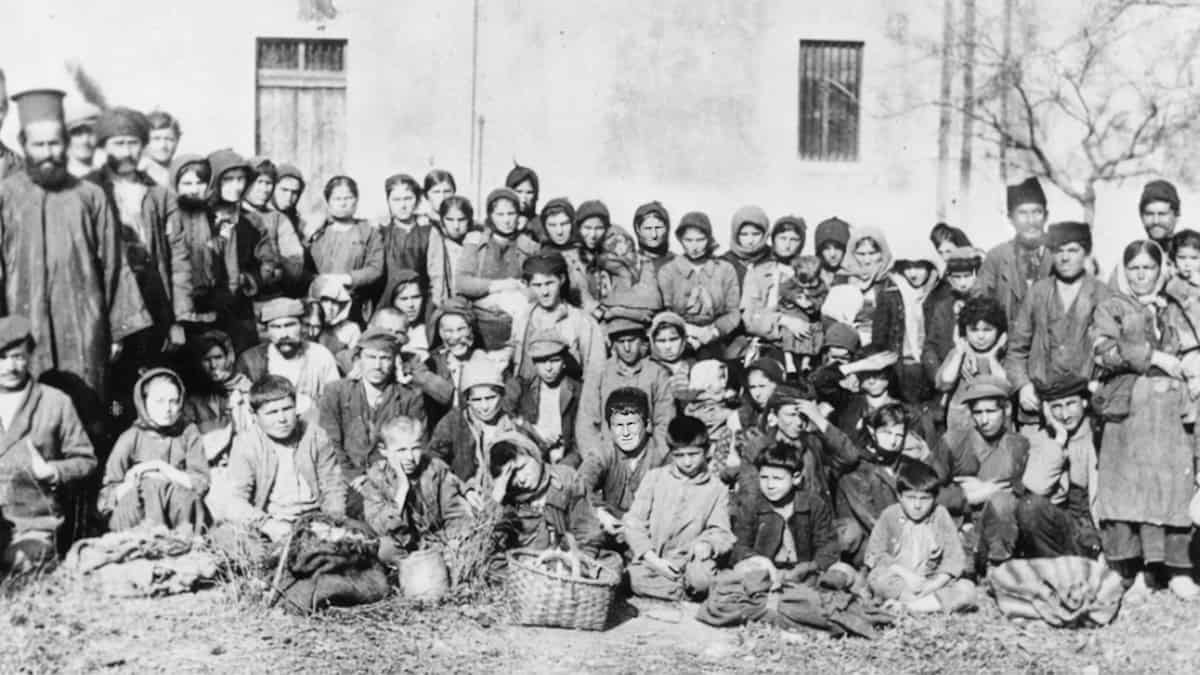
For Pontian Greeks, May 19 is not simply a day of remembrance. It is the date Greece has set aside to honor the victims of the Genocide of the Greeks of Pontus, and to remember a Black Sea homeland that was destroyed but never erased from memory.
The date is less familiar to many Greek Americans than March 25, Holy Week, or the parish festival calendar. But for Pontian families, it carries the weight of villages lost, families scattered, names changed, stories silenced, and a culture that survived through exile.
That is why May 19 is not just a date.
It honors the Greek Orthodox communities of Pontus, the historic region along the southern coast of the Black Sea. These communities had lived there for centuries, with their own villages, churches, monasteries, schools, music, dances, dialect, and ways of life. Pontus was not an idea. It was not only a region on an old map. For generations of Greeks, it was home.
And then, for hundreds of thousands, it was gone.
The Greek Parliament formally established May 19 as the day of remembrance in 1994. The date is tied to May 19, 1919, when Mustafa Kemal landed in Samsun, on the Black Sea coast. In Turkey’s official calendar, that date is remembered as the beginning of the Turkish War of Independence. For Pontian Greeks, it carries a very different meaning. It marks the beginning of the final and most devastating phase of persecution in Pontus.
The suffering of Pontian Greeks did not begin on that day. Violence, deportations, forced labor, dispossession, and persecution against Ottoman Greeks had already begun earlier, especially during the First World War. Men were sent into the Amele Taburları, the labor battalions where many died from exhaustion, hunger, disease, and abuse. Families were driven from their homes. Villages were emptied. People were forced into marches toward the Anatolian interior, often without food, shelter, or protection.
May 19 became the symbolic date because it stands at the door of the final chapter, when the destruction of Pontian Greek life became impossible to ignore.
The commonly cited Pontian figure is 353,000 victims. The exact demographic count remains debated among historians, as numbers from this period depend on geography, dates, records, and definitions of death through massacre, deportation, hunger, disease, and forced displacement. But the larger truth is not in doubt. A Greek world along the Black Sea was broken. Its people were killed, scattered, expelled, or forced into survival elsewhere.
A people can survive and still lose a world.
The Pontian tragedy also belongs to a wider history of violence against Christian communities in the late Ottoman period. Armenians, Assyrians, and Greeks experienced overlapping campaigns of massacre, deportation, dispossession, and forced displacement. Their histories are not identical, and each deserves its own memory. But they are connected by time, geography, and the long struggle to have suffering named honestly.
For Greek-American readers in Philadelphia, that connection is close to home. Armenian and Greek communities here have often carried parallel memories of survival, exile, silence, and public remembrance. Cosmos Philly has returned to this history before, including through earlier pieces on the Ottoman Greek genocide, the Armenian experience, and Marjorie Housepian Dobkin, the Armenian-American scholar whose work on Smyrna warned that crimes left unnamed become easier to repeat.
One Pontian voice belonged to Sano “Themia” Halo. Born Euthemia in a Pontian Greek village near the Black Sea, she was still a child when her community was forced from its home. Her daughter, Thea Halo, later told her story in Not Even My Name, a memoir of survival, exile, and return. The title itself carries the violence of uprooting. The child who had been Themia became Sano after others could not, or would not, keep her original name.
Her story is not every Pontian story. But it gives a human face to what mass displacement can do. It can take a home, a family, a language, and even a name.
That is where Pontian memory began. Not in Parliament, but in refugee homes.
After the 1920s, Pontian survivors and their children carried the trauma of Pontus into Greece, the Soviet Union, the Balkans, and later the wider diaspora. Many arrived as uprooted and impoverished refugees. They faced suspicion, political pressure, and the demand to assimilate. Some learned to speak less about what had happened. Others kept the memory alive in ways that did not always look political.
They kept it in songs, in the sound of the Pontian lyra, in the Serra dance, in surnames, village names, prayers, and the Pontian dialect. They kept it in the silence of grandparents who could not speak easily about what they had seen. They kept it in the stubborn habit of telling children, “Our people came from Pontus.”
Before May 19 became an official date, it lived as family memory. Sometimes painful. Sometimes interrupted. Sometimes pushed aside by poverty, fear, shame, or the need to blend in. But never fully erased.
That is why remembrance cannot be reduced to numbers alone.
Numbers matter. They give scale to suffering. They resist denial and minimization. But a number does not tell us about a mother separated from her children. It does not tell us about a church bell that stopped ringing in a Black Sea village. It does not explain why, more than a century later, a Pontian song can still make a room fall silent.
For Pontian Greeks, May 19 is not only about death. It is also about what survived.
Pontian identity could have been reduced to refugee status. It could have been folded quietly into the larger story of the Asia Minor Catastrophe and remembered only as one branch of a wider Greek tragedy. Instead, Pontian Greeks carried their history with unusual force. They built associations. They taught dances. They guarded dialect. They honored Panagia Soumela, the historic monastery of Pontus, and its spiritual successor in northern Greece, as more than a religious site. It became a symbol of a lost homeland and a living center of memory.
They insisted that Pontus was not simply something that ended. It was something that had to be remembered.
That determination still matters because recognition remains uneven beyond Greece. Some parliaments, scholars, and diaspora communities have recognized the genocide, while many governments and international institutions have not. Remembrance, then, is not only about honoring the dead. It is also about resisting the slow erosion of historical truth.
At the same time, remembrance must be handled with seriousness. May 19 should not become a slogan posted once a year and forgotten the next morning. It should not be reduced to a graphic, a hashtag, or a ritual phrase. Nor should it become hatred toward ordinary Turkish people today. Serious remembrance is not revenge. It is not a call to live forever inside grievance.
It is a demand that historical suffering be named honestly.
Pontian Greeks have shown that remembering and rebuilding can exist together. They entered new towns, new countries, and new languages while carrying an old grief that did not always announce itself. They became farmers, workers, teachers, soldiers, business owners, clergy, scholars, artists, and community leaders. They did not survive by forgetting. They survived by carrying memory into life.
For the wider Greek world, May 19 asks us to remember that Hellenism was never only Athens, Sparta, the islands, or the modern Greek state. It was also Smyrna, Constantinople, Cappadocia, Eastern Thrace, and Pontus. It was the Black Sea villages where Greek had been spoken for generations. It was a world shaped by empire, trade, faith, mountain life, migration, music, and memory.
When that world was destroyed, the loss did not belong only to Pontians. It belonged to all Greeks.
For the diaspora, the responsibility is even sharper. Greek-American identity is built from memory across distance. We are not living in Pontus. Many of us are not Pontian. Some may have no direct family connection to the Black Sea at all. But communities are held together by the stories they choose not to abandon.
May 19 is one of those stories.
It is the story of a people uprooted from their ancestral home, of churches emptied, villages erased, families scattered, and a culture forced to begin again elsewhere. It is also the story of descendants who still dance, still sing, still gather, still say the names, and still insist that Pontus has not disappeared.
For Pontian Greeks, May 19 is a day of mourning. For the wider Greek world, it should be a day of attention. And for the diaspora, it is a reminder that history does not survive automatically. It survives because someone tells the story again, carefully, honestly, and with enough love to keep it human.
Further reading from Cosmos Philly
May 19 symbolizes loss, resilience, and remembrance for Ottoman Greeks, Armenians, and their descendants who keep these histories alive. The articles below take up the threads this piece touches on: recognition, refugee memory, the wider Black Sea world, and the cost of silence.
- Pontus, Memory, and the Black Sea: What an Overlooked Council of Europe Project Still Tells Us Before May 19 — A closer look at a little-known 1999 Council of Europe project that placed the Greeks of Pontus inside the wider history of the Black Sea, showing that Pontus was not only a story of loss but part of a much older regional world.
- Comparing Genocide: Jews and the Ottoman Greeks — Why the Ottoman Greek genocide remains less widely known than other twentieth-century atrocities, and what comparison can and cannot tell us.
- Remembering the Greek Genocide — On survivor memory, refugee records, and the family names and village origins that became the last paper trail of a vanished world.
- “Who Speaks Today of the Extermination of the Armenians?” — A Philadelphia-centered look at Armenian-American scholar Marjorie Housepian Dobkin and her 1971 warning about the silence that lets atrocity repeat.