
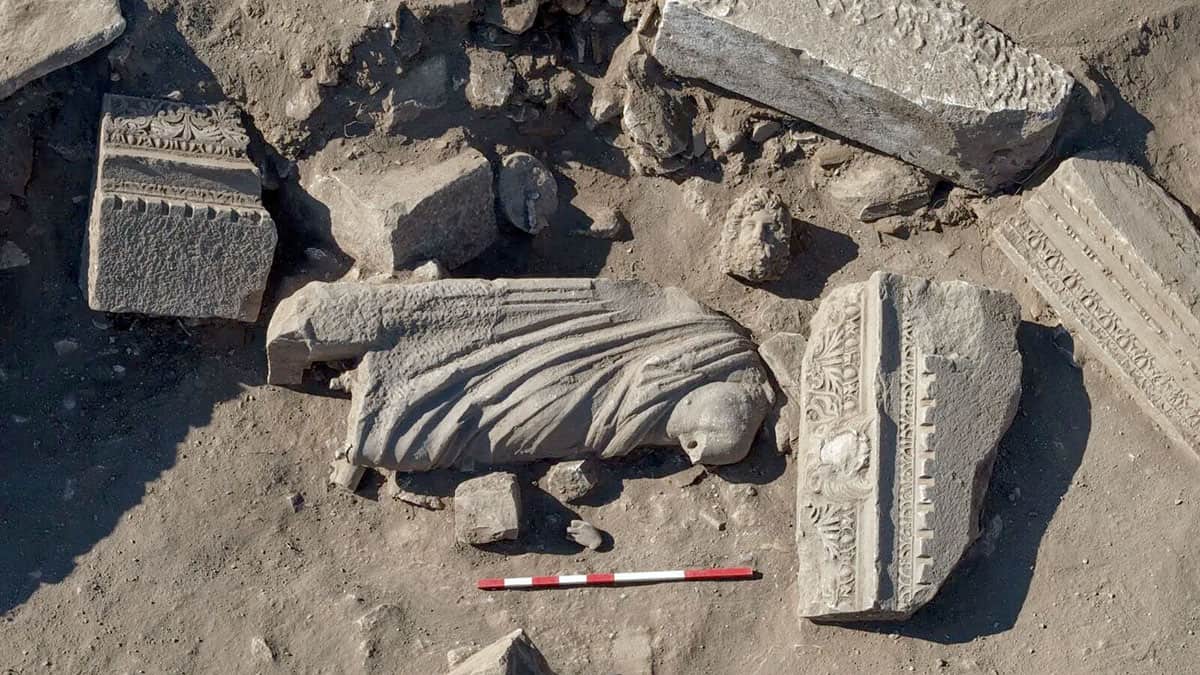
Archaeologists at ancient Aspendos in present-day Turkey have uncovered a marble statue group depicting Asklepios, the Greek god of medicine and healing, alongside Telesphoros, a smaller figure associated with recovery after illness.
The sculpture stands about 2.2 meters, or 7.2 feet, high and dates to the final quarter of the second century CE, during the Roman Imperial period. Turkey’s Culture and Tourism Minister Mehmet Nuri Ersoy announced the discovery on August 6. The excavation is part of Turkey’s Geleceğe Miras, or Legacy to the Future, project.
Excavators found the group among the collapsed remains of the northern wing of a monumental gateway on the western side of Aspendos’ East Square, along Theatre Street. The Culture and Tourism Ministry said the location indicates that the sculpture was displayed in a part of the city important to public and ceremonial life.
Asklepios is shown standing and facing forward, with long hair and a full beard. His upper torso is largely uncovered, while a himation falls from his left shoulder and wraps around his waist and legs in deeply carved folds.
Telesphoros appears near Asklepios’ left foot at a much smaller scale. He is represented as a childlike figure almost completely enclosed in a long hooded garment, a form known from other ancient representations of the deity.
The pairing carried a specific meaning in ancient healing belief. Asklepios represented medicine, treatment, and the preservation of health, while Telesphoros was associated with the completion of treatment, healing, and convalescence. Together, the two figures represented different stages of the healing process.
The discovery provides archaeological evidence for the presence of the Asklepios cult in Roman-era Aspendos, according to the ministry.
Aspendos lies in the ancient region of Pamphylia, near the Eurymedon River in today’s Antalya province. The city developed into an important regional center and retains monuments from its Hellenistic and Roman periods, including its exceptionally well-preserved second-century Roman theater and aqueduct system. The theater and aqueducts have been on Turkey’s UNESCO World Heritage Tentative List since 2015.
The statue group was uncovered during continuing excavation work along Theatre Street. Archaeologists reported in July that about 300 meters of the ancient roadway had been exposed, together with public buildings, houses, a bakery, sections of the monumental gate and infrastructure remains. The latest find adds evidence of the religious practices and ideas about health that formed part of daily life in Roman-era Aspendos.