
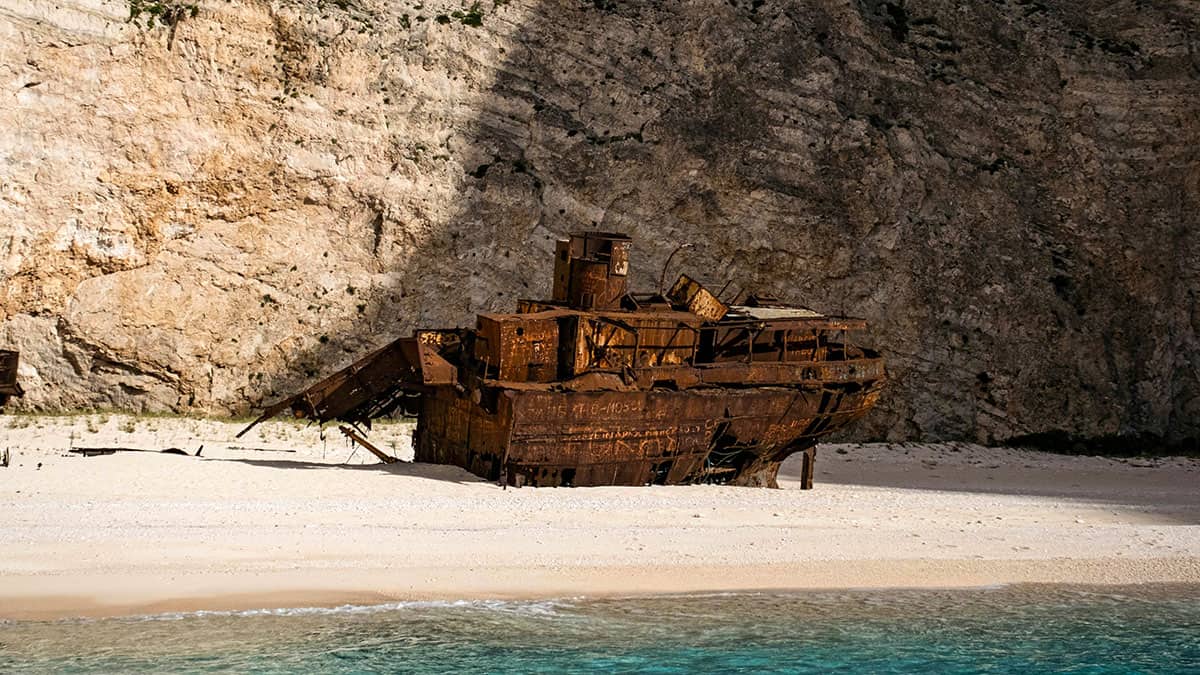
A €4.8 million plan would push the shoreline at Navagio roughly 30 meters toward the sea, reshaping part of the protected bay to slow the deterioration of the rusting Panagiotis shipwreck.
Navagio Beach owes its fame to an accidental pairing: a secluded limestone cove and the rusting remains of a ship stranded on its sand.
Greek authorities are now preparing to preserve that image by changing the beach itself.
A new government tender calls for placing approximately 45,000 cubic meters of sand-and-gravel material between the Panagiotis and the sea. The intervention would move the shoreline about 30 meters outward, creating a wider barrier against the waves that continue to reach the badly corroded hull.
The wreck would remain in place. But the visible beach and part of the seabed beneath the bay would be deliberately reshaped.
The project therefore raises a difficult question: how far should Greece alter a protected coastal landscape to preserve a man-made object that has become inseparable from it?
A formal tender, but no work yet
The Ministry of National Economy and Finance published the official design-and-build tender on July 8. Bids are due August 7.
The project has reached the procurement stage, but construction has not begun. No contractor has been selected, and authorities have not announced when physical work could start.
The tender values the project at €3.87 million before VAT, or approximately €4.8 million including VAT. The Ministry is the contracting authority, while the Municipality of Zakynthos would supervise the work through its technical services.
The contract would run for 340 days from the date of signing. That period includes final studies, permits, and other obligations, not only work on the beach.
More than adding sand
The government describes the intervention as “artificial beach nourishment,” but the plan involves more than spreading sand across the shore.
According to the tender documents, approximately 45,000 cubic meters of graded sand-and-gravel material would be placed along 193 meters of coastline.
The shoreline would move about 30 meters toward the sea. The rebuilt profile would continue underwater to a depth of about seven meters, helping waves break farther from the wreck.
The aim is to reduce how often ordinary wave action reaches the Panagiotis. Engineers would create a larger sediment buffer around the vessel, reconstructing both the beach and part of the underwater slope.
What the project could change
Navagio lies within a broader Natura 2000 protected area covering parts of the western and northeastern coasts of Zakynthos.
The protected zone includes marine and coastal habitats such as reefs, sea caves, and areas of Posidonia oceanica seagrass. The designation does not prohibit engineering work, but it requires authorities to consider how an intervention may affect the wider ecosystem.
The concern is not only that the beach may look different.
Moving such a large volume of sediment can temporarily reduce water clarity, disturb organisms on the seabed, and alter how waves and material move through the cove. The source and composition of the nourishment material are also important. Sediment brought from elsewhere must be compatible with the existing beach, while removing it from the seabed could create another disturbance.
The publicly available material does not identify the final sediment source or provide a complete picture of the environmental authorization, Natura 2000 assessment, construction method, and monitoring requirements.
The National Technical University of Athens study examined the wreck, waves, currents, seabed, cliffs, rockfall danger, and environmental conditions at Navagio. It concluded that nourishment could reduce the ship’s exposure to waves and that the principal environmental effects, especially during construction, could be managed.
The study also called for monitoring and maintenance rather than treating the intervention as a permanent solution.
One specialist who has studied the site questions whether nourishment is the right response.
Emmanuel Vassilakis, a geology professor at the National and Kapodistrian University of Athens, told Kathimerini that the beach is not eroding. He also questioned whether gravel added at considerable cost could eventually be carried away by the sea.
His comments challenge one of the project’s central assumptions, but they do not settle the wider engineering debate. The NTUA team argues that the added sediment would create a protective buffer around the wreck, while Vassilakis questions whether the shoreline requires that form of intervention.
Environmental authorization is required before the contract can proceed. The tender allows some supporting documents to be completed during procurement, and contract signing must wait if the necessary approvals are not ready.
A wreck already coming apart
The Panagiotis is no longer a stable object resting harmlessly on the beach.
More than four decades of exposure to salt, wind, waves, storms, and moving sediment have left the ship heavily corroded. The NTUA team documented openings in the hull, deformation, missing metal, and collapsed sections.
Its recommendations included internal supports, repairs to damaged areas, protective coatings, anti-corrosion systems, and continued monitoring.
Beach nourishment addresses only part of that problem.
Moving the waterline farther away could reduce repeated wetting, abrasion, and wave impact. It could also create better conditions for conservation work on the vessel itself.
It cannot guarantee that the wreck will survive indefinitely. A severe storm could still reshape the beach or reach the ship, and the new shoreline may require future maintenance or replenishment.
Greek officials have referred to a second intervention focused directly on the Panagiotis, but no separate public tender or signed restoration contract has yet been identified.
The cliffs are a different danger
The preservation project should not be confused with the safety restrictions that have kept visitors off Navagio Beach.
The wreck is threatened mainly by corrosion and the sea. Visitors are threatened mainly by the cliffs.
A major rockfall in September 2018 injured several people on the beach. Later earthquakes, erosion, and slope failures led to further inspections and closures.
In 2023, the Earthquake Planning and Protection Organization found extensive landslide danger and recommended that public access remain prohibited.
A peer-reviewed study of the Navagio cliffs, published in 2024, described the surrounding limestone as heavily fractured and affected by continuing erosion and seismic activity.
The new tender does not provide comprehensive stabilization of those cliffs.
A broader beach may protect the wreck from ordinary waves, but it cannot prevent rocks from falling from the slopes above it. Any reopening would require a separate decision based on geological risk, safe visitor routes, fencing, monitoring, emergency access, and enforcement.
No reopening date has been announced.
What visitors may do in 2026
The beach remains closed to visitors through October 31, 2026, under a joint ministerial decision based on an updated risk assessment.
Visitors may not land on the beach, approach the Panagiotis on foot, swim within the restricted bay, or anchor close to shore.
Boats may enter a designated offshore viewing zone under Port Authority rules but must remain at least 50 meters from the shoreline. Passengers cannot disembark, and vessels may not stop there for swimming.
The upper viewing platform may operate only when the required fencing and protective measures are in place. The decision does not authorize visitors to use informal paths or approach unprotected cliff edges.
The nourishment project may eventually become part of a wider plan for controlled visits, but the current tender neither reopens the beach nor resolves the danger from the cliffs.
A landmark and a changing coast
Navagio is central to the international image of Zakynthos and to the boat excursions that continue to bring visitors into the bay. Its deterioration has been discussed for years, while legal disputes and administrative delays prevented a coordinated response.
The tender is the clearest indication yet that the state is prepared to intervene.
But the cove is also a changing coastal system shaped by waves, storms, earthquakes, rockfalls, and sediment movement. Preserving the wreck means intervening in that system, with effects that will depend on the final design, the sediment selected, and how the work is monitored.
The unresolved question is not simply whether the Panagiotis should be saved. It is how much alteration of the bay is necessary to give the wreck a better chance of surviving.
What happens next
Bidding is scheduled to close on August 7.
The government must then evaluate the submissions, select a contractor, complete procurement reviews, and sign the contract.
Before physical work begins, the required engineering studies, environmental conditions, permits, material-source decisions, and construction plans must be completed.
Authorities have not said that work will begin during the 2026 tourism season. They have not announced when direct restoration of the ship will be tendered or when visitors might again be allowed to land on the beach.
The next documents to watch are the contract award, the final environmental decision, any required Natura 2000 assessment, the confirmed source of the nourishment material, and the monitoring plan for the beach and seabed.
A separate tender or funding decision will also be needed for work on the Panagiotis itself. Any reopening would require another safety decision focused on the unstable cliffs.
Until those steps are documented, the scale of the final intervention, its environmental safeguards, and any path toward renewed beach access remain unsettled.