
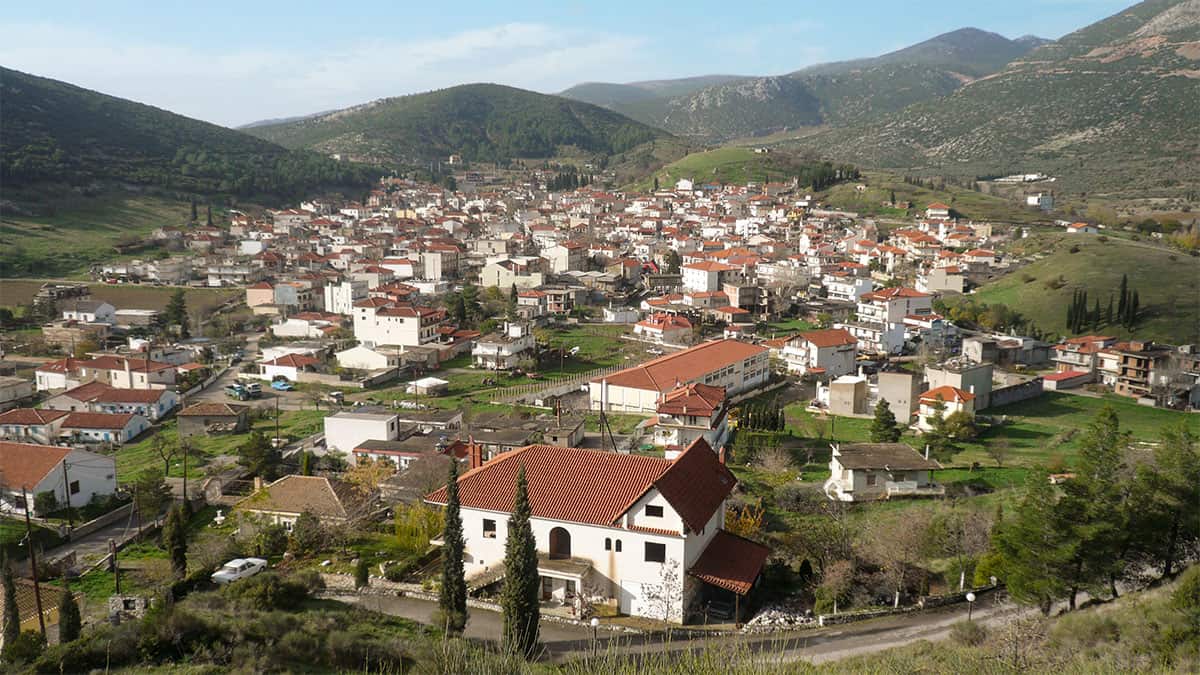
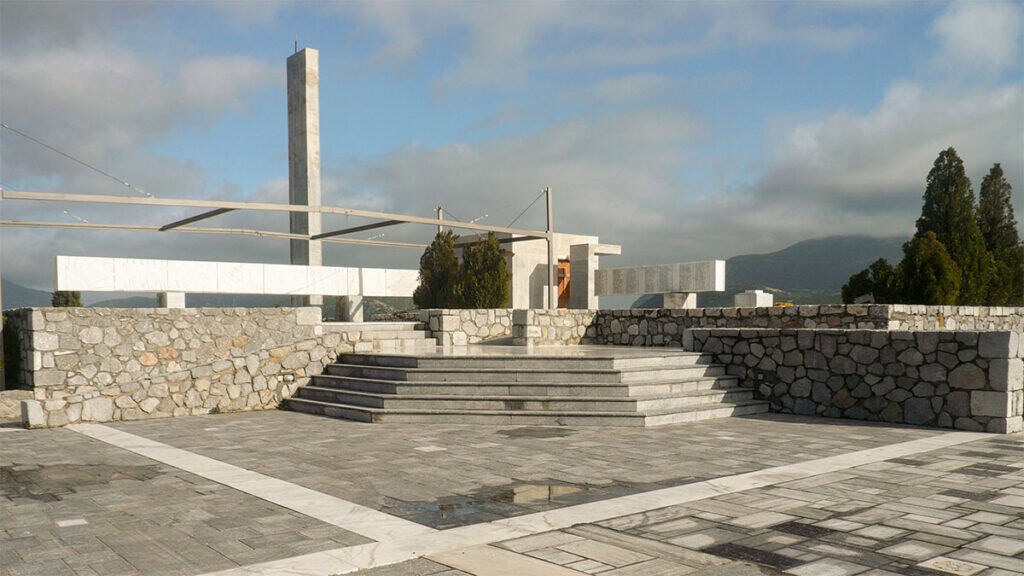
Every June 10, the village of Distomo falls silent. Names are read. Wreaths are laid at the mausoleum above the houses. For more than eighty years, the date has belonged to the dead. This is what happened on it.
On Saturday, June 10, 1944, a German SS column set out from Livadeia toward Distomo, a village in Boeotia, near Delphi and the mountains of central Greece.
The war was already turning. Four days earlier, Allied forces had landed in Normandy. In Greece, the German occupation was entering its final months. But for villages caught between occupation forces and resistance activity, the danger had not passed. In some places, it had become sharper.
Distomo was not a military target in the way armies usually speak of targets. It was a village. People lived there, worked nearby fields, kept homes, raised children, buried parents, and moved through the rhythms of a rural Greek day.
Around it, the occupation war was still being fought.
German units were conducting anti-partisan operations in an area where Greek resistance fighters were active. The force that came through Distomo belonged to the 4th SS Polizei Panzergrenadier Division. Its company commander was Fritz Lautenbach.
According to local accounts, the German movement that morning included a column of vehicles heading toward Distomo. Two commandeered Greek vehicles reportedly moved ahead of the rest, carrying German soldiers disguised as black marketeers. The apparent purpose was to draw out resistance fighters who might approach without suspicion.
Before the column reached the village, the killing had already begun. Near Karakolithos, German troops killed five people and took twelve farmers hostage while they were harvesting.
At the road junction between Distomo and Arachova, the force met other German vehicles coming from the direction of Amfissa. The column entered Distomo. The villagers were uneasy. The size of the force was unusual. The sight of the hostages made it worse.
The president of the community, Charalambos Kinias, and the village priest, Sotiris Zisis, tried to meet the German commander. According to the local account, the meeting was refused. German guards were placed on the heights around the village. Residents were told to remain inside their homes. Anyone who left, they were warned, would be treated as a partisan and executed.
The German force then moved toward Steiri, where resistance fighters were believed to be active.
Near Steiri, the column encountered Greek partisans. A firefight followed. The German unit suffered losses. Local accounts say the column then returned to Distomo, carrying the anger and shock of that clash back into the village.
Lautenbach later claimed that his men had been fired upon from Distomo itself. That claim became part of the German explanation. But Georg Koch, an officer of the German Secret Field Police who was present, wrote a different report. The attack on the German unit had taken place outside Distomo. The village had not been the source of the fire described in Lautenbach’s version.
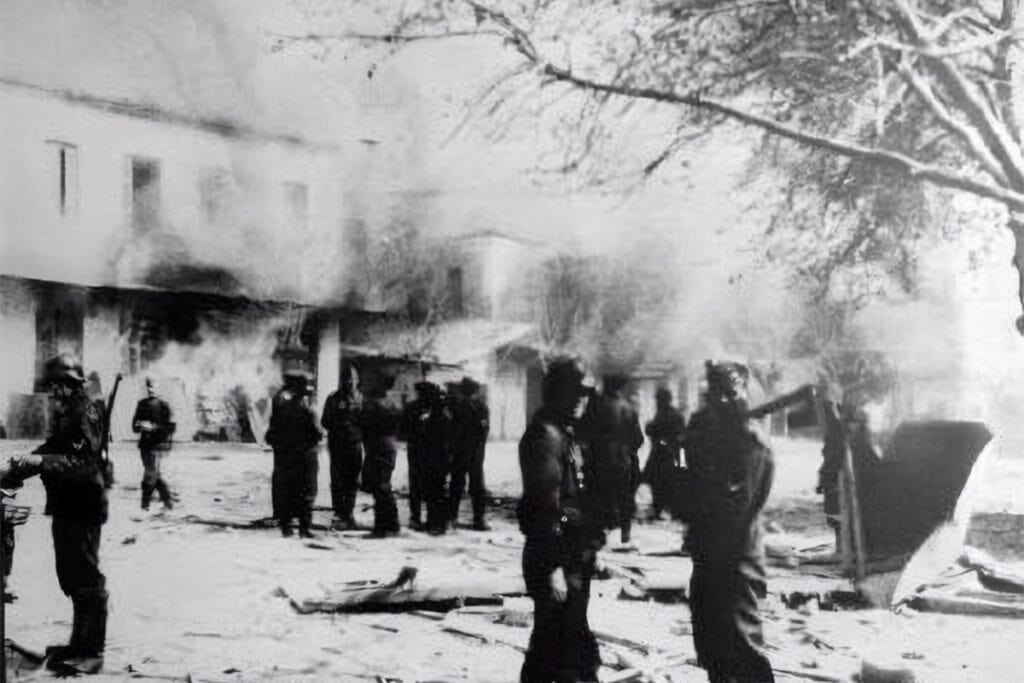
When the troops returned, the twelve hostages were taken to the area in front of the school and executed. After that, the violence moved into the village itself.
For more than two hours, they killed civilians. They went through homes and streets. People who had not been part of the fighting were killed inside the village. Survivor accounts and postwar reports describe killings in homes and streets, looting, and fire. The village priest was killed. Children were killed. Infants were killed.
The death toll is usually given as 218, though some accounts list 228. The exact figure varies by source. The reality does not. The dead were civilians.
Some villagers had already left. Others were in the fields or outside the village when the killing began. In later accounts, survivors described seeing smoke rise over Distomo. People looked back toward home and understood, before they knew the names, that something terrible was happening.
When the killing ended, the village had been burned and its dead left behind. The massacre did not happen in the fog of a battlefield. It followed a clash outside the village, then moved into civilian homes.
As night came, the village began to stir again. Survivors emerged. Children who had lost parents tried to find their way to nearby villages. The first questions were not historical. They were human. Who was alive? Who was missing? Where could a child go?
Distomo was not alone. Kalavryta, Kommeno, Viannos, Chortiatis, Kaisariani, Lingiades, and other places carry their own dates, names, and dead. By 1944, reprisals had become part of the occupation’s method of control. Resistance activity in or near an area could bring punishment on a whole village. The language was military. The victims were often not.
For Greece, World War II did not end as a clean national story of liberation. The occupation left famine, executions, collaboration, resistance, civil conflict, and memories that settled unevenly from one family to another. In many homes, the war survived as a tone of voice, a silence at the table, a photograph, a name that belonged to someone the younger generation never met.
Distomo became one of the places where silence was impossible.
Above the village, the mausoleum and memorial hold the names and ages of the dead. The names return the massacre to families. They show that the victims were not only a number, not only a wartime category, not only a line in a history book. They were people from one village, killed on one date.
The village itself continued. Distomo did not become a ruin sealed away from life. Houses were rebuilt. Children were born. Families stayed or returned. The road remained. The landscape remained. The massacre belongs to the past, but the village never stopped living beside it.
Today, the Museum of Victims of Nazism stands in Distomo near the municipal building. Each year, memorial events culminate on June 10 at the mausoleum. The ceremonies do not need to invent meaning for the day. They keep the names in public view.
For survivors, June 10, 1944, was not only the day of the killing. It became the beginning of everything that followed.
One of those survivors was Argyris Sfountouris. He was born in Distomo in 1940. His parents and about 30 relatives were killed in the massacre. In his own later account, he remembered fleeing the burning house while holding his sister’s hand.
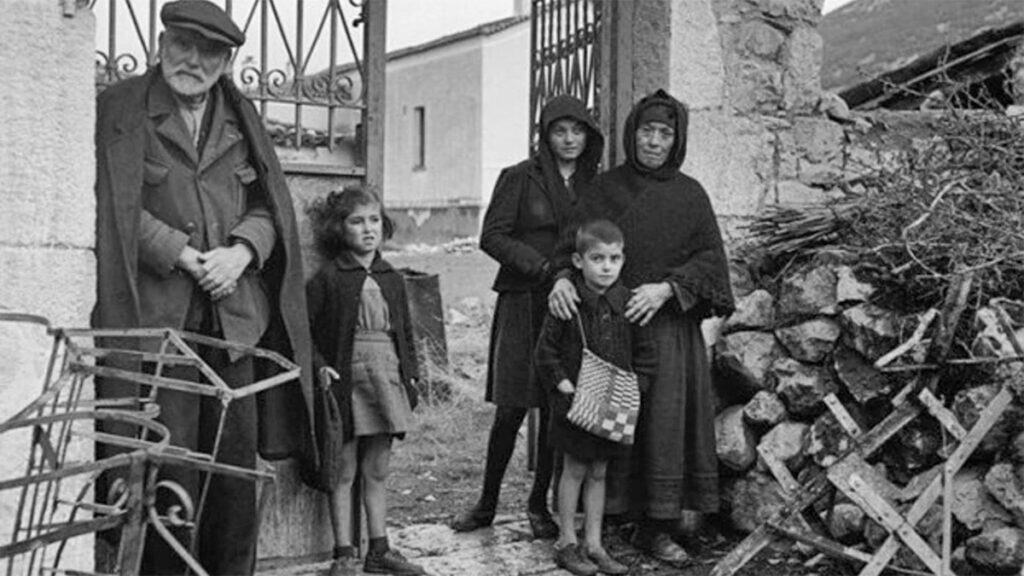
After the war, he lived first with his grandparents and later in orphanages in Piraeus and Athens. In 1949, at the age of eight and a half, he arrived in the Pestalozzi Children’s Village in Trogen, Switzerland, with other Greek war orphans.
He later became a physicist, teacher, translator, writer, and public voice for recognition of what happened in his village.
In the 1990s, relatives of victims brought claims against Germany in Greek courts. A court in Livadeia ruled in their favor in 1997. Greece’s highest civil and criminal court upheld the judgment in 2000. But the compensation was not enforced in Greece because enforcement against a foreign state required the approval of the Greek justice minister. That approval was not given.
The case continued through German and Italian courts and eventually before the International Court of Justice. There, the central question became state immunity: whether one state could be pursued in another country’s courts for wartime crimes committed by its armed forces.
The litigation did not end there. The effort to enforce the Greek judgment continued in Italy, where courts have repeatedly allowed steps toward enforcement against German state assets. In 2026, Italy’s Constitutional Court rejected a German appeal against enforcement, reopening hope among descendants of the victims, though not bringing immediate payment. Germany may still return to the International Court of Justice.
For the families, the result left a painful separation between recognition and remedy. The massacre was known. The victims were named. The Greek judgment existed. The compensation did not come.
On March 31, 2015, during the Greek debt crisis, Sfountouris appeared on Die Anstalt, a political satire program on Germany’s public broadcaster ZDF. The episode dealt with Greece, the Troika, German media portrayals of Greeks, and the question of Nazi-era reparations.
Before he appeared, the program had shown a photograph of him as a small child after the massacre. The hosts spoke about Distomo and about the German Embassy’s response to his compensation claim. According to that official language, the massacre had been treated as a measure within the conduct of war. On that basis, no compensation was owed.
Then Sfountouris entered the studio.
He introduced himself as the child in the photograph. He said he had lost his parents in 1944 and had fled the burning house holding his sister’s hand. The audience applauded before he could continue.
Sfountouris was no longer an image from 1944 or a name in a legal file. He was a survivor from Distomo, standing on German public television more than seventy years after his parents had been murdered.
Asked about the official German explanation, he said the embassy had repeated the “Distomo lie” of the perpetrators by presenting the massacre as a wartime measure. Asked whether he had ever received compensation, he said no. Germany, he said, had done everything possible not to pay, even taking the matter to the International Court of Justice in The Hague.
The exchange also turned to German President Joachim Gauck’s visit to Greece in 2014. Sfountouris acknowledged that Gauck had asked forgiveness and had said that Germans had brought robbery, murder, and terror to Greece. But Gauck, he noted, had not spoken on behalf of the German government and therefore could not address compensation.
At the end, Sfountouris was asked what Germans could do now.
His answer was simple: apply the rules. Debts must be paid. No tricks.
In 2015, Greece was often discussed in Germany through the language of debt, discipline, austerity, and obligation. Sfountouris reminded viewers that the relationship between Greece and Germany did not begin with the debt crisis.
Each June 10, the village remembers its dead. The ceremonies, the memorial, the names, and the survivor accounts keep the day in public view. Distomo does not need dramatic language. It needs accuracy, restraint, and names.
For Greek Americans, Distomo belongs to a larger inheritance of the occupation memory. Many families who left Greece after the war carried stories shaped by hunger, fear, loss, resistance, occupation, and silence. Some came from villages where the damage was visible. Others came from places where it stayed inside families. The second and third generations may know the occupation as history, but in Greece, it was often family memory first.
Distomo helps explain why the German occupation still sits close to the surface in Greek memory. It entered kitchens, courtyards, churches, fields, and children’s lives. It changed what a village remembered about itself. It changed how a country spoke about justice.