Through the eyes of photographer Pete Kalitsopoulos, the week the Evzones stepped beyond ceremony and into the Greek-American community.
Pete Kalitsopoulos remembers the sound first. A clarinet cutting through a packed church hall, just before the Evzones lifted off the ground in unison. For a moment, the presidential guard was no longer standing in formation. They were singing, playing music, and dancing in front of a Greek-American crowd in Philadelphia.
“It’s something we’ll probably never see again,” he says.
It happened once, in the mid-1980s, as he remembers it, and he was there with a camera.
The Week the Evzones Stepped Off Script
That year followed the usual pattern at first. The Evzones marched the Greek Independence Day parade route, moving in formation past Independence Mall and the Liberty Bell. But outside the parade, something changed.
Over several days, they appeared at churches and community halls across the region. In full uniform, they performed traditional dances, played music, and interacted with the community in ways that went far beyond their ceremonial role.
One of the central moments came at St. Demetrios Greek Orthodox Church in Upper Darby. Inside a hall lined with Greek flags, the Evzones took the stage in both their classic white fustanella and darker regional uniforms, dancing in lines, kicking in rhythm, and moving with a freedom few in the audience had ever seen.
“They blew my mind,” Pete says. “The way they dropped, kicked, even leaned back in those uniforms.”
At St. George Greek Orthodox Church in Hammonton, New Jersey, south of Philadelphia, his photos capture them mid-air, children watching from folding chairs, while at Evangelismos Greek Orthodox Church in Philadelphia, clarinets and drums turned a standard program into something closer to a village panigyri.
“If you go to Greece, you see them stand and march,” Pete says. “You don’t see this.”
How Pete Was There
Pete’s story in Philadelphia began in 1970, when he arrived from Thessaloniki at age ten. He grew up around St. George Greek Orthodox Cathedral, serving in the altar and absorbing the rhythm of church life and community events.
He also remembers a different parade route. In those years, the march began at St. George on 8th Street and moved through Olde City toward Independence Mall, connecting the early Greek community directly to the symbolic center of the country.
In one photograph from that time, Pete stands on 6th Street with a camera around his neck, Greek flags behind him.
“I played with toy soldiers,” he says. “And suddenly the real ones were in front of me.”
Photography came naturally. He started with black-and-white film, then moved through cartridge formats before buying a Nikkormat 35mm SLR. By his early teens, he was already known as the kid documenting parades and events.
Over time, he became a regular presence, invited by Federation organizers to follow the Evzones during their visits. That access is what allowed him to capture what happened next.
“I just wanted to make sure these moments didn’t disappear.”
The Moments He Captured
What stays with Pete is not just what the Evzones did, but how people reacted to it.
At St. Demetrios, one Evzone stepped forward with a clarinet and played directly to a man in the front row, Harry Zografos of St. Thomas Greek Orthodox Church.
“You could see it in his face,” Pete says. “This was Greece coming back to him.”
In other moments, the guard appeared in ways the community had never seen before. In Pontian black, dancing in front of parish banners. Kicking in unison as community leaders watched from the side, caught between disbelief and pride.
One of Pete’s most personal photos shows him standing between two Evzones, their uniforms framing him as he looks straight into the camera.
“I still think about that moment,” he says quietly.
After the Performances
The celebrations didn’t end with the performances. At a Pontian clubhouse in Upper Darby, the atmosphere shifted from formal to familiar, with the Evzones joining federation members in dancing, cutting cake, and sharing drinks.
In one moment Pete remembers clearly, a lieutenant poured a drink over his own head mid-dance, then later spoke with him about photography.
In other photos, the guardsmen appear in suits, standing outside their bus, relaxed and joking with local hosts. Many were traveling abroad for the first time.
“They didn’t know what to expect,” Pete says. “And it surprised them, the way we treated them.”
Where It Lives Now
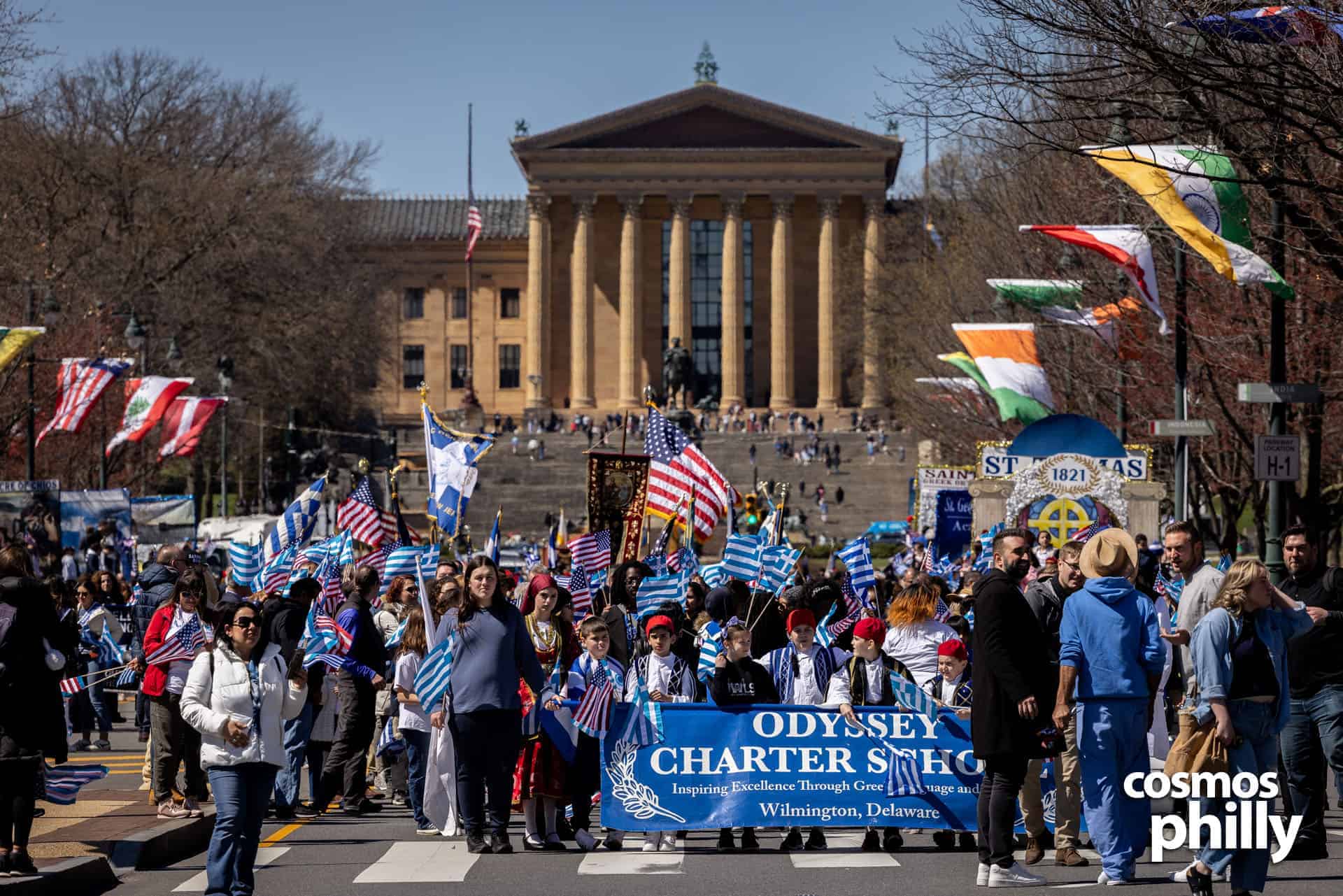
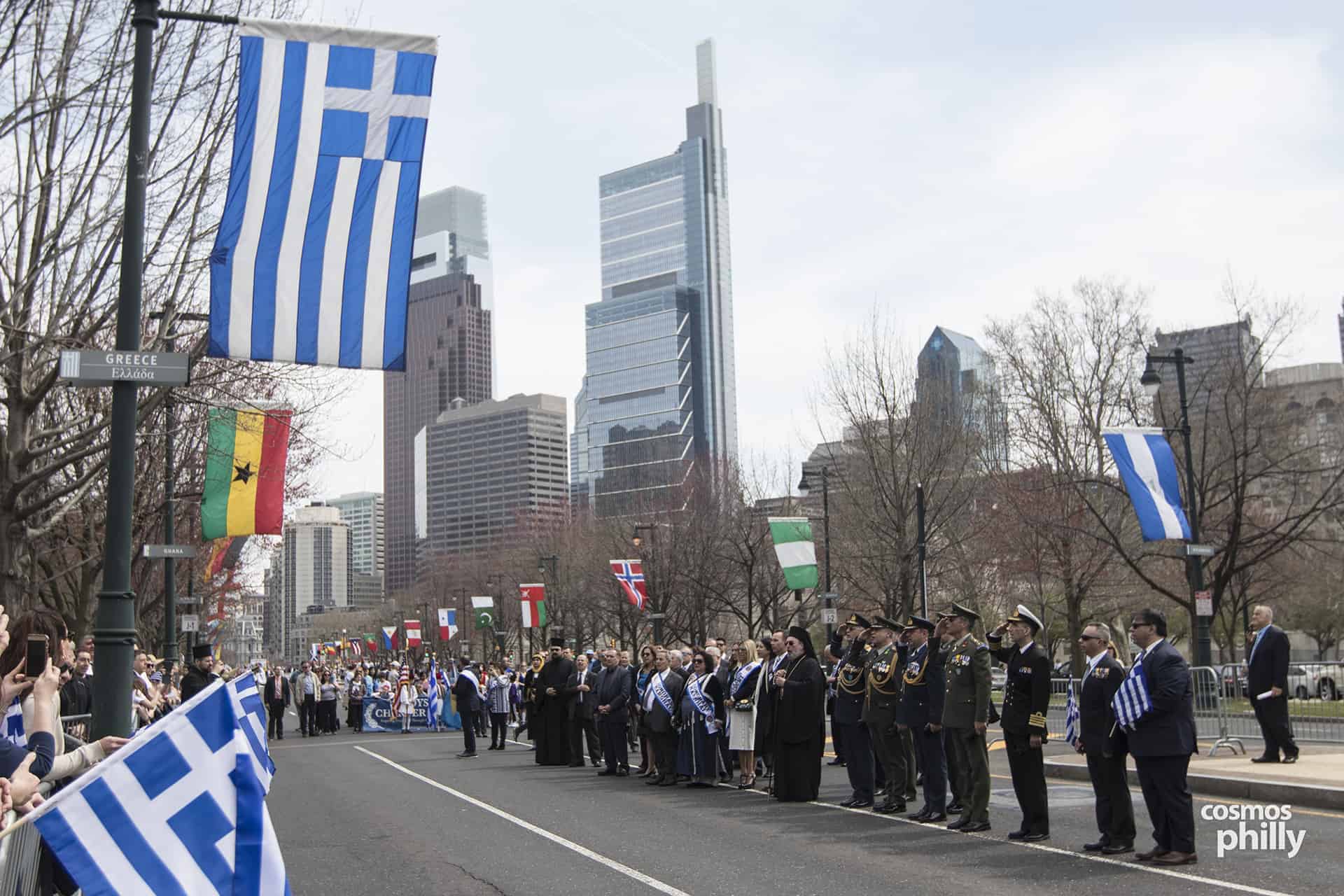
Today, the parade runs along the Benjamin Franklin Parkway, framed by city buildings and a broader public audience. Each year still begins at St. George Cathedral, where the Evzones enter, stand for the doxology, and prepare to march.
For Pete, the memory of that earlier route, from 8th Street through Olde City to Independence Hall, remains just as important, and so does that week.
“As far as I remember, it never happened again,” he says.
For many younger Greek Americans, the Evzones are figures of stillness, seen at attention along the parade route. Pete’s images show something else: a moment when the guard stepped into the community, not as symbols, but as participants.
“Endless memories,” he says. “Without that week, none of this would exist.”
Cosmos Philly is made possible through the support of sponsors and local partners. If you’d like to become a sponsor or promote your business to our community, get in touch.