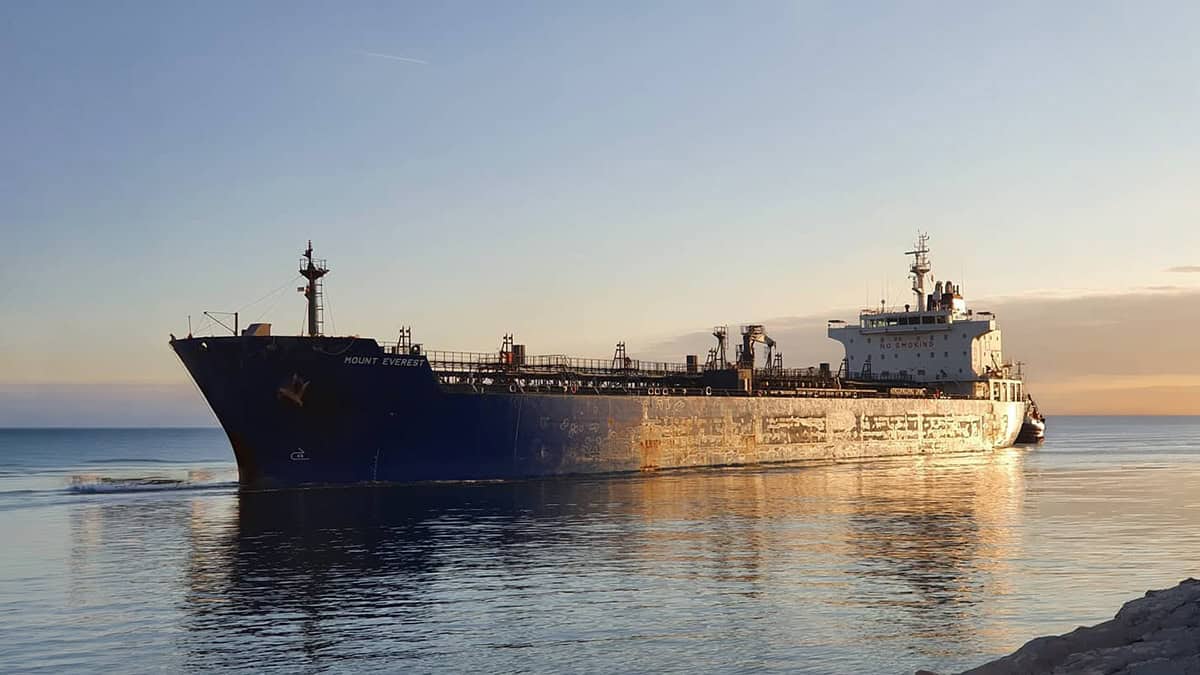
Even as tensions rise in the Strait of Hormuz, one of the world’s most sensitive shipping routes, a handful of tankers linked to Greek shipowners have continued sailing through the narrow passage that connects the Persian Gulf with global markets.
The Strait is one of the most strategically important energy chokepoints in the world. According to the U.S. Energy Information Administration, about 20 million barrels of oil pass through the Strait of Hormuz each day, equivalent to roughly 20 percent of global petroleum consumption and more than a quarter of seaborne oil trade. Large volumes of liquefied natural gas also move through the same route.
When conflict or instability increases in the region, shipping companies often reroute vessels or suspend voyages altogether. That appears to be happening now. Maritime tracking data and shipping industry reports suggest tanker traffic through the strait has fallen sharply, with hundreds of vessels waiting outside the Gulf or diverting to avoid the area.
Yet the flow has not stopped completely.
During the current crisis, at least five tankers belonging to the Dynacom group, controlled by Greek shipowner George Prokopiou, have been reported transiting the Strait of Hormuz while many other operators paused voyages. Industry analysts say these vessels were among the few commercial ships still crossing the passage at the height of the tensions.
The decision reflects both the risks and the powerful financial incentives that shape modern maritime trade.
Greek shipping companies play a central role in the global energy transport system. According to the Union of Greek Shipowners, the Greek-owned fleet remains the largest in the world by carrying capacity, with roughly 5,600 vessels representing about 20 percent of global shipping capacity. Greek shipowners also control about 29 percent of the world’s tanker fleet, giving them a dominant role in transporting crude oil between the Middle East, Europe, and Asia.
The current tensions in the Gulf have created extraordinary financial incentives for the ships that continue operating there. With many vessels avoiding the region, freight rates have surged.
For Very Large Crude Carriers (VLCCs) operating on some Middle East–Asia routes, daily earnings during the crisis have reportedly climbed to $440,000 to $500,000 per day, according to shipping market data cited by the energy analytics firm Kpler. Those figures do not include the additional war-risk insurance costs now required for ships entering the region.
Such spikes in earnings help explain why some shipowners are still prepared to send vessels through dangerous waters.
Prokopiou is frequently cited in industry reporting as one of the operators willing to do so. He founded Dynacom Tankers in 1991 and later expanded into liquefied natural gas shipping through Dynagas. Today his companies control a large fleet of tankers and bulk carriers.
Within shipping circles, Prokopiou has long been known as an owner willing to operate when others hesitate. In interviews he has often said that risk is simply part of the business.
That mindset reflects a long tradition in Greek maritime history. Throughout the twentieth century, Greek shipowners often expanded their fleets during periods of disruption in global trade.
Figures such as Aristotle Onassis and Stavros Niarchos built vast tanker empires by investing aggressively when competitors hesitated. After the Second World War, Onassis purchased surplus wartime tankers and later commissioned some of the largest ships ever built, helping usher in the supertanker era. Niarchos also ordered massive tankers and benefited from the surge in shipping demand that followed the Suez Crisis, when the closure of the canal forced vessels to take longer routes around Africa and drove freight rates sharply higher.
But the risks facing crews in the Gulf today are real.
Recent weeks have seen confirmed attacks on commercial vessels in and around the region, including strikes involving drones and projectiles. Maritime security advisories have also warned about a potential mine threat in the area, although reports of large-scale mine deployments remain largely unconfirmed.
Because of these dangers, maritime insurers and security organizations have expanded high-risk zones to include the Strait of Hormuz, the Gulf of Oman, and surrounding waters. Labor organizations representing seafarers have also raised alarm.
In March 2026, the International Bargaining Forum formally classified the Strait of Hormuz and nearby waters as a Warlike Operations Area. The designation allows seafarers to refuse assignments in the region and entitles those who do sail there to additional compensation and protections.
It remains unclear how many crews have exercised that right. Shipping companies rarely disclose crew-level decisions during active crises. Commercial tanker crews also typically include multiple nationalities, which makes firsthand reporting difficult during fast-moving conflicts.
Despite those warnings, a few tankers are still making the journey.
Among them are vessels linked to Greek shipping companies that continue moving crude oil out of the Gulf even as most traffic slows or stops. Their voyages underscore a reality that has defined global trade for decades: when freight rates surge and energy markets tighten, some ships will still sail.
For the crews aboard those vessels, the Strait of Hormuz remains one of the most dangerous passages in global shipping. For the companies sending them, it remains one of the most lucrative.
Cosmos Philly is made possible through the support of sponsors and local partners. If you’d like to become a sponsor or promote your business to our community, get in touch.