
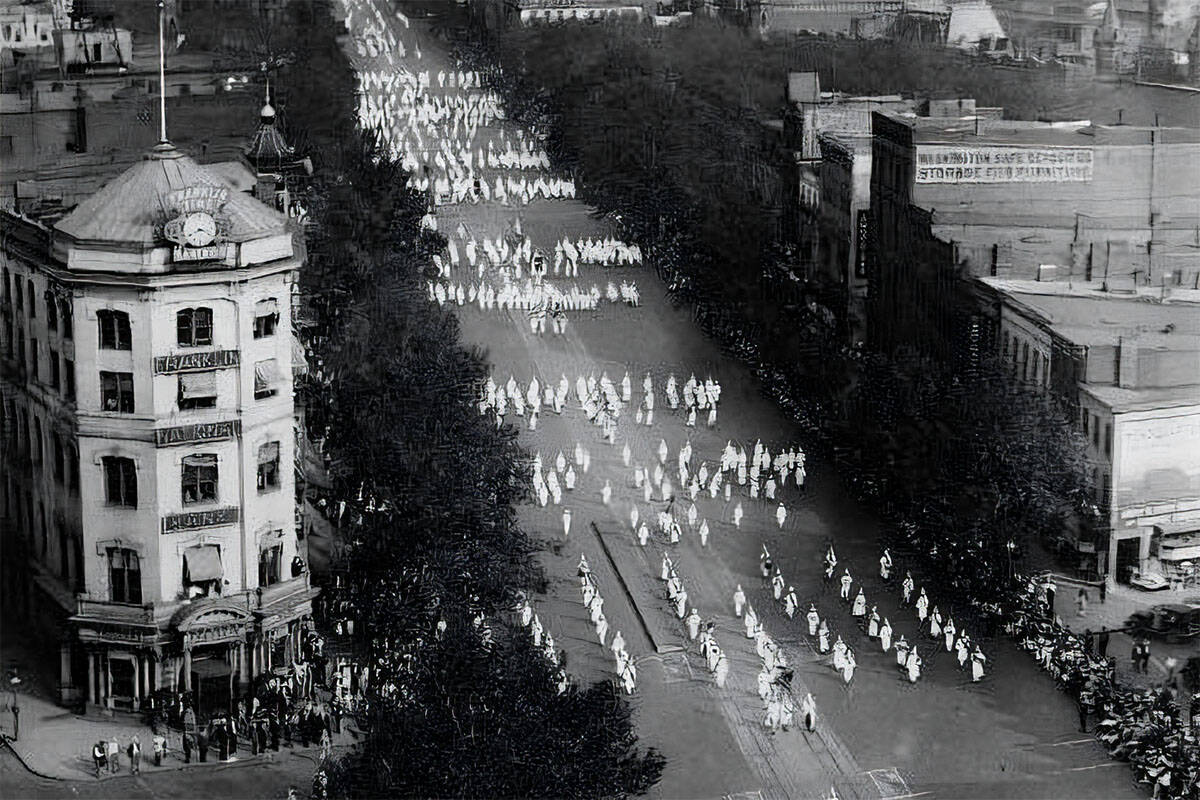
The bell over the diner door jingled once, then fell silent. A young Greek immigrant wiped his hands on a flour-stained apron and looked out at the street. The customers who usually crowded his counter were gone. Word had spread quickly: the Ku Klux Klan was watching. Anyone who entered a Greek-owned business risked being followed, threatened, or worse.
He turned the sign to Closed, though it was only mid-afternoon. Across the Midwest and South in the early 1920s, this was becoming routine. Greek immigrants who had worked their way into small businesses found themselves boycotted and branded as outsiders. Crosses burned in fields. Men were beaten for speaking Greek in public. Families feared drawing attention even when gathering for church.
In Pensacola, Florida, a Greek restaurateur received a note slipped into his hand.
“You are an undesirable citizen. Several trains are leaving Pensacola daily. Take your choice, but do not take too much time. Sincerely in earnest, KKK.”
He closed his doors not long after. Elsewhere in Florida, a young Greek man was dragged out and flogged for daring to date a white woman. In Indiana, crosses blazed in the yards of outspoken Greeks, a warning that silence or departure was the only safe option.
Years later, AHEPA’s own historical record captured just how devastating these boycotts were:
“Many Greek-owned confectionaries and restaurants failed financially or were sold at sacrificial prices to non-Greeks because of boycotts instigated by the Klan. Greek establishments doing as much as $500 to $1,000 a day business, especially in the South and Midwest, dropped to as little as $25 a day.”
For a community still finding its footing in America, the message was clear: you may have crossed the ocean to chase opportunity, but here you were not yet welcome.
The Shadow of the Klan
By the early 1920s, the Ku Klux Klan had become a national powerhouse. It was a mass movement with an estimated three million members.
They were everywhere: in small towns, in statehouses, and even in the halls of Congress. Sixteen United States Senators and eleven Governors owed their elections to the hooded order. In states like Indiana, Colorado, Georgia, and Texas, Klan-backed candidates swept into office.
The Klan marched openly in daylight parades. They distributed flyers warning that America was under siege from “aliens, Jews, Catholics, and Greeks.” Their intimidation was backed by violence: burning crosses, beatings, and boycotts. A Klan lecturer in Spokane declared, “Mexicans and Greeks should be sent back to where they came from so that white supremacy and the purity of Americans be preserved.”
For immigrants who had hoped to find freedom and stability in America, the Klan’s shadow was a constant reminder that they were still outsiders.
Greeks as Targets
Among the many immigrant groups singled out by the Klan, Greeks were especially vulnerable. They were visible, they were foreign, and in many towns their businesses stood right on the main street, easy to target.
Candy shops and restaurants that once thrived suddenly collapsed. Customers were threatened, families harassed, and even the Greek language itself was treated with suspicion. Families postponed building churches, fearful of drawing too much attention.
Even names were changed for safety. A “Papadopoulos” might become “Pappas,” not because he wanted to abandon his heritage, but because shortening a name could mean fewer problems with police, bosses, or neighbors.
A Meeting in Atlanta
On July 26, 1922, a group of Greek immigrants met in Atlanta. Their response to the wave of hatred was not violence but organization. That day, they founded the American Hellenic Educational Progressive Association, better known as AHEPA.
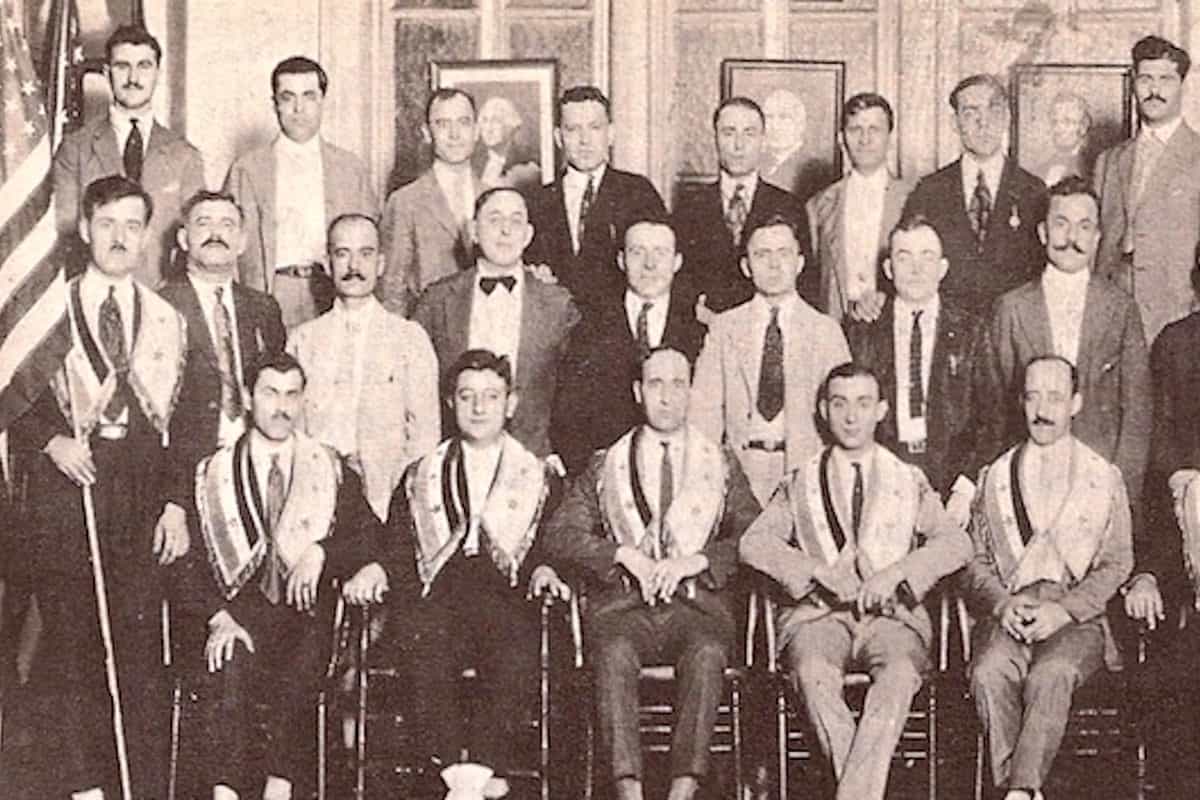
Its mission was clear: encourage citizenship, promote education, strengthen families, and demonstrate loyalty to America without abandoning Hellenic pride.
The men who gathered that day later reflected on why AHEPA had been necessary in those years. For Nick D. Chotas, the first Supreme President, it was born out of hardship:
“The spirit of AHEPA was born out of necessity. The Hellenic immigrant was misunderstood by the public, persecuted by the Ku Klux Klan, and not recognized as an important factor in the life of this nation. The only answer was organization.”
Others remembered the climate of hostility. Spiros J. Stamos recalled how immigrants were treated before 1922:
“Previous to 1922, Greeks were misunderstood and often mistreated. We were accused of being un-American. The immediate need was for collective action, not only to defend ourselves but to show that we could become part of America without losing our Hellenic pride.”
For James Vlass, the vision was to balance loyalty to America with loyalty to Greece:
“We wanted to teach the Greek immigrant that to love America did not mean to forget Greece. We wanted to prove that by good citizenship, by learning the English language, and by loyalty to the Constitution, Greeks could become respected Americans.”
And George A. Polos emphasized that AHEPA was not meant to shut others out, but to lift Greeks up while contributing to the nation around them:
“The idea was not to create a closed society, but to create an institution that would help the Greek immigrant stand up in the face of prejudice and at the same time offer something of value to his new country.”
What began in Atlanta grew into a brotherhood that protected and uplifted generations of Greek-Americans. Out of fear and hostility came an organization that still endures a century later.
The Early Years
From that one meeting in Atlanta, AHEPA spread rapidly. Chapters appeared in Chicago, Detroit, New York, Boston, and Philadelphia. They offered solidarity to business owners, lessons in English and citizenship for workers, and scholarships for students.
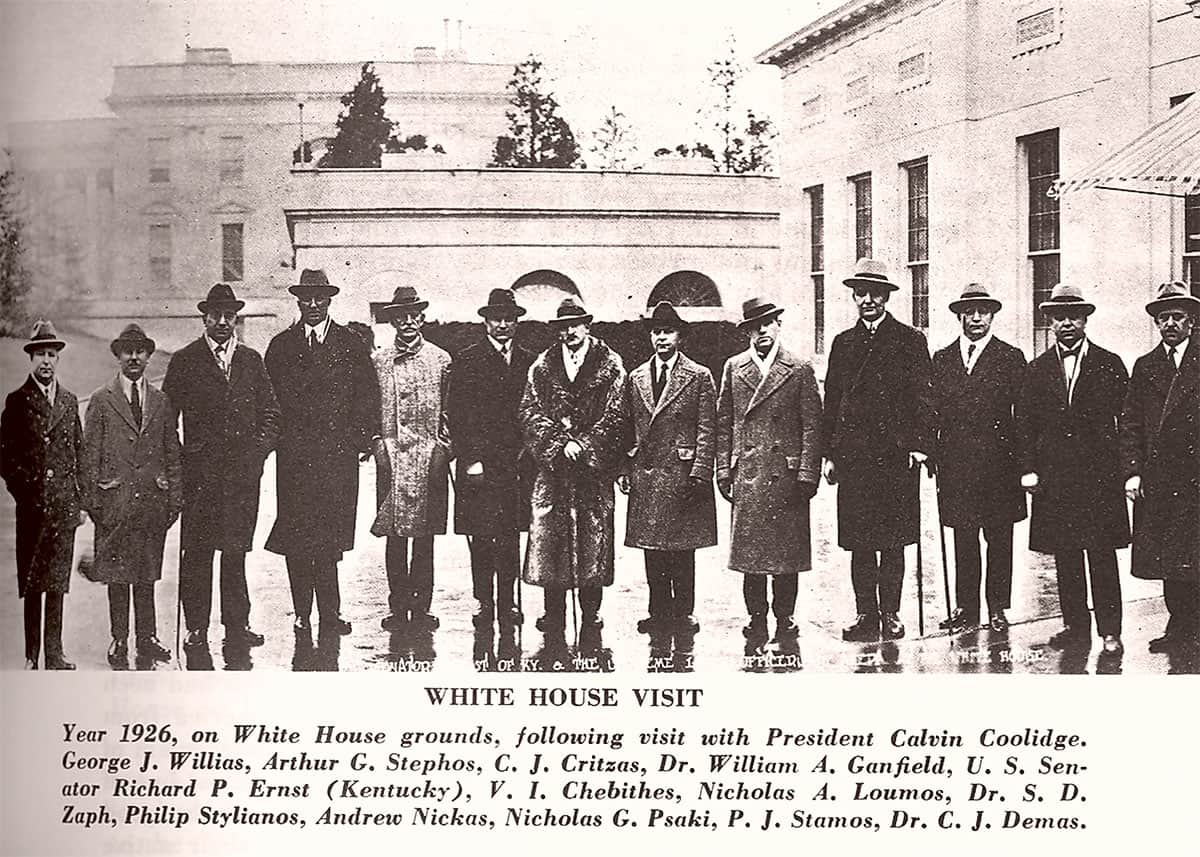
The organization quickly took root at the national level. In 1923, the first Supreme Convention was held in Atlanta, and the new headquarters were briefly established in Philadelphia before moving to Washington, D.C., the following year. In 1924, AHEPA leaders were welcomed at the White House by President Calvin Coolidge, a powerful recognition for immigrants who only a few years earlier had faced boycotts and intimidation.
The late 1920s and 30s brought civic and cultural milestones. The fraternity helped raise a statue of Greek independence hero Demetrios Ypsilanti in Ypsilanti, Michigan, in 1927, and in 1930 members dedicated the George Dilboy Monument in Somerville, Massachusetts, honoring the first Greek-American Medal of Honor recipient of World War I. AHEPA also established the Sons of Pericles as a youth auxiliary, laying the groundwork for future generations. Abroad, the fraternity funded the Agricultural and Industrial School in Corinth after the 1928 earthquake and sent delegations to Greece in 1929, 1930, and 1934 to strengthen ties with the homeland.
This mission resonated across generations. Daniel A. Siames, reflecting in 1981 on his family’s long involvement in Cedar Rapids, Iowa, described it this way:
“I have been an Ahepan for forty years. My father and uncles were charter members. There are many members like me who have enough to get by, but we still like to be around our own people, to hear and speak our language day and night.”
By the mid-1920s, AHEPA had moved its national headquarters permanently to Washington, D.C., and had become strong enough to influence civic life. Within just two years of its founding, its representatives were welcomed into the halls of American power.
Proving Patriotism
World War II proved to be AHEPA’s defining test. Its members sold over $253 million in United States War Bonds, a total confirmed in AHEPA’s 1947 Silver Jubilee history and one of the largest achieved by any civic organization. Later records would place the figure at more than $500 million, but either way, the impact was unmistakable. For a community only a few decades removed from boycotts and burning crosses, this was a profound statement of belonging.
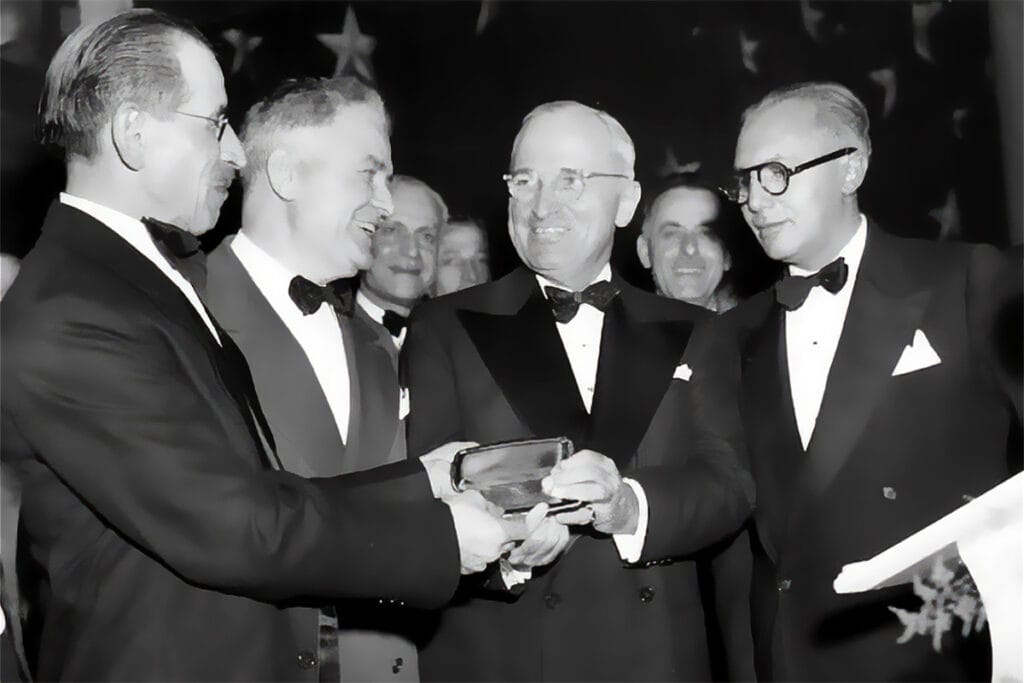
That service did not go unnoticed. From the White House, President Harry S. Truman praised the fraternity’s contributions, highlighting both its civic ideals and its wartime sacrifice:
“The American Hellenic Educational Progressive Association, during its twenty-five years of existence, has rendered valuable service in promoting good citizenship, encouraging education, and supporting humanitarian causes. Its war service in selling United States War Bonds is especially commendable.”
The recognition went beyond words. On March 25, 1946, Greek Independence Day, Truman himself was initiated into AHEPA in a ceremony at the White House. It was a remarkable milestone: less than 25 years after the fraternity’s birth in a small Atlanta schoolhouse, the President of the United States stood as a fellow member. That evening, at AHEPA’s Sixth National Banquet in Washington, Attorney General Tom Clark, Senator Robert Taft, and House Majority Leader John W. McCormack all spoke in tribute to the organization’s wartime service and civic contributions.
For members, the impact of AHEPA’s work was not just measured in ceremonies or government praise but in the opportunities it created at home. Scholarships and civic programs turned service into a cycle of giving back. As one father explained:
“My three sons won the Ahepa scholarships. I want to give back. You do not take in this world without giving back.”
Others, like George G. Horiates reflecting during his term as Supreme President, spoke with awe about the sheer scale of the fraternity’s reach:
“When I was elected to the highest office of our great fraternity, I was clueless as to the depth and scope of the wonderful work we do. I am in awe of the tremendous manpower exerted by our chapters all across the United States and the world.”
By mid-century, the transformation was clear. Where once Greeks had hidden their language and shortened their names in fear, now they proudly built churches, sent their children to universities, and ran for office with the backing of a national organization.
Legacy of Service
After World War II, AHEPA broadened its mission into philanthropy, education, and public service. It raised millions for scholarships, supported housing for the elderly, helped restore Ellis Island and the Statue of Liberty, and even commissioned an Olympic sculpture in Atlanta.
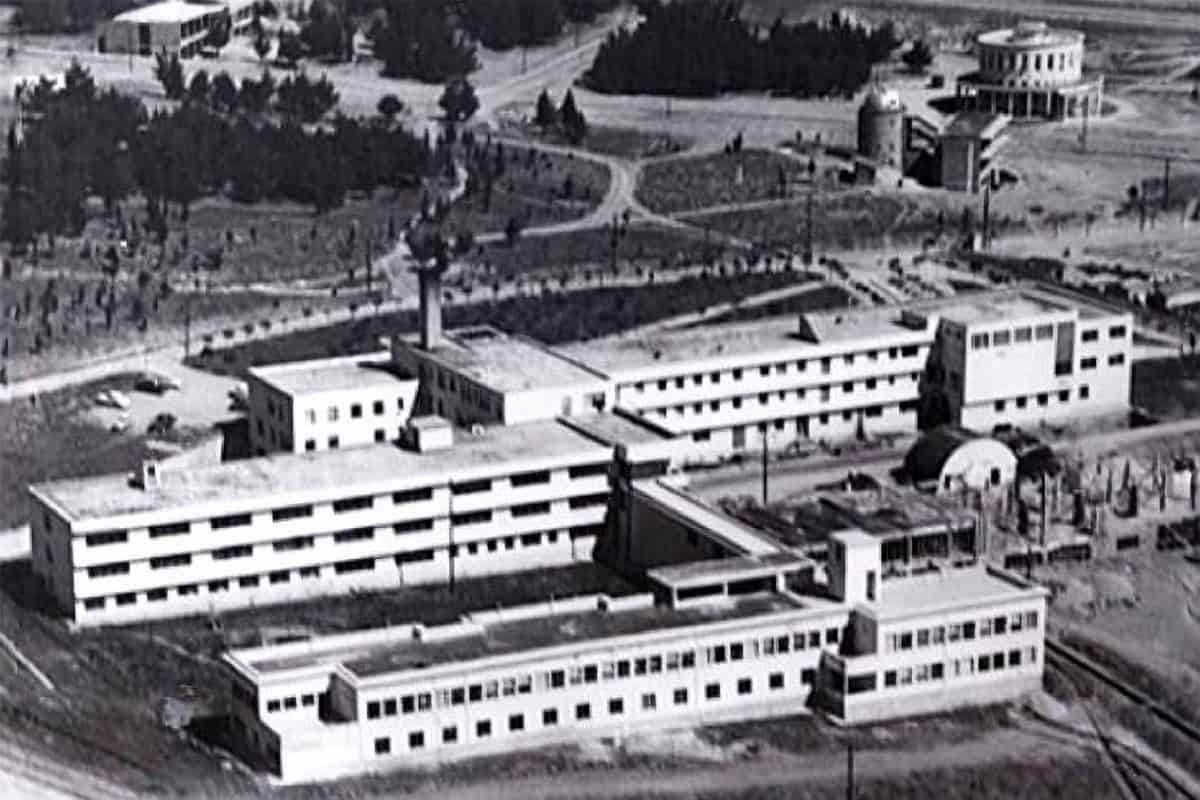
That spirit of service extended to health care as well. In the United States, the AHEPA Sanatorium in Albuquerque, New Mexico, provided care for tuberculosis patients at a time when it was desperately needed. In Greece, the fraternity helped establish the AHEPA University General Hospital in Thessaloniki in 1947 with the support of the Greek-American community and Aristotle University. It opened to the public a few years later and remains one of the country’s leading university hospitals.
But AHEPA’s role was not only charitable. It continued to stand firm whenever hatred and intolerance reappeared. In 1990, when the Ku Klux Klan challenged a Georgia law banning masks in public, the fraternity joined the NAACP and ADL in defending the law. The Georgia Supreme Court upheld it in the very city where AHEPA had been founded.
For George G. Horiates, who served as Supreme President, this history was not distant. In 2020, he reminded members of the brutality that once tied the Greek and African-American experiences together:
“Young Greek men in the South were taken along with young black men from their jobs by the KKK to lynching ‘parties’ in the woods. Greeks were roughed-up and told to leave town. The black men were not so fortunate and were lynched.”
That memory of shared struggle forged lasting bonds. One of the clearest symbols came in 1965, when Archbishop Iakovos of the Greek Orthodox Church marched arm in arm with Dr. Martin Luther King Jr. at Selma. Fifty years later, Ahepans returned to Selma to walk again with the African-American community, honoring both the legacy of the civil rights movement and their own history of endurance.
Irony and Endurance
The irony is hard to miss: the word Ku Klux comes from the Greek kyklos, meaning circle. The Klan borrowed a fragment of the very culture it despised to name its circle of hate. Yet it was Greeks who would ultimately outlast them.
The Klan of the 1920s, with its millions of members and its political machine, collapsed within a decade under the weight of corruption, infighting, and extremism. What once seemed like an unstoppable force burned itself out.
AHEPA, born in fear but built on service, went in the opposite direction. From six founders in Atlanta, it grew into hundreds of chapters across the United States, Canada, and Greece. Its auxiliaries, the Daughters of Penelope, the Sons of Pericles, and the Maids of Athena, carried the mission to women and youth, making the AHEPA family an institution that touched every corner of Greek-American life.
The contrast is striking. The circle that the Klan tried to close around immigrants and minorities broke apart. The circle that AHEPA formed around education, citizenship, and belonging expanded over time. A century later, it still holds, uniting generations who understand that solidarity can outlast even the fiercest hatred.
The Philadelphia Connection
For Philadelphia, AHEPA was never distant. After its founding in Atlanta in 1922, the fraternity’s national headquarters briefly moved to Philadelphia in 1923 before settling in Washington, D.C. The city also hosted the Fourth Supreme Convention in 1926, a landmark gathering that helped secure AHEPA’s place as a national force.
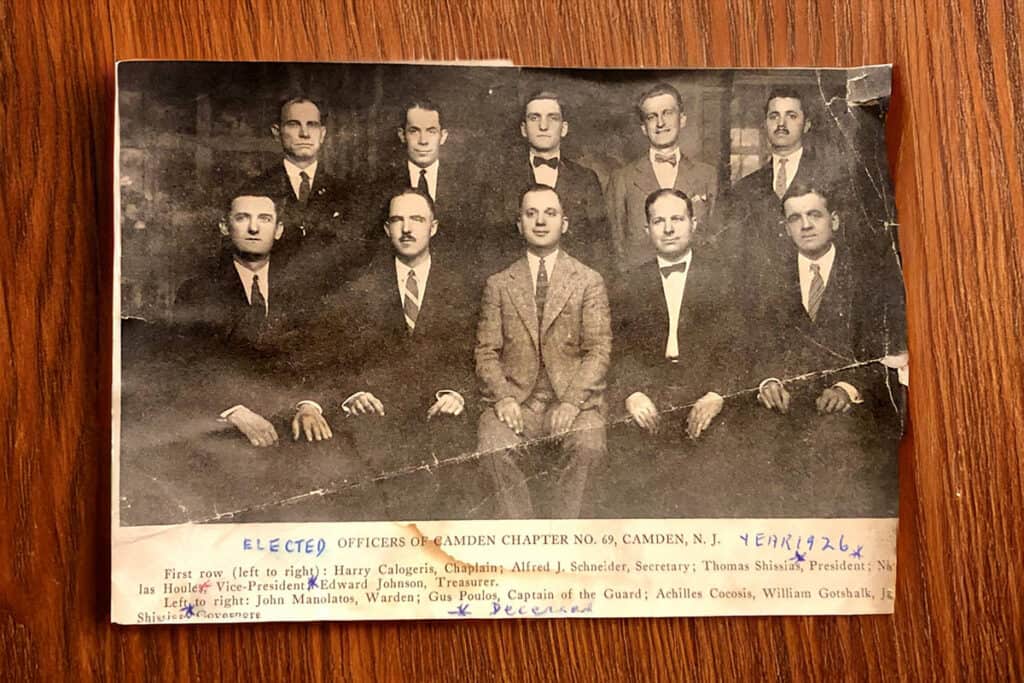
Locally, chapters grew quickly and became anchors of Greek-American life. They raised funds for parishes like Evangelismos, St. George, and Annunciation, organized dances and scholarship drives, and helped new arrivals from Greece find their footing.
When Philadelphia’s Greek community gathered to celebrate Independence Day, AHEPA banners were there. When a student needed a scholarship, AHEPA was there, too.
For Greek Philadelphians, AHEPA is one reason why parishes thrived, why children could aspire beyond the diner or the factory, and why a community once pushed to the margins now stands tall in the mainstream. It reminds us that out of fear and exclusion, immigrants built institutions of belonging, a legacy that continues to shape Greek-American life today.