

A phone that works perfectly in Athens may lose its signal inside a stone house on a Greek island, along a mountain road or at a beach below steep cliffs.
Most visitors will not need specialized equipment. A roaming plan, travel eSIM or Greek prepaid SIM will usually be enough. The challenge is choosing a service that works at the destination rather than relying on broad claims about coverage.
Before traveling, ask the hotel, rental host or relative which of Greece’s three nationwide mobile operators—COSMOTE, Vodafone or Nova—performs best at the property. Confirm what kind of Wi-Fi is available, and download anything needed to continue the trip if the connection disappears.
Ask which network works locally
Mobile reception can vary sharply within the same village or island. Mountains, sheltered coves, thick stone walls and the position of the nearest antenna can all affect the signal. A busy summer evening may also produce slower service than a quiet morning.
The company selling a travel eSIM is not necessarily the company operating the Greek network underneath it. Travelers should check which local network the plan uses and ask someone at the destination whether it works there.
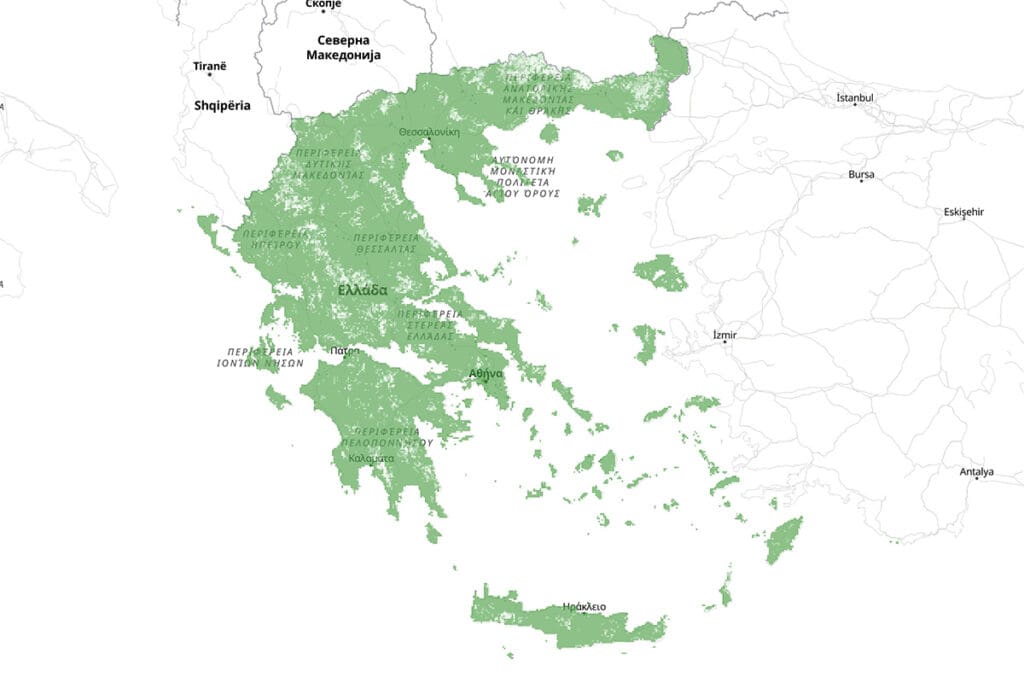
Greece’s National Broadband Map provides an initial view of fixed and mobile coverage. Users can search by address or postal code, although the map cannot show whether a signal reaches a particular bedroom, courtyard or terrace. Recent information from someone at the property is usually more useful.
Check the existing roaming plan
Travelers using an eligible mobile plan issued in an EU or European Economic Area country can generally use their domestic calls, texts and data while visiting Greece. Fair-use restrictions may limit roaming data on some unlimited or inexpensive plans.
Eligible customers generally pay the same rates as at home when roaming temporarily in Greece, but they should confirm their allowance before departure through the European Union’s roaming guidance.
Travelers using plans issued elsewhere, including in the United States, Canada, Australia and the United Kingdom, should check their carrier’s terms. Some plans include Greece, while others charge a daily fee or require an international package.
A daily pass may be convenient for a brief visit. Over two or three weeks, repeated daily charges may cost more than a travel eSIM or Greek prepaid plan.
Visitors keeping their home number active for calls or banking codes should make sure the phone uses the travel line for mobile data. Otherwise, the original line may continue generating roaming charges.
Consider a travel eSIM
For many short-term visitors, a travel eSIM is the easiest way to obtain mobile data without visiting a store after arrival.
Before purchasing one, check:
- whether the phone is unlocked and supports eSIMs;
- which Greek network carries the service;
- whether the plan includes calls or only data;
- when the validity period begins;
- whether the phone can share its connection with a laptop or another device;
- how additional data can be purchased.
An eSIM can often be installed before departure and activated after landing. The provider’s instructions matter because some plans begin when installed, while others begin when they first connect in Greece.
Travelers with compatible dual-SIM phones can keep their home line active while using a second line for data. Recent iPhones, for example, support using one line for a home number and another for a local or travel plan. The phone can use only one mobile-data network at a time, and the device must generally be unlocked to use different carriers. Apple provides further guidance on dual-SIM use.
Travel eSIM prices vary according to the provider, amount of data and number of days. The lowest price is not always the best value if the plan uses a network with weak reception at the destination.
A Greek prepaid SIM may suit a longer visit
A local prepaid SIM can be useful for someone staying several weeks, consuming substantial data or returning regularly to the same area.
The phone must be unlocked, and the buyer should expect to show a valid passport or identification document when registering the line. A conventional Greek voice-and-data SIM normally provides a local telephone number, unlike many travel eSIMs that offer data only. That can make it easier to call accommodation hosts, drivers, restaurants and other businesses.
Buying from an official carrier store also gives the visitor somewhere to resolve activation or account problems. Travelers should confirm how much data is included, how long it remains valid and whether a separate package must be activated after the SIM is purchased.
Visitors should allow extra time for the purchase and activation of a Greek SIM. The process may be completed relatively quickly when identification, registration and payment proceed smoothly, but queues, passport-verification problems, system outages or activation issues can turn a brief store visit into a much longer one.
Anyone on a tight schedule should avoid leaving the purchase until just before a ferry, flight or long drive. Visiting an official carrier store earlier in the day and carrying the original passport or identification document may help prevent delays.
Sample prepaid data prices in July 2026
Prices and promotions change frequently, but official offers available on July 18, 2026, give visitors a rough idea of the cost.
These are data-focused products and should not be confused with tourist voice-and-data packages. Some include a new SIM, while others are data packages for an existing service.
Nova listed a data-only SIM with 15GB valid for 60 days at €15, including VAT. The package had to be activated at a Nova store. The service supported internet access but not ordinary voice calls or text messages.
COSMOTE listed a SIM-only pack with 15GB valid for 12 months at €20. The longer validity period does not necessarily make it the best option for a short holiday, but it may suit someone returning to Greece later in the year.
Vodafone listed portable-data packages including 15GB for 30 days at €7.95 and 50GB at €12.95. Travelers should confirm current availability, validity and activation terms before purchasing.
The offers are not directly comparable. The network that works at the destination matters more than saving a few euros on a larger allowance.
Would a second phone help?
A spare unlocked phone can be useful, but most tourists do not need to buy one solely for a trip to Greece.
It may make sense when a traveler wants to leave an expensive primary phone safely at the accommodation, use one device as a Wi-Fi hotspot or place SIMs connected to different networks in separate phones.
A second device can also preserve the main phone’s battery for maps, tickets and emergency calls. It should be unlocked, compatible with current 4G or 5G service and still receiving security updates.
A second phone improves redundancy only when its line works where the primary line does not. Travelers should choose both networks according to recent local experience rather than assuming that two different operator names will automatically provide separate coverage.
For most visitors with a recent dual-SIM phone, adding an eSIM is simpler than carrying another device. A low-cost spare travel phone is most useful when it has a defined purpose rather than serving as extra luggage.
Verify the accommodation’s Wi-Fi
“Free Wi-Fi” in a rental listing does not establish that the connection is fast, stable or available throughout the property.
A remote villa might use a fixed line, mobile router or satellite connection. Several rooms may share one router. In an older stone house, the internet may work well near the equipment but fail to reach a bedroom or outdoor seating area.
Travelers who need dependable access should ask:
- Does Wi-Fi reach the actual room or house?
- Is it shared with other rental units?
- Can the host provide a recent speed test from the guest area?
- Are outages common?
- Is there a backup connection?
A visitor who only needs maps and messages can tolerate more uncertainty than someone planning daily video meetings.
Starlink can serve isolated accommodations
Some villas, guesthouses, campsites and boats use Starlink where fixed broadband or mobile reception is weak.
The satellite service still needs electricity and a sufficiently open view of the sky. Buildings, trees and surrounding terrain can interrupt the connection.
For most tourists, the question is whether the accommodation already provides Starlink—not whether they should buy the equipment themselves.
Portable Starlink may interest sailors, camper-van travelers and remote workers moving between isolated places. Starlink Mini includes its own Wi-Fi router, but it remains more equipment than the average visitor needs.
As of July 18, 2026, Starlink advertised residential service in Greece from €35 per month and Roam Unlimited from €45 per month. Hardware prices and available offers varied by location and plan.
Anyone considering portable Starlink should account for the equipment cost, electrical power, installation space and the need for an open view of the sky—not only the monthly fee.
Use the phone as a hotspot
A phone with enough mobile data can share its connection with a laptop, tablet or another traveler. This may cover an occasional work session or keep a family online when the accommodation’s Wi-Fi fails.
Sharing data uses the phone’s battery quickly and may cause it to become hot during long calls. Travelers should confirm that their plan allows connection sharing and carry a power bank when the phone is also needed for navigation.
A dedicated portable router can serve several devices without tying up the main phone, but it still needs a usable mobile signal.
When no free Wi-Fi is advertised, ask politely
Many cafés, tavernas and small guesthouses have Wi-Fi without displaying a sign.
The simplest solution is often to ask politely. Many businesses will share the password with paying customers, although some reserve their network for staff or overnight guests.
This can be useful when a traveler needs to download a ticket, check a route or contact a host before continuing into an area with weak reception.
Some ferries also offer internet, sometimes through a paid package. Service varies by company, vessel and route, and mobile reception can disappear once the ship moves away from the coast.
Tickets, accommodation details and essential documents should be downloaded before boarding rather than left dependent on ferry Wi-Fi.
Use a VPN on open networks
An open network in a café, port, ferry or public square is not automatically unsafe. Most legitimate websites and apps now encrypt their connections, making public Wi-Fi safer than it once was.
A reputable virtual private network, or VPN, adds another encrypted layer between the device and the VPN provider. It can provide additional privacy on open or heavily shared networks, particularly for travelers accessing work accounts.
A VPN does not prevent phishing, fraudulent websites, malicious downloads or problems caused by outdated software. An unknown free VPN may also introduce a different privacy risk.
Travelers should confirm the network’s exact name with an employee or posted notice before connecting. They should also turn off automatic Wi-Fi connections and file sharing, use two-factor authentication and keep their devices updated.
When mobile data is available, travelers may prefer it for banking and other sensitive activity.
Prepare for time offline
No connection should be treated as guaranteed in a remote destination.
Before leaving a well-connected town, airport or hotel, download offline maps, tickets, booking details, driving directions and translation files. Save the host’s telephone number and the accommodation address somewhere that does not require an app to load.
A screenshot can be more useful than an email stored in a cloud account when the phone has no signal.
For most visitors, a roaming plan or eSIM, Wi-Fi checked with the host and downloaded maps will be enough. Those heading farther from dependable service should carry a second connection or make sure essential information is available offline.